



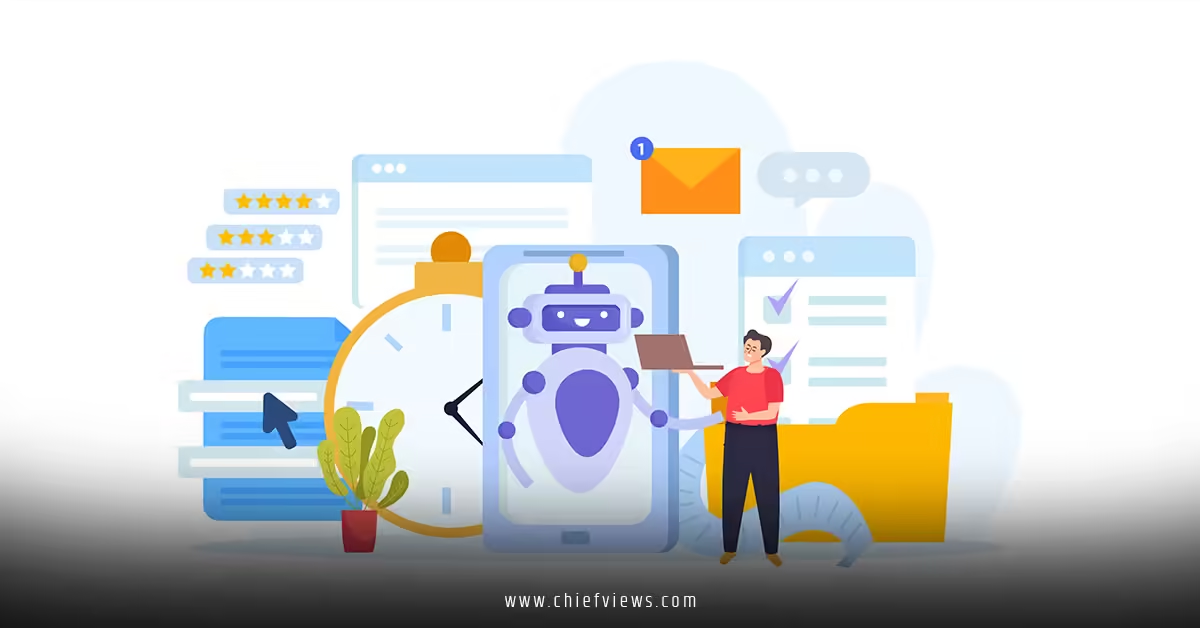
AI-powered personalized marketing strategies for CMOs in 2026 are reshaping how brands connect with audiences at scale. Instead of spray-and-pray campaigns, modern CMOs are leveraging AI to deliver the right message, to the right person, at the right moment—often without human intervention. This shift isn’t incremental. It’s a complete recalibration of how marketing budgets, teams, and technology stacks operate.
Why This Matters Right Now
The landscape has changed. Generic email blasts and one-size-fits-all ad copy don’t cut it anymore. Consumers expect personalization, and AI has finally made it economically viable for brands of any size. CMOs who sleep on this? They’re leaving revenue on the table while competitors capture market share.
Here’s the snapshot of what’s changed:
- Personalization at scale: AI handles millions of individual customer journeys simultaneously, not hundreds or thousands.
- Real-time decisioning: Campaigns adapt in seconds based on user behavior, weather, time of day, or inventory levels.
- Predictive power: AI forecasts which customers are likely to churn, convert, or spend big before they even know it themselves.
- Reduced bias: Properly configured AI systems catch demographic blind spots that humans miss.
- Efficiency gains: Marketing teams shrink headcount while output multiplies.
What AI-Powered Personalized Marketing Strategies for CMOs in 2026 Actually Looks Like
Let me cut through the hype. AI-powered personalized marketing strategies for CMOs in 2026 operate across three core layers:
Layer 1: Data Unification & Customer Intelligence
You can’t personalize what you don’t understand. Most CMOs work with fractured data: email platforms, CRM systems, web analytics, social, offline sales. Each silo tells a different story.

AI stitches this together. It creates a unified customer view—sometimes called a customer data platform (CDP) or unified marketing platform—that consolidates every interaction, purchase, and signal. The AI then layers on behavioral patterns: what this customer usually buys, when they typically engage, and what predicts their next move.
The kicker? This happens automatically. No manual data engineering required, though data quality still matters (garbage in, garbage out is alive and well).
Layer 2: Predictive Segmentation & Micro-Targeting
Forget static segments. “Females 25–34, urban, high income” is dead.
AI creates dynamic, outcome-focused segments based on propensity models. It asks: Who’s likely to respond to a product launch in the next 14 days? Who’s about to churn? Who’s a high-LTV candidate for a premium offering? These segments shift daily, sometimes hourly.
Each segment then receives AI-optimized messaging: custom subject lines, product recommendations, channel selection, send times. A customer might see an SMS at 2 PM Tuesday because that’s when their engagement peaks, while another gets an email at 9 AM Friday.
This isn’t one-to-one targeting. It’s cohort-based personalization: groups of similar users get similar (but not identical) experiences.
Layer 3: Creative & Channel Optimization
Here’s where most CMOs stumble: they think they’re using AI to create ads, but they’re really using it to test and learn faster.
AI doesn’t write your brand voice (yet—not well, anyway). It does two things brilliantly:
- Generates and tests variations: AI creates 50 versions of an ad headline, tests them, and identifies the winner in hours instead of weeks.
- Matches customer to channel: AI knows that Segment A responds best to video on Instagram, Segment B prefers LinkedIn articles, Segment C engages with TikTok. It routes each customer accordingly.
Top platforms now use multimodal AI that can reason across text, image, and video, so optimization becomes far more sophisticated.
A Quick Comparison: AI-Personalized vs. Traditional Marketing Approaches
| Aspect | Traditional Approach | AI-Powered Personalized Approach |
|---|---|---|
| Segmentation | Static, manual; updated quarterly | Dynamic, real-time, outcome-focused |
| Creative testing | A/B test 2–3 versions; weeks to conclusion | Generate & test dozens of variations; hours to conclusion |
| Send timing | Fixed schedule (e.g., 9 AM daily) | Optimal time per individual; adapts daily |
| Message content | Same for everyone in segment | Personalized copy, product recs, CTAs |
| Performance lag | Reported post-campaign | Real-time dashboards; live optimization |
| Scalability | Increases cost with reach | Cost-per-touch decreases at scale |
| Team size needed | Large (data engineers, analysts, copy team) | Smaller core team + AI tools |
Real-World Implementation: How CMOs Are Winning in 2026
Scenario 1: E-Commerce Personalization
A CMO of a mid-market fashion retailer implements AI-powered product recommendations. Instead of showing the same “bestsellers” feed to everyone, the platform learns each customer’s style, size, price sensitivity, and occasion-based needs.
Result: 35% increase in email click-through rates, 18% higher average order value.
The AI also predicts which customers are most likely to abandon their carts in the next 6 hours and triggers a personalized recovery email—not with a generic discount, but with items that specific person is likely to repurchase or upgrade.
Scenario 2: B2B Account-Based Marketing
A B2B SaaS CMO shifts from company-level targeting to individual-level personalization within target accounts. AI identifies decision-makers at high-intent companies, learns their content preferences (technical whitepapers vs. case studies vs. video demos), and delivers tailored nurture sequences.
Result: Sales cycles compress by 20–30%, win rates climb.
Here’s the magic: the AI doesn’t just segment the account; it segments people within the account, knowing that the CFO needs ROI proof, the COO needs operational fit, and the end-user needs ease-of-use. Each gets custom messaging.
Scenario 3: Retention & Churn Prevention
A SaaS CMO uses AI to predict which paying customers are likely to cancel in the next 30 days. Instead of waiting for a churn event, the system proactively surfaces at-risk accounts to the marketing team, who then trigger personalized win-back sequences: a feature announcement tailored to why this customer is at risk, an exclusive discount, or a 1:1 onboarding session.
Result: 12–15% reduction in churn; lifetime value increases.
The Tools & Technology Stack CMOs Need
You don’t need to build this from scratch. Modern marketing platforms are baking AI into every layer:
Marketing Automation + AI: HubSpot, Marketo, Eloqua—all now include AI-driven send-time optimization, predictive lead scoring, and automated content personalization.
Customer Data Platforms (CDPs): Segment, mParticle, Treasure Data—unify data and activate it into any channel.
Predictive Analytics: Platforms like Insider, Dynamic Yield, and Kenshoo use machine learning to optimize every customer touchpoint.
Generative AI for copy: Tools like Copy.ai, Jasper, and branded alternatives are speeding up ad copy and email subject line creation (though they still need human judgment).
Analytics & BI: Looker, Tableau, and newer AI-native tools like Sisense now auto-generate insights—flagging which campaigns are underperforming and suggesting optimizations.
Real-time data platforms: Segment, Kafka-based systems, and edge computing enable instantaneous personalization decisions.
The honest take? You probably don’t need a completely new stack. Most CMOs can activate AI capabilities within their existing tools. The bottleneck is usually strategy and people, not technology.

Step-by-Step Action Plan: Getting Started with AI Personalization
Phase 1: Audit & Prioritize (Weeks 1–2)
- Map your current data sources: CRM, email, web analytics, social, sales, customer support. Where do they live?
- Identify your biggest pain point: Is it churn? Low engagement? Poor conversion? Pick one.
- Set a success metric: What will “winning” look like? 15% higher email CTR? 20% churn reduction? Be specific.
Phase 2: Unify Data (Weeks 3–6)
- Select a CDP or marketing automation platform with AI capabilities. If budget is tight, Segment + HubSpot is a solid entry point.
- Start consolidating customer data: Your CRM should be your single source of truth. Everything else feeds into it.
- Run a data quality audit: Deduplicate, remove test records, standardize fields.
Phase 3: Build Your First AI Model (Weeks 7–10)
- Choose a use case: Lead scoring, churn prediction, or propensity-to-buy modeling.
- Let the platform do the heavy lifting: Most modern tools train models automatically with minimal configuration.
- Validate the results: Does the model segment your audience in a way that feels right? If 95% of your customers are “high-intent,” the model isn’t useful.
Phase 4: Launch & Optimize (Weeks 11–16)
- Activate one personalization tactic: Maybe it’s send-time optimization for email, or dynamic content on your website.
- A/B test against a control group: You need to prove the uplift is real, not coincidence.
- Measure and iterate: Weekly dashboards. Monthly business reviews. Quarterly strategy adjusts.
Phase 5: Scale & Expand (Ongoing)
- Add new channels: Once email works, layer in SMS, push, web, social.
- Deepen personalization: Move from segmentation to individual-level micro-campaigns.
- Build on learnings: Document what worked and why. Train your team.
Common Mistakes CMOs Make (And How to Avoid Them)
Mistake 1: Assuming “AI” Means Autonomous
The trap: Many CMOs buy an AI tool and expect it to run campaigns untouched. They don’t.
The fix: AI is a force multiplier. Humans set strategy, define success metrics, and review recommendations. AI accelerates execution.
Mistake 2: Over-Personalizing Too Fast
The trap: A CMO personalizes every touchpoint immediately and overwhelms the team or confuses customers.
The fix: Start with one tactic (e.g., send-time optimization or email subject lines). Master it. Then expand.
Mistake 3: Poor Data Quality
The trap: Garbage data = garbage insights. If your CRM is full of duplicates, outdated email addresses, and missing fields, AI won’t help.
The fix: Treat data hygiene as a standing project, not a one-time initiative. Quarterly audits. Clear data governance.
Mistake 4: Ignoring Privacy & Compliance
The trap: Personalization sounds creepy if done wrong. Privacy laws (CCPA, GDPR, state laws) are tightening.
The fix: Be transparent. Get consent for data use. Use first-party data, not sketchy third-party data. Your legal team should review personalization tactics.
Mistake 5: Setting Unrealistic Timelines
The trap: CMOs expect 50% uplift in week one. When it doesn’t happen, they abandon the project.
The fix: AI-driven personalization usually shows measurable gains in 6–12 weeks. Set expectations accordingly. Focus on learning, not immediate ROI.
Mistake 6: Not Retraining Your Team
The trap: You hire an AI tool but your team still thinks like marketers from 2018. They use it wrong.
The fix: Invest in training. Run workshops. Make your CMO office the “AI champions” for the org.
Key Takeaways
- AI-powered personalized marketing strategies for CMOs in 2026 are now table-stakes, not nice-to-have. Competitors are using them; lagging behind is a strategic risk.
- The three layers—data unification, predictive segmentation, and creative optimization—work together. One without the others won’t move the needle.
- Start small, measure rigorously, then scale. Pick one use case, prove it works, then expand to other channels and tactics.
- Data quality is non-negotiable. If your data is messy, AI won’t save you. If it’s clean and connected, AI multiplies your output.
- Privacy and transparency matter. Customers expect personalization, but they also expect respect for their data. Frame it that way.
- Your team needs to evolve. CMOs should shift from “campaign builders” to “growth strategists” who partner with AI, not compete with it.
- ROI is real, but patience is required. Most CMOs see meaningful uplift in 6–12 weeks, with gains accelerating over time.
- The competitive advantage is in the strategy, not the tool. Ten CMOs with the same software will see ten different results based on execution.
Why Now Matters
We’re at an inflection point. Three years ago, AI-powered personalization was an experiment for big enterprises with large budgets. Today, it’s accessible to mid-market companies. In 2027, it’ll be an expectation for any marketer who wants to compete.
The CMOs who move now will build institutional knowledge and competitive moats. The ones who wait will be scrambling to catch up while their peers capture market share.
The question isn’t whether to invest in AI-powered personalized marketing strategies. It’s whether you’ll lead the shift or follow it.
Conclusion
AI-powered personalized marketing strategies for CMOs in 2026 aren’t a future state anymore—they’re happening now. The difference between a CMO who embraces this shift and one who doesn’t will be measured in market share, customer lifetime value, and ultimately, revenue.
The path forward is clear: unify your data, build predictive models, and test personalization tactics rigorously. Start small, measure obsessively, and scale what works. Your team will evolve, your tools will improve, and your results will compound.
The competitive window is open, but it won’t stay wide forever. Move now, and lead. Wait, and you’ll be explaining to the board why your competitors pulled ahead.
Here are three high-authority external links relevant to AI-powered personalized marketing strategies for CMOs in 2026
- Gartner report on AI-driven customer experience trends – Covers predictive personalization forecasts and CMO priorities.
- Harvard Business Review on scalable personalization – Explores real-world B2B/B2C case studies and strategic frameworks.
- Forrester Research on marketing technology stacks – Analyzes AI tools for 2026-era personalization at enterprise scale.
Frequently Asked Questions
Q: How much does AI-powered personalized marketing infrastructure typically cost?
A: Entry-level platforms (HubSpot, basic CDP) start around $5K–$10K monthly for small teams. Mid-market solutions run $20K–$50K monthly. Enterprise platforms can exceed $100K monthly. The key is ROI: a 15–20% revenue lift usually justifies the spend within 6–9 months. Consider it a revenue-generating investment, not an expense.
Q: Can AI personalization work for B2B and B2C, or is it primarily B2C?
A: Both. B2B actually sees higher ROI because deals are larger and longer cycles benefit from smart nurturing. B2C sees volume benefits—more transactions at higher velocity. The tactics differ (account-based marketing for B2B, micro-segmentation for B2C), but the core principle—using AI to match the right message to the right person—applies to both.
Q: What happens if customers don’t consent to data tracking?
A: First-party data (what customers directly share or that you observe on your owned channels) requires no third-party consent and powers personalization just fine. Privacy regulations actually favor first-party data strategies. If a customer opts out of tracking, you still have their purchase history and engagement patterns on your website or app. Use that. Respect the no.
Q: How do I know if my AI personalization is actually working or if gains are just random?
A: A/B testing against a control group. Split your audience: Group A gets AI-personalized campaigns, Group B gets your traditional approach. Run for at least 2–4 weeks with statistically significant sample sizes (usually 1,000+ in each group). Use a statistical significance calculator to confirm the uplift isn’t just noise. If your platform doesn’t enable control groups, it’s not mature enough for enterprise use.
Q: What’s the difference between AI personalization and basic segmentation or dynamic content I’m already doing?
A: Scale, speed, and sophistication. Basic segmentation might have 5–10 segments based on manual rules. AI creates thousands of micro-segments based on predictive models. Dynamic content swaps one variable (product image, discount %). AI personalization rewrites the entire message, timing, and channel based on individual behavior. And AI learns and adapts continuously; manual campaigns require human intervention to update.