

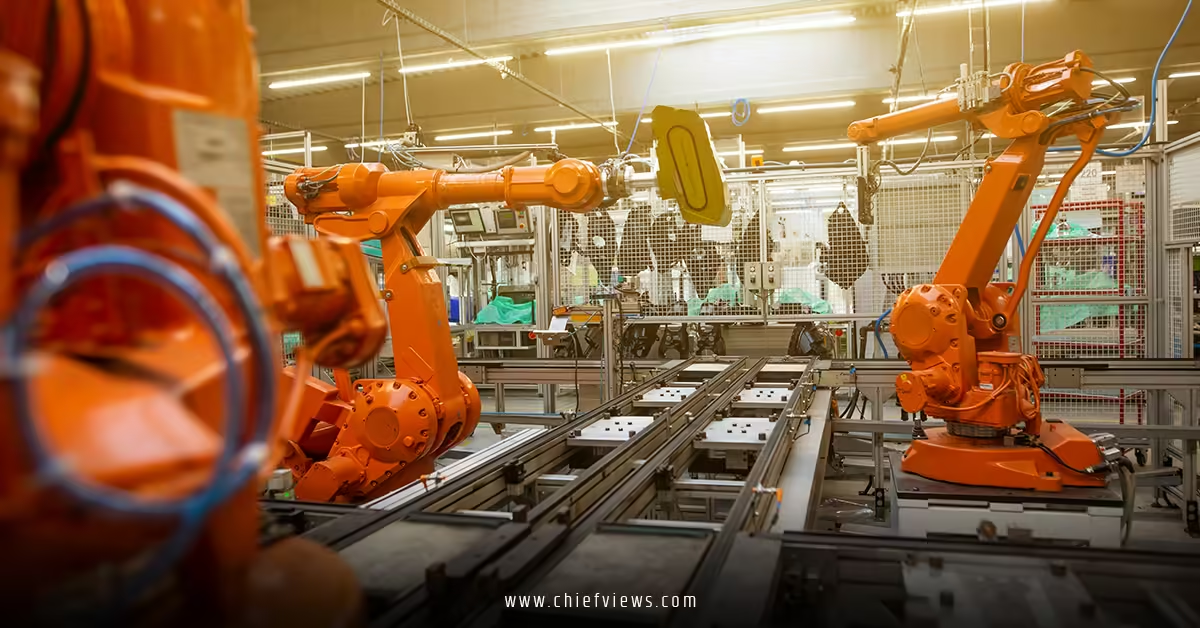
Predictive Maintenance in Manufacturing delivers the edge US plants desperately need in 2026. Machines fail at the worst moments. Unplanned downtime still costs hundreds of thousands per hour. Yet many teams still chase breakdowns or stick to rigid schedules that waste time and parts.
Predictive maintenance flips the script. It uses real-time sensor data, vibration analysis, temperature readings, and AI models to forecast failures before they happen. Fix issues during planned windows. Cut emergency repairs. Boost uptime without over-maintaining equipment.
- Core idea: Shift from time-based or reactive fixes to condition-based actions driven by actual equipment health.
- Key gains: Up to 50% less unplanned downtime and 25-30% lower maintenance costs, according to U.S. Department of Energy benchmarks.
- Who wins: Plants running CNC machines, assembly lines, presses, or any high-value assets where downtime hurts profits.
- 2026 reality: IoT sensors got cheaper. AI prediction accuracy hit 85-95% on many assets. Yet adoption hovers around 27%, leaving huge opportunity on the table.
- Link to bigger picture: This sits at the heart of a manufacturing CXO guide to Industry 4.0 implementation—one of the fastest ways to prove value from connected systems and data.
Short version? Stop guessing when equipment will break. Start knowing.
Why Predictive Maintenance Beats Old-School Approaches in 2026
Reactive maintenance waits for failure. Preventive maintenance runs parts on a calendar, even if they still have life left. Predictive maintenance watches the actual condition—vibration spikes, oil degradation, unusual heat—and acts only when needed.
The difference shows up fast on the bottom line. Manufacturers report 30-50% downtime reductions versus preventive strategies in many cases. One heavy industry example delivered 57x ROI in months through targeted monitoring.
Here’s the thing. Downtime doesn’t just stop production. It cascades into missed deliveries, overtime, and quality slips. In an era of tight margins and labor shortages, every hour of reliable runtime counts.


What would I do as a veteran ops leader? Target the 10-20% of assets causing 80% of the pain first. Prove the concept there before scaling.
How Predictive Maintenance in Manufacturing Actually Works
Sensors collect data continuously. Vibration, acoustics, thermal imaging, current draw, pressure—you name it. Edge devices or cloud platforms crunch the numbers with machine learning models trained on historical failures plus your plant’s own patterns.
The system flags anomalies. It predicts “bearing failure likely in 3-4 weeks.” Maintenance teams get prioritized work orders with clear recommendations. No more guessing. No more tearing down healthy machines.
Digital twins take it further in mature setups, simulating “what if” scenarios for maintenance timing.
This isn’t sci-fi anymore. Many mid-sized US plants run pilots with off-the-shelf IoT kits and cloud analytics, then integrate with existing CMMS or ERP systems.
Step-by-Step Action Plan for Getting Started
Beginners, keep it simple. Don’t boil the ocean.
- Identify critical assets — Map equipment by downtime cost, repair frequency, and production impact. Start narrow.
- Baseline your data — Track current maintenance spend, unplanned stops, and mean time between failures for 4-6 weeks. Clean data wins.
- Select monitoring tech — Vibration sensors and thermal cameras deliver quick wins on rotating equipment. Add oil analysis or ultrasonic for others.
- Pilot on 3-5 assets — Deploy sensors, set up dashboards, train a small team. Run for 3-6 months and measure everything.
- Integrate and scale — Connect alerts to your work order system. Refine models with plant-specific data. Expand to more assets once ROI shows.
- Review and improve — Monthly governance meetings. Adjust thresholds. Keep humans in the loop—AI suggests, technicians decide.
Intermediates already running pilots? Focus on reducing false positives and closing the loop from alert to completed repair.
Predictive vs Preventive Maintenance Comparison
| Aspect | Preventive Maintenance | Predictive Maintenance | Winner for Most Plants |
|---|---|---|---|
| Trigger | Fixed schedule (time or cycles) | Real-time condition data + AI | Predictive |
| Downtime Reduction | 10-30% vs reactive | Up to 50% vs reactive; 30-50% vs preventive | Predictive |
| Maintenance Costs | Moderate savings, risk of over-maintenance | 18-30% lower overall | Predictive |
| Parts Usage | Higher (replace early) | Optimized (use full life) | Predictive |
| Implementation Time | Fast and simple | 3-12 months for solid ROI | Preventive (initially) |
| Best For | Low-criticality or predictable assets | High-value, high-downtime equipment | Depends on asset |
This table cuts the debate. Use preventive where failures follow clear patterns and costs stay low. Go predictive where surprises hurt most.

Common Mistakes in Predictive Maintenance in Manufacturing (and Fixes)
Mistake 1: Jumping plant-wide without a pilot.
Fix: Prove value on critical assets first. One strong success story unlocks budget faster than any PowerPoint.
Mistake 2: Poor data quality or ignoring legacy equipment.
Fix: Invest early in cleaning asset hierarchies and standardizing sensor data. Brownfield integration beats rip-and-replace.
Mistake 3: Treating it as “set and forget” tech.
Fix: Maintenance teams need training. Build trust by showing how alerts save them from 3 a.m. callouts.
Mistake 4: Chasing perfect accuracy instead of actionable insights.
Fix: Accept some false positives early. The cost of investigating one alert pales against a $125,000 downtime hour.
Mistake 5: No clear ownership or governance.
Fix: Assign cross-functional leads—ops, maintenance, IT. Review ROI monthly.
The kicker? Many programs stall because leadership underestimates the cultural shift. Floor techs have seen plenty of “next big thing” tools come and go.
For authoritative standards and implementation frameworks, see the National Institute of Standards and Technology (NIST) advanced manufacturing resources.
Predictive Maintenance as Part of Your Manufacturing CXO Guide to Industry 4.0 Implementation
This isn’t a standalone project. Predictive maintenance serves as the perfect entry point into broader Industry 4.0 efforts. IoT sensors feed data. AI turns it into insights. Digital twins model outcomes. All of it builds the connected, intelligent factory.
CXOs who start here often see payback in 12-18 months, creating momentum for larger digital twin or full automation rollouts. It delivers measurable wins in OEE, throughput, and cost per unit—exactly what boards want to see.
In my experience, plants that treat predictive maintenance as a data foundation move faster on the rest of the Industry 4.0 journey.
Key Takeaways
- Predictive maintenance in manufacturing uses real condition data to slash unplanned downtime by up to 50%.
- Expect 18-30% maintenance cost reductions and strong ROI, often 10:1 within 12-24 months when executed well.
- Start small: pilot on high-impact assets, measure rigorously, then scale.
- Combine with preventive strategies for a hybrid approach that fits different asset classes.
- Data quality and people buy-in determine success more than the sensors themselves.
- It forms a practical first step in any manufacturing CXO guide to Industry 4.0 implementation.
- False positives decrease and accuracy climbs as your models learn your plant’s unique patterns.
- In 2026, the gap between adopters and laggards will widen—don’t stay on the sidelines.
Bottom line: Every prevented breakdown frees capacity and cash. Get predictive maintenance right and your plant doesn’t just run longer. It runs smarter.
Ready to move? Pull your top three downtime culprits from last quarter. Run a quick baseline audit. Then scope a small sensor pilot on the worst offender. Results will do the selling for you.
FAQs
How does predictive maintenance in manufacturing differ from preventive maintenance?
Preventive follows fixed schedules regardless of condition. Predictive monitors actual health via sensors and AI, performing work only when data shows degradation. The latter typically delivers higher savings and less unnecessary intervention.
What ROI can manufacturers realistically expect from predictive maintenance?
Many see payback in 12-18 months with 10:1 ROI common. Reductions of 25-30% in maintenance costs and 30-50% in unplanned downtime appear frequently in well-run programs, though results vary by asset criticality and execution.
How does predictive maintenance support a manufacturing CXO guide to Industry 4.0 implementation?
It creates immediate visibility and quick wins using IoT and AI—the same foundational technologies needed for digital twins, smart factories, and broader automation. Successful pilots build internal confidence and data infrastructure for larger initiatives.