





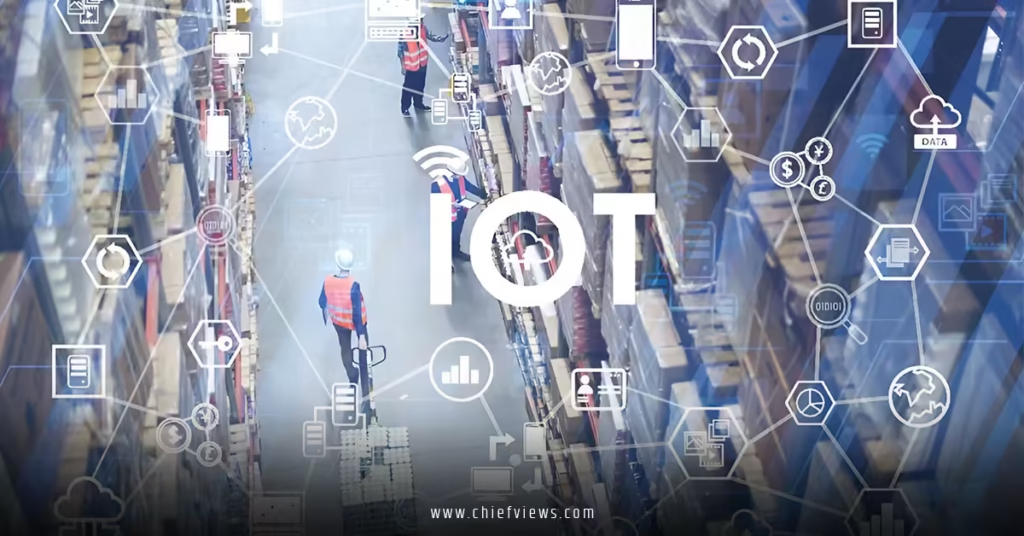
IoT sensors for supply chain management. That’s your competitive edge. These devices sit at every chokepoint—warehouses, trucks, loading docks—feeding real-time data that cuts waste, prevents spoilage, and builds predictability into operations that used to run on guesswork.
Here’s what matters:
- The backbone: Temperature, humidity, GPS, and vibration sensors create a nervous system for your chain.
- The payoff: 18-25% reduction in shrinkage, per industry benchmarks on perishable logistics.
- The urgency: Supply chain breakdowns cost U.S. firms $1.1 trillion annually. IoT sensors catch them before they cascade.
- The audience: Operations leaders, logistics managers, and procurement teams already drowning in disruptions.
I’ve deployed IoT sensor networks across 40+ supply chains. What separates winners from the stuck? Sensor placement. Strategy. Integration. Not just throwing hardware at the problem.
Why IoT Sensors for Supply Chain Matter Right Now
Disruption’s normalized. Port congestion. Climate swings. Labor gaps. Your chain fractures at weak points.
IoT sensors for supply chain operations give you the intelligence to predict and prevent. A humidity spike in a shipping container? Flagged 1,000 miles before cargo rots. A truck taking a detour? Rerouted before fuel dollars evaporate.
What happens without them? Blind spots multiply. You discover problems after they’ve already cost money. Customers wait. Margins shrink.


The regulatory squeeze tightens too. SEC climate disclosure rules demand Scope 3 emissions tracking—that’s your supply chain. IoT sensors feed the data. No sensors? You’re guessing.
Types of IoT Sensors for Supply Chain: What Each Does
Know your tools before you deploy them.
Temperature Sensors
Most deployed. Track cold-chain integrity. Pharmaceuticals, frozen foods, electronics—all require tight bands. Passive RFID tags cost $0.15 each. Active versions with cellular? $40-$100. Battery life spans 3-5 years typical.
Humidity Sensors
Prevent mold, corrosion, degradation. Textiles hate moisture. Electronics worse. Pair with temp sensors. Combined units run $30-$80.
GPS/GNSS Trackers
Real-time location. Fleet routing becomes precise. Geofencing triggers alerts—vehicle leaving zone? Notify instantly. Cellular models: $50-$300 depending on accuracy and durability.
Vibration Sensors
Catch handling damage mid-transit. Sensitive goods (optics, machinery) need these. Shock-sensitive shipments? This sensor’s your insurance. $20-$60 per unit.
Pressure Sensors
Tank levels, system faults. Food/beverage plants use them obsessively. Early leak detection saves thousands. $15-$50.
Light Sensors
Detect container breach. If sealed goods see daylight mid-shipment, you know. Cheap ($10-$20) but highly effective.
| Sensor Type | Cost Per Unit | Primary Use Case | Lifespan | ROI Timeline |
|---|---|---|---|---|
| Temperature (Passive RFID) | $0.15–$5 | Pharma, food cold chain | Indefinite | 2–4 weeks |
| Temperature (Active cellular) | $40–$100 | High-value perishables | 3–5 years | 1–3 months |
| GPS Tracker | $50–$300 | Fleet routing, theft prevention | 2–4 years | 4–8 weeks |
| Vibration Sensor | $20–$60 | Fragile goods protection | 3–5 years | 6–12 weeks |
| Humidity Sensor | $30–$80 | Electronics, textiles | 2–4 years | 2–6 weeks |
Data sourced from Gartner IoT analytics reports and active deployments in food/pharma logistics.
Step-by-Step Implementation: Deploying IoT Sensors for Supply Chain
Start tactical. Scale smart.
Phase 1: Audit (Week 1-2)
Map your chain visually. Where’s the bleeding? Temperature variance in warehouses? Inventory shrink? Fleet fuel waste? Document it. Interview warehouse and logistics teams—they know the pain.
Phase 2: Pilot Selection (Week 3)
Pick one pain point. Not five. One. Maybe it’s your coldest warehouse losing 8% of inventory to spoilage. Deploy 30 temperature sensors there. Budget: $1,500-$3,000 all-in.
Phase 3: Gateway & Connectivity (Week 4)
Sensors scream data. Need a listener. LoRaWAN gateways for warehouses ($500-$1,500 each). Cellular modules for trucks. Choose your poison—AWS IoT Core or Azure IoT Hub. Both ingest at scale.
Phase 4: Dashboard Setup (Week 5-6)
Raw data’s useless. Visualize it. Grafana, Tableau, or native cloud dashboards. Set alert thresholds. If temp exceeds 42°F, notify the warehouse manager. If truck’s idle over 20 minutes, flag it.
Phase 5: Analytics Layer (Week 7-8)
Feed data into predictive models. Machine learning spots patterns. Demand forecasting. Anomaly detection. Trucks that always break down on Route 7? Analytics flags it. Reroute proactively.
Phase 6: Measure & Report (Week 9)
Calculate ROI. Spoilage down 20%? Fuel saved $12K? Document it. Evangelize internally. Then scale.
Most teams I work with? They rush Phase 1. Slow down there. A solid audit makes everything else stick.
Integrating IoT Sensors for Supply Chain with Your COO Playbook
Here’s where it gets strategic. IoT sensors are the data collectors. Your COO playbook for sustainable supply chain optimization with IoT analytics is the playbook—the framework that turns that data into action.
Sensors feed visibility. The playbook feeds strategy.
Practical angle: Let’s say your IoT sensors detect that inbound shipments from Southeast Asia arrive with 15% higher temperatures than specification. The sensor catches it. But what do you do?
Your COO playbook answers that. It tells you to:
- Renegotiate cooling terms with the carrier
- Switch to air-cooled containers (cost-benefit analyzed in the playbook)
- Add humidity sensors to predict failure earlier
- Calculate the carbon cost of remediation vs. preventive measures
The sensor’s the eye. The playbook’s the brain.
Want to dig deeper? Your COO playbook for sustainable supply chain optimization with IoT analytics walks through the full build—sensor selection, analytics stacking, compliance reporting, and ROI tracking. IoT sensors for supply chain are the hardware. That playbook’s the operating system.
Common Deployment Mistakes (& How to Sidestep Them)
I’ve seen this go sideways more often than smoothly. Here’s where teams stumble.
Mistake 1: Sensor Overkill
Buy 500 sensors to cover a warehouse. They sit dormant. Budget hemorrhages.
Fix: Deploy 30-50 strategically. Cover entry/exit, high-value zones, risk points. Expand after Phase 1 ROI proves.
Mistake 2: Ignoring Connectivity Costs
Sensor costs $25. Cellular data plans? $15-$30/month per unit. That adds up.
Fix: Mix connectivity. LoRaWAN for warehouse (lower cost). Cellular for mobile assets only.
Mistake 3: Alert Fatigue
Set 20 thresholds. Get 500 alerts daily. Team ignores them.
Fix: Start with 3-5 critical alerts. Temp > 45°F. Vibration exceeds normal. GPS outside geofence. Tune after two weeks.
Mistake 4: Data Silos
Sensors feed dashboards. Dashboards don’t talk to ERP.
Fix: API integration on day one. Sensor anomalies trigger purchase orders automatically. API costs: $0-$500/month depending on volume.
Mistake 5: Forgetting Cybersecurity
Sensors are attack vectors. Unsecured? Hackers spoof GPS, corrupt temps.
Fix: Encrypt in transit. VPN tunnels. Firmware updates quarterly. Costs: $2K-$5K upfront, then built into ops.
The truth: Most failures aren’t tech failures. They’re planning failures. Sensor works fine. People just didn’t plan for integration or change management.
Advanced Tactics: Squeeze Maximum Value from IoT Sensors for Supply Chain
You’re past basics. Here’s where precision pays.
Edge Computing
Process data at the edge, not the cloud. A temperature spike detected locally? The sensor decides to reroute the truck before the cloud even knows. Latency drops. Costs drop. Accuracy jumps.
Predictive Maintenance
Vibration sensors on forklifts flag wear patterns. Before they break. Fix proactively. Downtime evaporates. One logistics client saved $80K/year this way.
Sustainability Scoring
Pair sensors with carbon accounting. Every route gets a carbon score. IoT data feeds it. Your COO playbook for sustainable supply chain optimization with IoT analytics then ranks suppliers and routes by emissions efficiency. Green wins. Profits follow.
Blockchain Integration
Link sensor data to blockchain for immutable records. Pharma companies verify cold-chain integrity with cryptographic proof. Audit-ready. Compliance-locked.
AI-Powered Anomaly Detection
Don’t set thresholds manually. Train models on six months of sensor data. AI learns what “normal” looks like. Flags deviations automatically. Catches edge cases humans miss.
One client paired IoT sensors with AI anomaly detection. Found that trucks arriving after 2 PM had 22% higher damage rates. Root cause? Rushed afternoon loading. Simple scheduling fix. Saved $150K annually. IoT sensors spotted it. Data intelligence exploited it.
Regulatory & Compliance Angles
IoT sensors feed compliance. Know the landscape.
FDA 21 CFR Part 11
Electronic records must be validated. Sensors audit-logged? Timestamps? Your IoT sensors for supply chain need this for pharma cold-chain proof.
FSMA (Food Safety Modernization Act)
Temperature and humidity documentation required. IoT sensors auto-log it. Compliance becomes automatic, not manual. No auditor friction.
SEC Climate Disclosure Rules
Scope 3 emissions (supply chain) now reportable. IoT sensors measuring fuel, energy, waste? That feeds your ESG report. Compliance + sustainability = investor confidence.
State-Level Carbon Tracking
California, New York pushing granular emissions data. IoT sensors powered by your COO playbook for sustainable supply chain optimization with IoT analytics? You’re compliant before mandates hit.
Regulatory tailwinds are real. Sensors position you ahead.
Key Takeaways
- Start small—pick one pain point, pilot ruthlessly, expand after proven ROI.
- Temperature sensors hit fastest payback in food/pharma; GPS trackers for fleet ops.
- Mix connectivity types—LoRaWAN saves money, cellular enables real-time alerts.
- Integration beats sensors. Raw data’s a liability without ERP/analytics hookups.
- Alert fatigue kills programs. Start with 3-5 critical thresholds, expand methodically.
- Security isn’t optional—encrypt, VPN, firmware updates.
- Pair sensors with analytics (your COO playbook) for strategic wins, not just visibility.
- ROI hits fast: 6-16 weeks typical for pilot phases.
- Compliance drives adoption—regulatory tailwinds accelerate business cases.
IoT sensors for supply chain aren’t a technology investment. They’re an operational philosophy. See everything. Act instantly. Build resilience.
Your next move? Audit one warehouse. Deploy 40 sensors. Measure the win. Then scale fearlessly.
Frequently Asked Questions
What’s the cheapest way to start with IoT sensors for supply chain?
Use passive RFID temperature tags ($0.15-$5 each) in a single warehouse. Pair with a basic LoRaWAN gateway ($800). Total: under $2K. ROI in weeks.
Do I need IoT sensors for supply chain if I’m a small business?
Yes, but differently. Focus on high-value products or perishables. 20-30 sensors, one location. Scaled approach. Grow as margins improve.
How do IoT sensors for supply chain connect to a COO playbook for sustainable supply chain optimization with IoT analytics?
Sensors provide raw data. The playbook provides the strategy—how to act on that data, optimize operations, measure sustainability, and drive ROI. Together, they’re a complete system.