



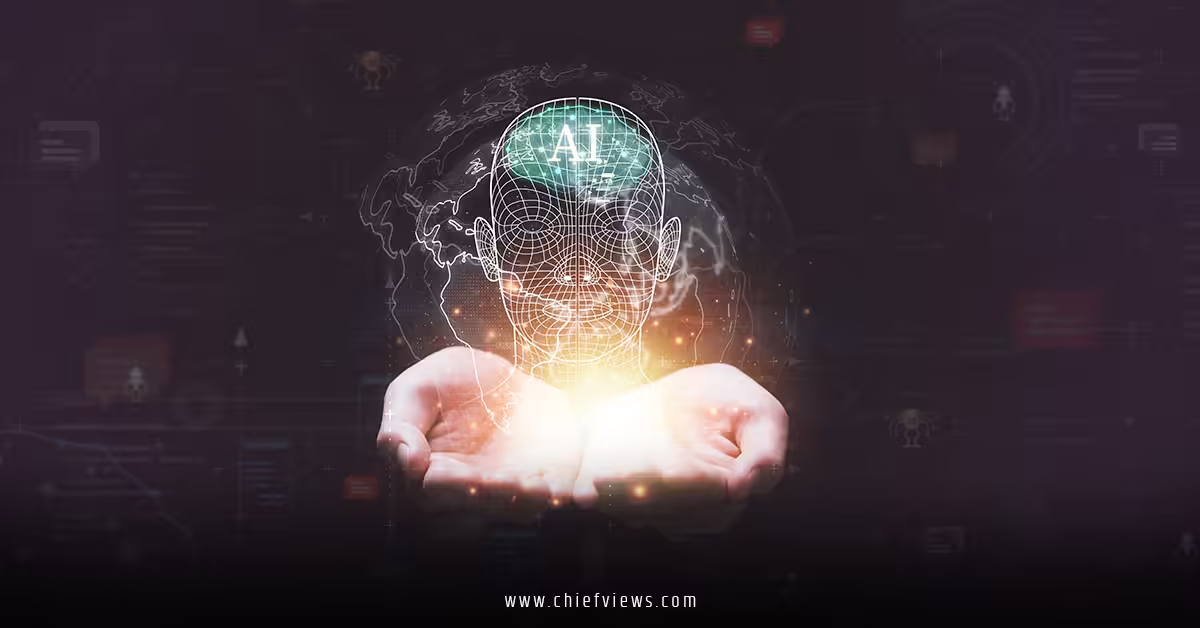
AI Marketing Strategies 2026 AI is no longer a helpful assistant in marketing—it is the core operating system. Forward-thinking brands are moving beyond basic automation and generative content to deploy agentic AI systems that autonomously plan, execute, optimize, and iterate campaigns in real time.
This shift directly powers the CMO evolution from brand steward to growth architect 2026, where marketing leaders own revenue outcomes, pipeline velocity, and enterprise growth rather than just awareness and creative.
Why AI Marketing Strategies Matter in 2026
Economic pressures, privacy regulations, and empowered buyers (both human and AI agents) have compressed years of change into months. Gartner reports revenue growth as the top CMO priority, with AI agents already in pilot or production at over 80% of marketing tech organizations.
Brands that master AI marketing strategies 2026 will achieve:
- Hyper-personalization at scale
- Dramatic efficiency gains
- Measurable revenue impact
- Resilience in a “Search Everywhere” world
Those who treat AI as just another tool for pretty images or faster emails will fall behind.


Top AI Marketing Strategies for 2026
1. Agentic AI Workflows: From Automation to Autonomous Marketing
The biggest leap is agentic AI — systems that don’t just follow rules but set goals, plan multi-step actions, execute across channels, measure results, and self-optimize.
Practical applications in 2026:
- Autonomous campaign management: Agents adjust budget allocation, creative variants, and targeting in real time.
- Predictive customer journeys: AI agents anticipate needs and deliver next-best-actions without human triggers.
- Machine customers: Optimize for AI agents that shop on behalf of users.
Action step: Start with one high-impact workflow (e.g., lead nurturing or ad optimization) and give the agent clear guardrails, KPIs, and human oversight loops.
2. Hyper-Personalization Powered by Real-Time Data and Predictive Analytics
2026 personalization goes far beyond segments or rules. AI builds dynamic, individual-level experiences using unified customer data platforms (CDPs), behavioral signals, and predictive models.
Examples:
- Website experiences that change hero images, pricing, and recommendations per visitor.
- Email and messaging that adapt content, send time, and offers dynamically.
- Predictive content that anticipates trends and individual preferences.
Pro tip: Invest in a composable martech stack with a central data warehouse for flexibility and privacy compliance.
3. Search Everywhere Optimization (GEO + AEO)
Traditional SEO is evolving into Generative Engine Optimization (GEO) and Answer Engine Optimization (AEO) as discovery happens across ChatGPT, Google AI Overviews, voice, and agent interfaces.
Strategies that win:
- Create authoritative, structured content optimized for AI summarization.
- Focus on entity-based SEO and clear, factual answers.
- Optimize for zero-click and action-based search (where AI completes tasks).
4. Composable AI Tech Stacks for Agility
Rigid marketing clouds are giving way to modular, API-first composable architectures. This allows marketers to swap best-in-class tools quickly and build custom AI orchestration layers.
Key components for 2026:
- Central data platform (Snowflake, Databricks, etc.)
- Headless CMS + CDP
- AI orchestration and agent platforms
- Privacy-first consent and zero-party data tools
5. Human + AI Hybrid Creativity and Content
Generative AI handles volume and iteration, while humans provide strategy, empathy, and brand soul. Brands using AI slop face backlash; those balancing it with authenticity win trust.
Best practice: Use AI for brainstorming, drafting, testing variants, and personalization—at scale—then apply human judgment for final approval and storytelling.
6. Closed-Loop Measurement and Revenue Attribution
Tie every AI initiative directly to business outcomes:
- Marketing-influenced revenue
- CAC payback periods
- Customer lifetime value uplift
- Experiment win rates
Growth architects use predictive analytics and AI dashboards to forecast impact and prove ROI in boardroom language.
Step-by-Step Implementation Plan for AI Marketing Strategies 2026
- Audit & Baseline — Map current martech, data flows, and AI usage. Identify high-ROI use cases.
- Build Data Foundation — Unify customer data and implement strong governance/privacy controls.
- Pilot Agentic Workflows — Choose one contained area (e.g., paid media optimization or content personalization).
- Upskill Teams — Focus on AI literacy, prompt engineering, critical evaluation of outputs, and revenue thinking.
- Establish Governance — Set ethical guidelines, brand safety rails, and human-in-the-loop checkpoints.
- Scale & Iterate — Expand winning pilots, double down on what drives revenue, and retire underperformers fast.
- Measure Relentlessly — Connect everything to P&L impact.
Common Pitfalls to Avoid
- Chasing tools without clear problems.
- Over-relying on AI for creativity without human oversight (authenticity matters).
- Ignoring sales/customer success alignment.
- Reporting vanity metrics instead of revenue outcomes.
- Neglecting brand equity while chasing short-term performance.
Real-World Payoff
Early adopters report faster campaign velocity, higher conversion rates, lower costs, and stronger C-suite influence. The CMOs who treat AI as a strategic forcing function for systems thinking become indispensable growth architects.
Key Takeaways for AI Marketing Strategies 2026
- Agentic AI moves marketing from reactive campaigns to proactive, autonomous systems.
- Data fluency and composable stacks are table stakes.
- Personalization and search optimization must adapt to AI intermediaries.
- Balance speed with authenticity and ethics.
- Success is measured in revenue, not impressions.
Ready to evolve? The brands winning in 2026 aren’t using AI to do more of the same—they’re using it to fundamentally rearchitect how they grow.
Start with one agentic pilot this quarter. Tie it to revenue metrics. Use the wins to expand scope and influence.
FAQs on AI Marketing Strategies 2026
What is the biggest AI marketing trend for 2026?
Agentic AI—autonomous systems that plan and execute campaigns with minimal human input—tops the list, alongside hyper-personalization and Search Everywhere optimization.
How does this connect to CMO evolution?
These strategies accelerate the shift from brand steward to growth architect, demanding CMOs own revenue systems, data orchestration, and cross-functional impact rather than just campaigns and awareness.
Can SMBs implement advanced AI marketing?
Yes. Start lightweight with no-code agent tools, unified analytics platforms, and focused pilots. Many SMBs move faster due to less legacy infrastructure.
How do you measure success?
Focus on pipeline influence, revenue attribution, customer retention contribution, efficiency gains (e.g., time/cost savings), and experiment velocity.