



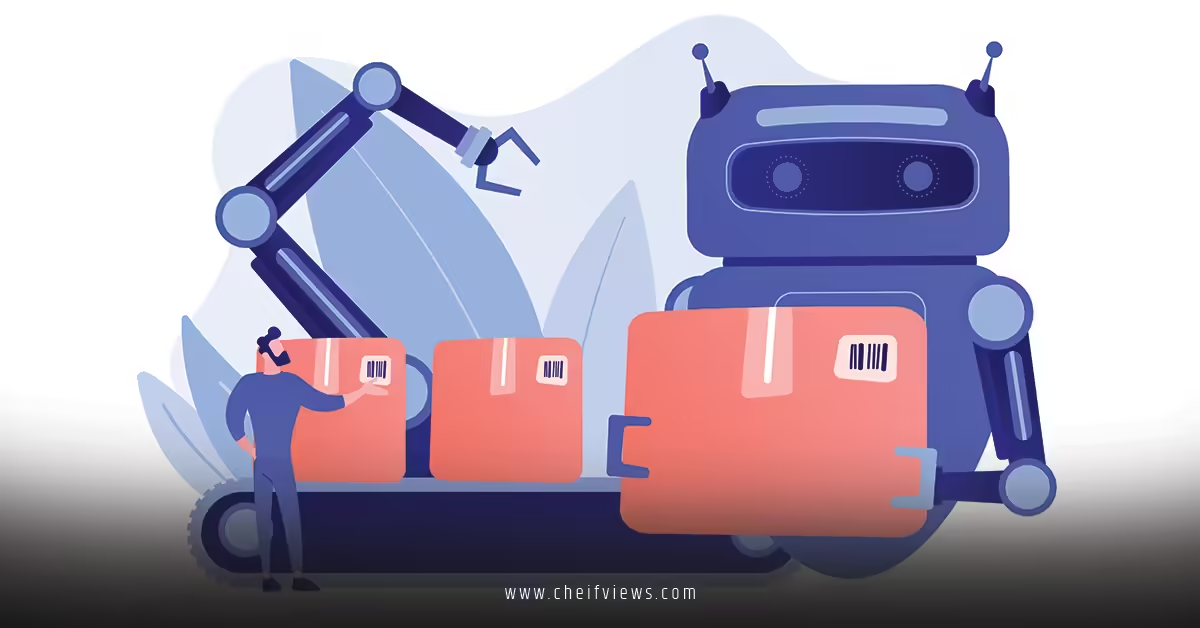
COO role responsibilities in AI supply chain operations 2026 have evolved into something genuinely different from even three years ago. The Chief Operating Officer isn’t just optimizing logistics anymore—they’re orchestrating a hybrid machine-human ecosystem where artificial intelligence handles complexity that would’ve made your head spin a decade back.
What You Need to Know Right Now
Here’s the snapshot before we dig deeper:
- AI integration isn’t optional anymore. Supply chain COOs now own responsibility for deploying, monitoring, and optimizing AI systems across procurement, demand forecasting, and warehouse operations.
- Data governance became a core operational mandate. With AI making real-time decisions on inventory and routing, COOs must ensure clean data flows and ethical model performance.
- The skill gap is real. Finding leaders who speak both operations and AI fluently remains the bottleneck for most organizations.
- Vendor complexity exploded. COOs manage traditional 3PLs, new AI-powered logistics platforms, and legacy ERP systems simultaneously.
- Risk surfaces shifted. Cybersecurity, model drift, and supply chain disruption now sit equally at the table as traditional operational risk.
The Modern COO’s AI Supply Chain Playbook
Here’s the thing: the COO role responsibilities in AI supply chain operations 2026 center on three pillars that didn’t exist in the same form five years ago.
Pillar 1: AI Technology Deployment & Optimization
Your job isn’t to become a data scientist. It is to become fluent enough to ask the right questions.
What this actually means: You’re responsible for identifying which supply chain processes benefit from AI versus which ones don’t. Demand forecasting? Yes—AI models catch patterns human analysts miss. Should your entire supplier relationship hinge on an algorithm? Probably not.
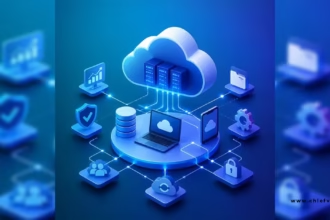
Modern COOs partner closely with procurement and logistics teams to pilot AI solutions. I’d typically recommend starting with high-frequency, low-consequence decisions (dynamic pricing, micro-fulfillment routing, shipment consolidation) before moving to strategic ones (supplier selection, production scheduling).
The implementation reality:
The COO shoulders accountability for AI project timelines and budgets, even if the CTO/CIO owns technical execution. That means you need to understand implementation friction: data quality issues eat 40-60% of AI projects’ timelines, not because the models are hard to build, but because supply chain data is messy. Legacy systems. Manual spreadsheets. Inconsistent vendor feeds.
Your practical move: Demand an audit of data quality before any pilot launches. Real question to ask: “What percentage of our supply chain data is actually machine-readable without manual correction?” If the answer isn’t above 75%, you’ve found your first bottleneck.
Pillar 2: Risk Management & Model Governance
Here’s where most organizations stumble. They deploy AI and then don’t check if it’s still working correctly three months later.
COO role responsibilities in AI supply chain operations 2026 include active model monitoring. This means:
- Performance tracking: Is your demand forecast still accurate? Did external shocks (geopolitics, supply disruptions, tariff changes) throw it off? How quickly can you detect and correct drift?
- Bias detection: If your AI is making supplier or routing decisions, does it show inadvertent bias toward certain regions, carrier types, or vendor sizes? This becomes an operational and compliance issue.
- Scenario planning: What happens when your AI gets it wrong? You need documented playbooks for manual override, not panic mode at 2 AM.
The supply chain is less forgiving than, say, a recommendation engine. Bad inventory predictions ripple into customer stockouts. Faulty routing blows service levels. A COO I worked with learned this the hard way—a predictive model marked a critical supplier as “low-reliability” based on outdated data, and the system automatically reduced orders. Shortage followed within weeks. Lesson: humans still make the final call on strategic moves.
Core COO Responsibilities: The Breakdown
| Responsibility | 2024 Context | 2026 Evolution | New Skill Required |
|---|---|---|---|
| Demand Planning | Statistical forecasting, human judgment | AI models + exception management | ML model interpretation |
| Supplier Management | RFQ cycles, relationship building | Algorithm-assisted vendor scoring + human vetting | Data governance literacy |
| Warehouse Operations | Labor scheduling, inventory placement | Autonomous systems coordination, AI-driven picking | Tech integration oversight |
| Risk Mitigation | Supply disruption scenarios | Scenario + AI anomaly detection | Predictive analytics review |
| Cost Optimization | Vendor negotiations, process efficiency | AI-driven route optimization, dynamic pricing | Model economics evaluation |
| Team Leadership | Operations expertise | Operations + AI mentorship capability | Cross-functional facilitation |

The Action Plan: How to Step Into This Role (Beginner’s Guide)
If you’re new to a COO position in an AI-enabled supply chain—or upgrading your skills—here’s the playbook:
Month 1: Audit & Baseline
- Map every AI system currently in use. Document who built it, what it does, who owns it, and whether it has monitoring in place. You’ll find gaps.
- Schedule 1:1s with your procurement, logistics, and finance leads. Ask: “Where does AI help you most? Where does it create friction?”
- Request a data quality assessment from IT/analytics. Get real numbers on data completeness, accuracy, and freshness.
Month 2-3: Governance Build-Out
- Define decision authorities: Which supply chain decisions require human sign-off? Which can be fully automated? Which are AI-assisted?
- Establish an AI steering committee (operations, finance, IT, compliance). Meet monthly to review model performance.
- Draft a playbook for when AI systems underperform or fail. Include escalation, manual override protocols, and communication steps.
Month 4+: Optimization & Learning
- Run quarterly model health checks. Pull performance reports and ask: “Are we getting the ROI we expected?”
- Identify your next AI opportunity. Pilot small, measure rigorously, scale deliberately.
- Invest in team upskilling. Your managers don’t need PhDs in AI, but they need enough literacy to interpret dashboards and spot problems.
Common Mistakes & How to Fix Them
Mistake 1: “We deployed AI, now it’s set and forget.”
The fix? Install quarterly model audits into your calendar, non-negotiable. AI systems degrade as data distributions shift. Your job is to catch it before the business does.
Mistake 2: “The tech team owns AI; operations just executes.”
Wrong ownership structure. Technology builds it; operations owns the outcome. That means you’re accountable for adoption, performance, and course correction. Push back if you’re being excluded from AI decisions.
Mistake 3: “We automated everything, and now our team feels irrelevant.”
This one’s on you. COOs who succeed communicate the why behind AI adoption. Position it as “we’re automating the boring stuff so you can focus on exceptions and strategy”—because that’s exactly what happens. Your best team members will spend time on edge cases, supplier relationships, and innovation, not data entry.
Mistake 4: “We’re not measuring anything beyond cost savings.”
Measure what actually matters: forecast accuracy, on-time delivery, service levels, cash-to-cash cycle time. Cost isn’t the only lever. AI often improves speed and resilience more than it improves cost.
Mistake 5: “Our vendors don’t understand the AI systems we’re using.”
If your suppliers can’t predict how your AI will behave, they can’t partner effectively. Transparency here isn’t weakness—it’s operational maturity.
COO Role Responsibilities in AI Supply Chain Operations 2026: What Success Looks Like
You’ve hit your stride when:
- Your forecast accuracy improves quarter-over-quarter without increasing headcount.
- Your team discusses AI performance in operational reviews the same way they discuss KPIs.
- You catch model drift before it impacts service levels.
- Your supplier partners actively ask for visibility into your AI systems (not resist it).
- You’ve reduced manual, routine decisions by 30-50%, freeing your team for high-value work.
The Technology Stack Reality
Most organizations run a hybrid stack in 2026:
- Legacy ERP systems (SAP, Oracle, Infor) still handle core financial transactions.
- Cloud-native AI platforms (providers like Coupa, Blue Yonder, E2open) layer AI on top of procurement and planning.
- Best-of-breed point solutions (AI-powered logistics, demand sensing, inventory optimization) integrate where ERP falls short.
As COO, you need to understand integration points, data flow, and where the truth of your data lives. Most operational fires in 2026 aren’t technical failures—they’re data integration gaps.
Key Takeaways
- AI is now operational infrastructure. COO role responsibilities in AI supply chain operations 2026 require active oversight, not passive acceptance.
- Data quality comes before model quality. Invest here first, and everything else becomes easier.
- Your team needs a translator. That might be a principal analyst or a COO-level AI lieutenant, but don’t fly blind.
- Start small, measure rigorously, scale deliberately. Pilot one AI use case end-to-end before building out a platform.
- Governance isn’t bureaucracy; it’s resilience. Models fail, predictions miss, systems drift. You need playbooks, not panic.
- Change management is half the battle. Brilliant AI adopted by no one is worthless.
- Vendor transparency matters. Push your AI platform providers for explainability, and hold your team accountable for communicating it to suppliers.
Your Next Move
The COO role responsibilities in AI supply chain operations 2026 demand a learner’s mindset. You don’t need to become a technologist, but you do need to become operationally fluent in how AI changes supply chain decisions. Start by mapping your current AI footprint, establishing governance, and identifying one pilot that could move a key KPI. Run that pilot with rigor, learn from it, and scale.
The organizations winning in 2026 aren’t those with the most sophisticated AI—they’re the ones with COOs and operations leaders who’ve integrated AI thinking into how they operate, every single day.
Frequently Asked Questions
Q: What specific certifications or training should a COO pursue to master AI supply chain operations?
Most COOs I know don’t chase formal AI certifications. Instead, they complete short programs in supply chain data analytics (often 4-8 weeks through universities or platforms like Coursera), read case studies, and attend industry conferences. What matters more is hands-on familiarity with your own company’s AI systems and a bias toward learning by doing. COO role responsibilities in AI supply chain operations 2026 benefit far more from operational wisdom combined with AI literacy than from a specialized degree.
Q: How do we measure ROI on AI supply chain investments?
Track three categories: cost (reduced labor, lower inventory carrying costs, optimized freight), speed (faster order-to-delivery, quicker demand response), and resilience (improved forecast accuracy, fewer stockouts, better scenario planning). Most AI projects show payback in 12-18 months when measured holistically. The trick is to baseline these metrics before you deploy, then measure the same way consistently. Avoid the trap of only counting cost—AI often delivers its biggest value in speed and reliability.
Q: What happens when an AI model makes a costly mistake in supply chain decisions?
This is the reality check. It happens. Your job is to limit the blast radius and learn from it. That’s why governance exists—you’ve got decision authority rules, override capabilities, and monitoring in place. Most organizations find that early-stage model mistakes are small and recoverable (a few thousand dollars), while the alternative—no AI and slower response times—costs way more over time. The key is psychological: treat model failures as learning events, not career disasters, and you’ll iterate faster.