




How CMOs can use AI for growth engine strategies and ROI in 2026 comes down to one truth: stop bolting AI onto old playbooks. Build the entire engine around it instead.
Smart leaders treat AI as the core operating system for customer acquisition, retention, and revenue expansion. They move beyond content tweaks and chatbots to predictive systems that spot opportunities, personalize at scale, and deliver measurable payback.
- Predictive customer intelligence spots high-value prospects and churn risks weeks ahead.
- Agentic AI workflows run campaigns that self-optimize in real time.
- Hyper-personalization engines boost returns, often tripling those of generic offers.
- Closed-loop attribution ties every dollar spent to actual revenue impact.
- Continuous experimentation at machine speed compounds small wins into explosive growth.
This matters because budgets face scrutiny and customers demand relevance. AI turns marketing from a cost center into a self-funding growth machine.
Why AI Growth Engines Outperform Traditional Marketing in 2026
Old-school campaigns launch, run, and die. AI-powered growth engines never sleep. They ingest data from every touchpoint, learn constantly, and adjust on the fly.
What usually happens is this: a CMO pilots a few tools, sees some efficiency gains, then hits a wall on scaling impact. The winners integrate AI across strategy, execution, and measurement from day one.
In my experience, the shift pays off fastest when you focus on revenue outcomes first—acquisition cost, lifetime value, pipeline velocity—not vanity metrics.

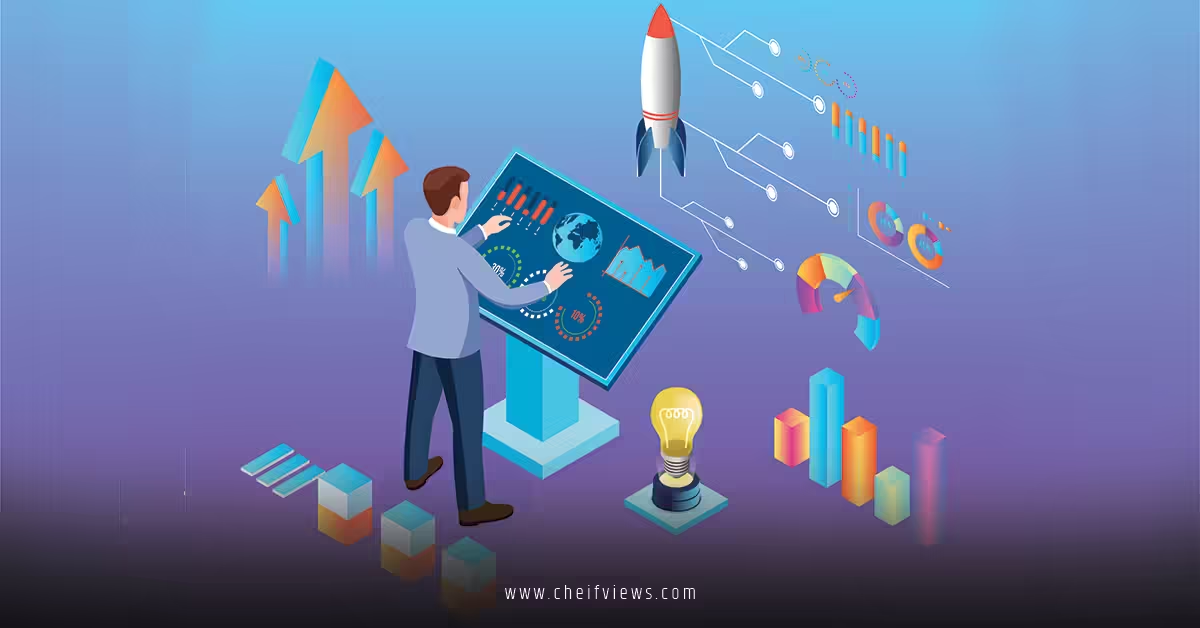
How CMOs can use AI for growth engine strategies and ROI in 2026 starts with data foundations. Clean, unified customer data feeds everything else. Without it, even the best models hallucinate.
Core AI Capabilities Driving Marketing ROI
Predictive Analytics and Intent Signaling
AI scans behavioral signals, firmographics, and external data to predict who will buy, when, and why.
Tools flag accounts showing buying intent before they fill out a form. Campaigns reach them at the perfect moment.
Result? Shorter sales cycles and higher win rates.
Hyper-Personalization at Scale
Forget segments. AI delivers one-to-one experiences across email, ads, websites, and even sales outreach.
BCG research shows personalized offers generate three times the returns of mass offers.
Agentic AI for Autonomous Execution
This is the big leap in 2026. Agentic systems don’t just suggest—they act. They adjust bids, test creatives, nurture leads, and reallocate budget while you sleep.
Gartner highlights brands adopting agentic AI for one-to-one interactions and composable marketing organizations.
Creative and Content Acceleration
AI handles first drafts, A/B variants, and optimization. Humans steer brand voice and strategy.
Teams report 4-8x output increases without proportional headcount growth.
Step-by-Step Action Plan for Beginners and Intermediate CMOs
Here’s exactly what I’d do if stepping into a new role today:
- Audit and Unify Data (Weeks 1-4)
Map every customer data source. Implement a customer data platform (CDP) if you don’t have one. Garbage data kills AI value. - Pick High-Impact Use Cases (Weeks 5-8)
Start with lead scoring, email personalization, and campaign optimization. These deliver quick, visible wins. - Build or Buy Core Tools
Integrate platforms like HubSpot AI, Salesforce Einstein, or specialized agents. Test agentic capabilities on one channel first. - Set Up Measurement Guardrails
Define ROI metrics upfront: customer acquisition cost (CAC), return on ad spend (ROAS), lifetime value (LTV), and incremental revenue lift. - Pilot, Measure, Scale
Run controlled experiments. Compare AI vs. control groups. Only expand what moves the needle. - Train and Govern
Upskill teams. Create clear guidelines on brand safety, data privacy, and human oversight.
| Use Case | Expected ROI Timeline | Key Metrics to Track | Beginner Tip | Investment Level |
|---|---|---|---|---|
| Predictive Lead Scoring | 1-3 months | Conversion rate, sales cycle | Start with built-in CRM AI | Low |
| Personalized Email/Campaigns | 2-4 months | Open rate, CTR, Revenue | Use templates + human review | Medium |
| Agentic Ad Optimization | 3-6 months | ROAS, CPA | One platform, one audience | Medium-High |
| Churn Prediction & Retention | 4-8 months | Retention rate, LTV | Combine with customer feedback | Medium |
| Full Growth Engine | 6-12 months | Overall revenue attribution | Cross-functional team required | High |
How CMOs Can Use AI for Growth Engine Strategies and ROI in 2026: Advanced Tactics
Layer multi-agent systems that handle end-to-end workflows. One agent researches audience insights, another generates variants, a third optimizes delivery, and a fourth reports back with recommendations.
Focus on moment-based marketing over rigid journeys. AI detects micro-moments in real time and triggers the right response.
How CMOs can use AI for growth engine strategies and ROI in 2026 also means treating creativity as a system. Feed performance data back into creative generation for compounding gains.
Explore Gartner’s predictions on agentic AI in marketing for deeper benchmarks.
Common Mistakes & How to Fix Them
- Chasing shiny tools without strategy. Fix: Tie every initiative to a specific revenue or efficiency goal.
- Ignoring data quality. Fix: Invest in cleaning and governance before scaling models.
- Over-automating brand voice. Fix: Keep humans in the loop for final approval on high-visibility assets.
- Poor cross-team alignment. Fix: Create shared dashboards and quarterly AI review sessions with sales and product.
- Measuring the wrong things. Fix: Focus on incremental lift, not just absolute performance.
The kicker is most failures come from treating AI as a plug-in rather than a new operating model.
Measuring True ROI: Beyond Surface Metrics
Track these rigorously:
- Incremental revenue from AI-influenced campaigns.
- Efficiency ratios—output per marketer, time-to-launch.
- Customer lifetime metrics—acquisition cost payback period, expansion revenue.
Compare AI-powered cohorts against control groups. That’s the cleanest proof.
See how IBM frames adaptive lifetime value with AI.
Key Takeaways
- How CMOs can use AI for growth engine strategies and ROI in 2026 requires rethinking marketing as a perpetual, self-optimizing system.
- Start with data foundations and high-ROI use cases like personalization and predictive scoring.
- Agentic AI represents the biggest competitive edge for those who deploy it thoughtfully.
- Measure incremental impact religiously—vanity metrics will mislead you.
- Human oversight remains essential for strategy, creativity, and brand trust.
- Quick wins fund bigger transformations—use early ROI to build internal buy-in.
- Continuous experimentation beats perfect planning.
- Teams that integrate AI deeply across workflows see compounding advantages.
AI won’t replace great CMOs. It will amplify the ones who learn to direct it like a seasoned conductor.
The next step? Pick one growth bottleneck in your business—lead quality, campaign velocity, or retention—and map an AI solution to it this quarter. Run the pilot. Measure everything. Scale what works.
The gap between experimenters and engine-builders is widening fast. Which side will you be on?
FAQs
How do beginners start with how CMOs can use AI for growth engine strategies and ROI in 2026 without a huge budget?
Focus on platforms you already use. Most major CRMs and marketing clouds now include capable AI features. Begin with predictive lead scoring or email personalization, measure results against a control group, and expand from proven wins.
What ROI can CMOs realistically expect when implementing AI growth engines?
Early results often show 20-30% lifts in campaign performance, with personalized approaches delivering up to 3x returns versus generic ones. Full engines compound over 6-12 months as data loops strengthen and agentic systems take over routine decisions.
How does how CMOs can use AI for growth engine strategies and ROI in 2026 differ for B2B versus B2C?
B2B emphasizes account-based predictive intelligence and longer nurture sequences. B2C leans harder into real-time personalization and creative testing at massive scale. Both benefit from unified data and agentic optimization, but B2B requires tighter sales-marketing alignment.