




CTO guide to evaluating and adopting agentic AI safely is no longer a theoretical exercise—it’s a daily question for any business leader watching competitors move faster with fewer people. You’re hearing about AI “agents” that can plan, execute, and coordinate tasks across your stack, and you’re wondering: how do we use this power without breaking things, exposing data, or damaging customer trust? That tension between opportunity and risk is exactly where most founders and CTOs get stuck.
You don’t need a PhD in machine learning to make good decisions here. You do need a clear way to judge vendors, set guardrails, and roll out agentic AI in stages so you’re learning without gambling the business. In this article, we’re going to be taking a look at CTO guide to evaluating and adopting agentic AI safely, and how you can turn AI agents into a reliable part of your operations instead of a risky experiment. If you would like to find out more, feel free to read on.
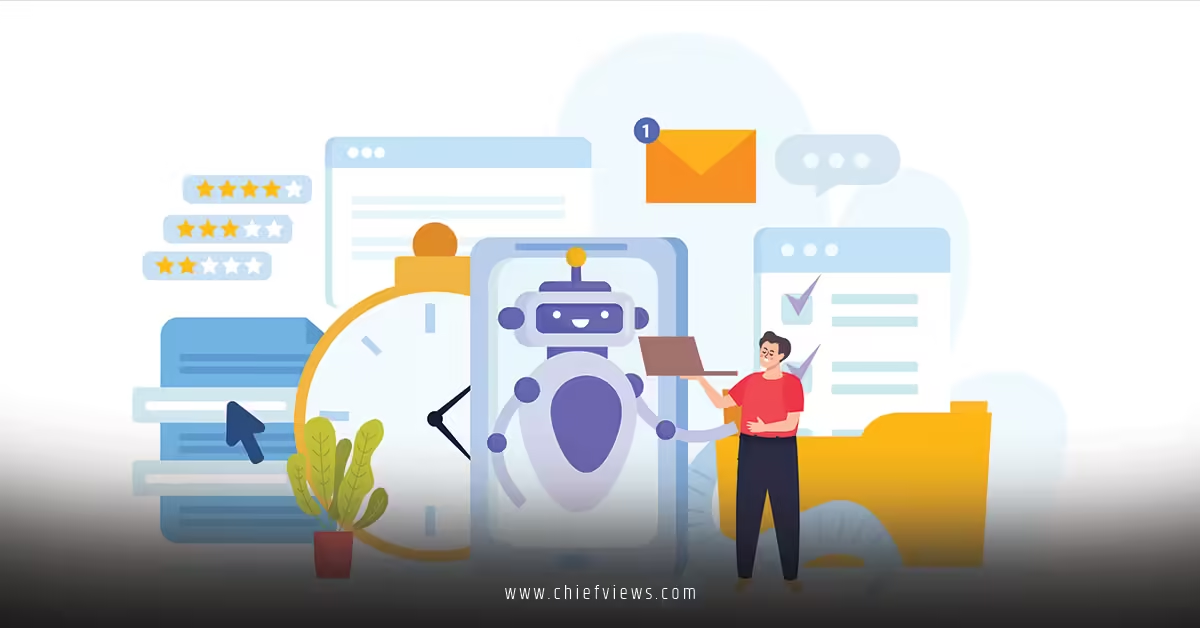
Pic – CC0 License
What agentic AI actually is (in plain English)
Before you buy anything, we need a simple shared definition. Agentic AI refers to systems that don’t just answer questions; they take action on your behalf. They can call APIs, update records, send messages, and chain multiple steps together based on goals you set.
Think of three broad types:
- Workflow agents: automate multi-step processes like onboarding, reporting, or support routing.
- Integration agents: sit between tools like your CRM, helpdesk, and ERP, and move data or trigger tasks.
- Decision-support agents: monitor signals (like customer churn risk) and recommend actions, sometimes taking low-risk actions automatically.
This mix of autonomy and access is why safety matters so much. You’re effectively giving a smart intern the keys to parts of your stack. Your job is to make sure those keys are limited, monitored, and easy to revoke.


A CTO guide to evaluating and adopting agentic AI safely: the non‑negotiable questions
When you look at any agentic AI platform or vendor, you should have a short list of questions you always ask. These questions aren’t “nice to have”; they are your baseline.
Here are the big ones:
- Data custody: Where is data stored? How is it encrypted? Is it used to train their models by default, or can you opt out? Reputable providers will explain this clearly and often link to a transparent security overview.
- Identity and access: How does the agent authenticate to your systems? Do they support granular permissions, role-based access, and least‑privilege design? Look for support of industry standards like OAuth 2.0 and SSO so you can manage access centrally.
- Auditability: Can you see a full log of every action the agent took, with timestamps and parameters? Logging is your black box recorder. If something goes wrong, you need a trail.
- Compliance posture: Ask how they align with recognized frameworks such as SOC 2 or ISO 27001, and whether they’re aware of evolving AI governance guidelines from organizations like the National Institute of Standards and Technology. You’re not just buying a product; you’re buying their risk posture too.
If a vendor struggles to give clear answers on any of these, you have your first red flag.
Mapping agentic AI to real business value
Safety doesn’t mean saying “no” to everything. It means saying “yes” where the value is clear and the downside is manageable. As a CTO or founder, you should start by mapping agentic AI to a handful of specific outcomes.
Common high‑value starting points include:
- Support operations: agents that draft responses, summarize conversations, and route tickets, while agents with higher permissions only act on low‑risk tasks like tagging or scheduling callbacks.
- Sales operations: pipeline hygiene, data enrichment, and meeting prep. Agents can write summaries, suggest follow‑ups, and keep CRM fields consistent.
- Internal workflows: employee onboarding, access requests, content drafting, and reporting. These are great early sandboxes because they’re mostly inside your walls.
The key is to tie each agent use case to a measurable outcome: faster resolution time, fewer manual touches, more accurate data, or happier customers. That’s how you justify the investment and keep experiments from drifting into “cool but useless.”
Risk tiers: how you decide what an agent is allowed to do
One of the most practical steps in any CTO guide to evaluating and adopting agentic AI safely is to classify tasks into risk tiers. This helps you decide which actions agents can perform and which actions should require human approval.
A simple model looks like this:
- Low‑risk tier: read‑only actions, content drafting, basic data tagging, scheduling, or internal reminders. Agents can mostly act freely here.
- Medium‑risk tier: updating internal records, changing statuses, triggering standard workflows, sending internal messages. Agents can act, but you monitor these closely.
- High‑risk tier: touching money (refunds, invoices), changing contract terms, sending external communications at scale, altering security settings, or deleting data. In this tier, agents should never act without human review or very strict constraints.
You can borrow safety ideas from software engineering and cybersecurity communities, such as role‑based access control and change management principles, and apply them directly to agent permissions.

Guardrails, policies, and “kill switches”
Once you know what agents can and cannot do, you need to build policy and control into your setup. This is where CTOs and founders often under‑invest and later regret it.
There are a few practical guardrails you should insist on:
- Clear approval workflows: for anything in your high‑risk tier, agents should propose actions, not execute them. Humans approve or reject.
- Rate limits: limit how many actions an agent can take per minute, hour, or day. This limits blast radius if something misfires.
- Environment separation: test agents in staging environments before production. Many cloud and devops teams already do this for code; extend the same thinking to AI agents.
- Instant “off switch”: make sure you can revoke agent permissions or shut down the integration quickly if needed. This is your safety net in case of unexpected behavior.
When you speak to vendors, ask to see how these controls are implemented. If they treat safety as an afterthought, that’s another red flag.
Building a phased adoption plan your team can trust
Even a strong CTO guide to evaluating and adopting agentic AI safely is useless if your team doesn’t buy in. People worry about job loss, errors, and systems “going rogue.” Your rollout plan should calm those fears.
A simple phased plan might look like this:
- Discovery and design: identify 3–5 candidate workflows, map them into risk tiers, and document the guardrails you’ll use.
- Pilot in a safe domain: choose a low‑risk, internal use case and run a 4–6 week pilot with tight monitoring and clear success metrics.
- Expand to adjacent use cases: if the pilot works, extend similar agents into neighboring workflows, keeping the same safety model.
- Formalize governance: set up an internal AI review process, document policies, and align with external guidance such as the OECD AI Principles.
- Scale with shared standards: create internal templates for agent design, access levels, and logging so future projects don’t reinvent the wheel.
Communicate early and often. Make it clear that agents are there to remove grunt work and give your people more time for judgment, relationship‑building, and creativity.
Choosing partners and staying compliant as laws evolve
Agentic AI doesn’t sit in a vacuum. Regulations, insurance requirements, and customer expectations are all changing. As you choose vendors in the USA, UK, AUS, Singapore, or Dubai, you’ll need to pay attention to both local and global signals.
Here are helpful habits:
- Follow developments from trusted organizations like the UK Information Commissioner’s Office that publish practical AI guidance for businesses.
- Ask vendors how they track upcoming legislation and whether they offer features that help with consent management, data subject requests, and incident reporting.
- Build a simple internal AI use policy that covers data types, approved tools, and escalation paths for concerns or incidents.
You don’t need to predict every law. You just need processes that make it easy to adapt. That’s what turns AI safety from a one‑off project into an ongoing capability.
Bringing it all together
We hope that you have found this article enlightening in some way and that you feel more confident about moving from curiosity to action with agentic AI. As a CTO or founder, your job isn’t to do all the engineering yourself; your job is to set a clear bar for safety, value, and governance so your team can build and buy with confidence. When you ask the right questions, classify risks, and roll out agents gradually, you can get the upside of automation without betting your business on untested systems.
Agentic AI is going to sit inside more and more of your workflows over the next few years. The businesses that win will be the ones that treat safety as a design principle, not a bolt‑on. If you start with a thoughtful CTO guide to evaluating and adopting agentic AI safely, you’ll be well‑placed to turn AI agents into a secure, dependable part of how your company operates every day.