





CFO guide to advanced scenario planning in uncertainty 2026 starts with a simple truth: if your business is only planning for one future, you are taking on more risk than you need to. When costs jump, demand shifts or funding gets tighter, the businesses that stay steady are usually the ones that have already thought through a few different paths. In this article, we’re going to be taking a look at CFO guide to advanced scenario planning in uncertainty 2026, and how you can build stronger decisions, protect cash flow and move faster when conditions change. If you would like to find out more, feel free to read on.
Pic – CC0 License
Why scenario planning matters now
If you run a business in the USA, UK, Australia, Singapore or Dubai, you already know the pressure points can change fast. Interest rates, inflation, supply costs, labor markets and customer demand do not always move in the same direction. That makes simple forecasting useful, but not enough.
Advanced scenario planning helps you prepare for more than the “most likely” case. It gives you a clearer view of what happens if sales miss target, if margins shrink, if a supplier fails or if growth outpaces your team. The point is not to predict the future perfectly. The point is to make sure your business can still act with confidence when the future refuses to behave.
CFO guide to advanced scenario planning in uncertainty 2026: start with the right questions
Before building spreadsheets, start with the questions that matter most. What would hurt your business fastest? Where are you most exposed? What would you do if revenue dropped 15%, 25% or 40%?


A strong CFO plan focuses on the decisions behind the numbers, not just the numbers themselves. For practical help on setting up a rolling forecast, see the guidance from The Chartered Institute of Management Accountants on management accounting and planning. That mindset keeps the work grounded in action, not theory.
Here are the core questions we would ask:
- Which revenue streams are most fragile?
- Which costs can be changed quickly?
- Which decisions need board approval and which do not?
- What is the earliest warning sign that a scenario is becoming real?
Build three scenarios, not one spreadsheet
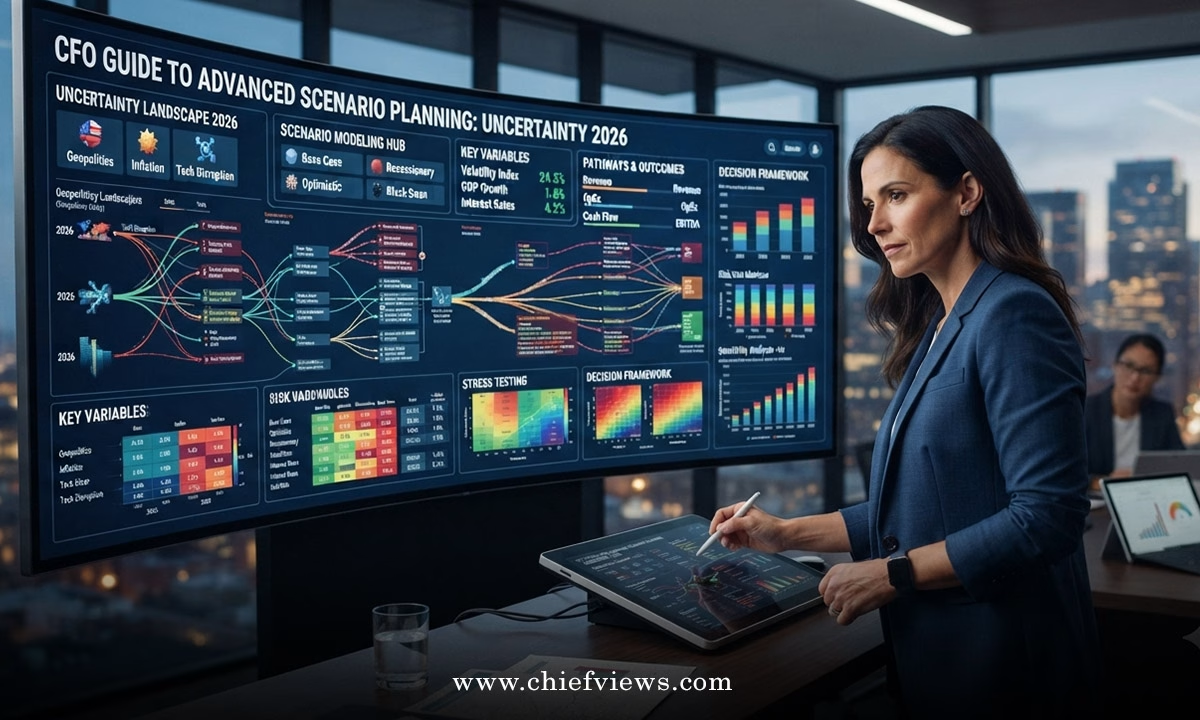
A good scenario model is usually simple enough to use and strong enough to trust. We would build at least three versions: base case, downside case and stress case. If you want to go further, add an upside case so you can see what to do if growth arrives faster than expected.
Each scenario should include:
- Revenue by product, region or channel
- Gross margin
- Headcount and hiring pace
- Cash balance
- Working capital needs
- Debt repayment or financing options
The best models are easy to update. If your team needs a finance degree to use them, the model is too hard. Keep the logic clean and make sure every assumption is visible.
Focus on the drivers, not just the outcomes
The most useful CFO models are built around drivers. A driver is something that actually moves the result, like average deal size, conversion rate, churn, store traffic or supplier lead time. Once you know your drivers, you can test how a small change turns into a big result.
For example, if one region slows, do you need to slow hiring across the whole company or only in one team? If your margin falls by two points, does that mean you pause expansion, raise prices or renegotiate contracts? This is where scenario planning becomes a real management tool, not just a finance exercise.
You can see a useful public framework in Harvard Business Review’s strategy coverage, which often shows how leaders turn uncertainty into decision-making discipline.
Use triggers so action starts early
A scenario plan is only useful if it tells people when to act. That is why we recommend setting trigger points. These are clear markers that say, “If this happens, we do this.”
Your triggers might look like this:
- If pipeline coverage falls below a set level, freeze discretionary spend
- If collections slow by more than a set number of days, tighten cash review
- If sales in one market drop for two months, revise the forecast
- If inventory turns weaken, reduce purchase orders
This gives your business a faster response time. It also removes some of the emotion from hard decisions. People know in advance what the playbook is.
Keep cash front and center
In uncertain times, cash is the thing that buys you options. Profit matters, but cash keeps the business alive while you adjust. That is why advanced scenario planning should always show how much cash you have, how fast you are using it and how long it lasts in each case.
That means looking at:
- Cash inflows from customers
- Payment terms with suppliers
- Payroll timing
- Tax obligations
- Debt covenants
- Capital spending plans
If you are unsure how to compare liquidity scenarios across markets, the International Monetary Fund provides broad economic context that can help you think about stress conditions in a more structured way. Your goal is to know your runway before pressure hits, not after.
Make it a team habit, not a finance-only task
Scenario planning works best when it is shared. Finance should lead it, but sales, operations, HR and the founder all need a role. Otherwise, the plan stays on one desk and never changes how the business behaves.
We would keep the process simple:
- Review the scenarios monthly
- Update assumptions when the market changes
- Ask leaders what they are seeing on the ground
- Track the same key drivers every time
- Tie decisions to the same trigger points
This creates better alignment. It also helps your team get comfortable talking about uncertainty without panic.
CFO guide to advanced scenario planning in uncertainty 2026 in practice
If you want to start this week, do not wait for a perfect model. Start with the numbers you already have. Pick the five to seven drivers that matter most, build three scenarios and agree on the trigger points that would change your actions.
Then ask one honest question: if the worst case happens, what would we do in the first 30 days? That answer is often more valuable than a polished deck. It tells you whether your business is truly ready.
We hope that you have found this article enlightening in some way. If you remember one thing, let it be this: advanced scenario planning is not about guessing the future. It is about giving your business more ways to win, even when the future is uncertain.