





How CIO can drive CIO CFO alliance for AI tech decisions starts with one simple truth: the CIO owns the technology path, but the CFO usually owns the financial guardrails. When those two leaders move together, AI decisions get faster, cleaner, and far harder to kill in committee.
- It means building a shared case for AI that connects business value, risk, cost, and timing.
- It matters because AI programs stall when tech teams sell capability and finance teams ask for payback.
- The win is not “getting approval.” The win is joint ownership of the decision.
- The best alliances are built on a common scorecard, not optimistic slide decks.
- The CIO who can speak CFO gets budgets, priority, and momentum.
The kicker? AI is not a one-time purchase. It is a portfolio of bets. If the CIO and CFO are not aligned, the company ends up funding pilots that never scale, or saying no to the wrong things for the wrong reasons.
how CIO can drive CIO CFO alliance for AI tech decisions without turning it into a turf war
The first move is to stop treating the CFO like a final gate and start treating finance like an early design partner. That shift changes the tone immediately. Instead of “Can we afford this?” the question becomes “Which AI use case creates the best business outcome for the money, risk, and time we have?” That framing aligns with the way strong SEO content strategies start with business goals, clear intent, and measurable outcomes, not just ideas in isolation.[1][2]
AI decisions are especially sensitive because they touch infrastructure, data governance, security, operating cost, vendor risk, and change management all at once. The CIO usually sees the architecture. The CFO sees the capital stack, operating expense, and payback window. Both views are right. The job is to make them meet in the same room, on the same numbers.
Here’s the thing: if the CIO brings the CFO a finished recommendation, the CFO will often do what finance does best — interrogate assumptions. If the CIO brings a decision framework early, finance can help shape the business case before it hardens into a political problem.


What the CIO and CFO alliance should actually decide on
A strong alliance does not mean both leaders vote on every technical detail. It means they agree on the few decisions that matter most.
| Decision area | CIO focus | CFO focus | Shared outcome |
|---|---|---|---|
| AI use-case priority | Feasibility, architecture, data readiness | ROI, payback period, budget fit | Pick the highest-value use cases first |
| Build vs. buy | Integration, security, maintainability | Total cost of ownership, vendor concentration risk | Select the lowest-risk path to value |
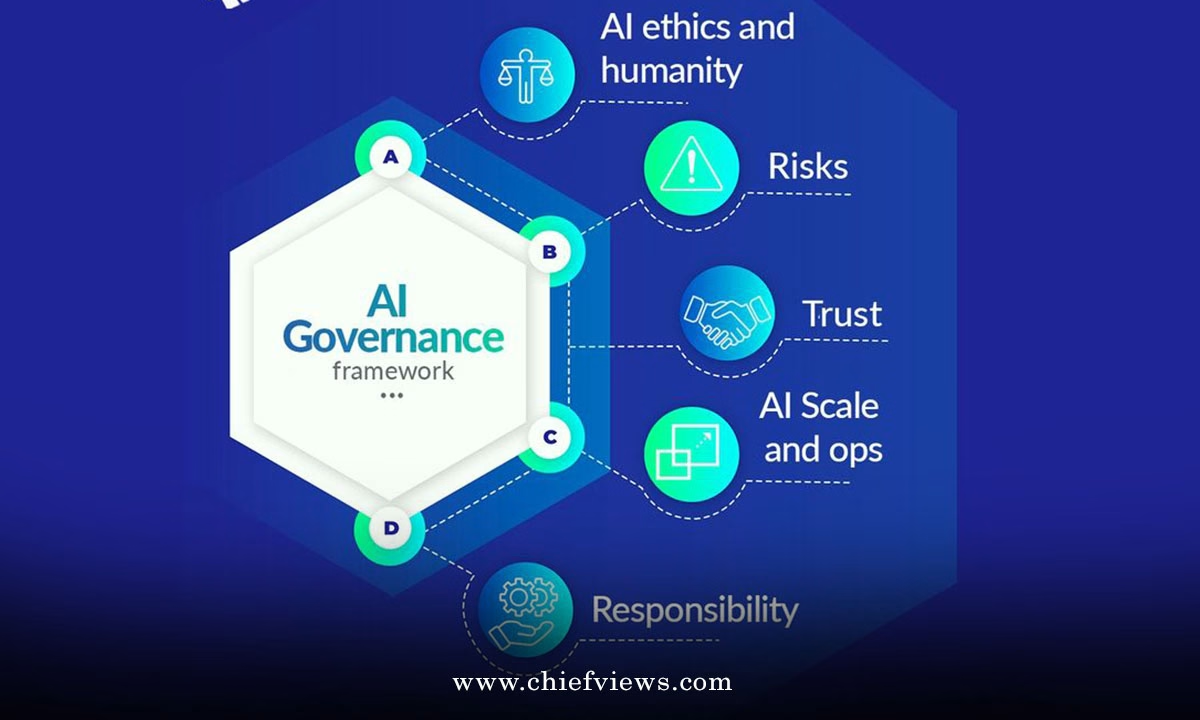
| Governance | Model controls, access, systems oversight | Auditability, compliance exposure, spend control | Deploy AI with guardrails that scale |
| Funding model | Phased rollout, platform reuse | Capex vs. opex, budget timing, commit limits | Fund AI in stages with clear checkpoints |
| Performance measurement | Adoption, reliability, cycle-time gains | Margin impact, cost avoidance, cash flow | Track business results, not vanity metrics |
A table like this works because it cuts through the fog. It shows where the CIO leads, where the CFO leads, and where both must agree.
how CIO can drive CIO CFO alliance for AI tech decisions with a common language
The fastest way to lose a CFO is to talk about AI as if technical elegance were the business case. The fastest way to lose a CIO is to reduce everything to spreadsheet caution. Both sides need a shared language built around outcomes.
That means converting technical terms into financial and operational terms:
- “Model accuracy” becomes “fewer bad decisions and less rework.”
- “Automation” becomes “labor hours returned to the business.”
- “Cloud inference cost” becomes “unit economics at scale.”
- “Data modernization” becomes “speed to deploy more use cases.”
The best alliances work like a gearbox. The CIO provides the engine. The CFO controls how power gets transferred to the business. If the gears do not mesh, the machine grinds.
For a strong external benchmark on AI governance and risk, the NIST AI Risk Management Framework is worth using as a common reference point.[20] For budget discipline and structured decision-making, the U.S. Government Accountability Office’s leading practices for program management can help anchor phased investment thinking.[21] And for search-friendly content structure and clarity, Google’s SEO Starter Guide reinforces the value of readable, original, well-organized material.[14]
Step-by-Step / Action Plan for beginners
If the goal is to build the alliance from scratch, start here.
1) Pick one AI problem, not ten
Do not walk into the room with a giant AI ambition map. Choose one business problem with a visible pain point, such as claims processing, service desk deflection, revenue forecasting, or procurement triage.
2) Map the decision to business value
Define the exact outcome in plain English. Faster cycle time. Lower labor cost. Better forecast accuracy. Fewer compliance mistakes. Keep it concrete.
3) Bring finance in before the vendor demo
This is where many CIOs get it wrong. Bring the CFO or finance partner in early, before enthusiasm locks in. Ask what would make the case credible from a finance perspective.
4) Build a one-page business case
Keep it simple:
- Problem
- AI use case
- Estimated benefit
- Estimated cost
- Main risks
- Success metrics
- Decision needed
5) Agree on guardrails
Set thresholds for security, data quality, privacy, model risk, and spend. Without guardrails, the alliance will get bogged down later in exceptions and second-guessing.
6) Fund in stages
Start with a pilot, but design it to prove a scale decision. If the test works, know exactly what triggers expansion. If it fails, know when to stop.
7) Review results together
Do not let IT report to finance after the fact. Review outcomes jointly. Same dashboard. Same numbers. Same definitions.
Common mistakes & How to fix them
Mistake 1: Selling AI as innovation instead of business impact
That sounds exciting. It also sounds expensive.
Fix: Anchor every AI proposal to a measurable business outcome. If the benefit cannot be named, the proposal is not ready.
Mistake 2: Waiting for conflict before involving the CFO
By then, the fight has already started.
Fix: Bring finance into the design phase, not the approval phase. That is where trust gets built.
Mistake 3: Using different scorecards
The CIO tracks technical delivery. The CFO tracks dollars. If neither side shares a common scorecard, every review becomes a debate.
Fix: Use one scorecard with both operational and financial metrics.
Mistake 4: Overpromising ROI
AI business cases often fail because they assume perfect adoption, perfect data, and perfect timing. None of those exist.
Fix: Use conservative assumptions and phase the upside. CFOs respect realism.
Mistake 5: Ignoring operating cost after launch
A model can look cheap in pilot and expensive in production. That is where projects quietly bleed.
Fix: Include run costs, monitoring, retraining, vendor fees, and support in the total cost model.
Mistake 6: Treating governance as paperwork
It is not paperwork. It is what keeps the alliance credible when auditors, regulators, or the board start asking questions.
Fix: Define ownership for data, model risk, approval rights, and escalation paths before launch.

How the CIO and CFO alliance changes AI tech decisions in practice
The real payoff is speed with discipline. When the CIO and CFO are aligned, AI decisions stop bouncing between enthusiasm and veto. The business gets a cleaner path:
- fewer dead-end pilots
- better prioritization
- tighter vendor selection
- clearer funding logic
- faster scale decisions
That is what makes the alliance powerful. It removes the hidden tax of mistrust.
And let’s be honest: in many companies, the fight is not about AI itself. It is about who gets to define value. Once the CIO and CFO agree on how value is measured, the technical debate gets a lot easier.
What I’d do if I were the CIO
If the goal were to win real alignment, I would do three things immediately.
First, I would set up a standing CIO-CFO AI review, not a one-off meeting. Rhythm matters. Second, I would force every AI proposal into a one-page template with the same fields, every time. Third, I would ask finance to help define the stop-loss criteria before any pilot starts.
That last one matters more than people think. What happens if the model underperforms? What if the data quality is worse than expected? What if adoption lags? The alliance gets stronger when both leaders agree in advance on when to keep going and when to cut bait.
Key Takeaways
- how CIO can drive CIO CFO alliance for AI tech decisions starts with shared business outcomes, not technology enthusiasm.
- The CIO should bring finance in early, before a vendor or pilot hardens into a political position.
- The best AI decisions use one scorecard that combines ROI, risk, cost, and delivery.
- AI governance should be treated as a decision enabler, not a blocker.
- The CIO and CFO should align on use-case priority, funding stage, and scale criteria.
- A simple one-page business case beats a bloated deck every time.
- Conservative assumptions build credibility and reduce rework.
- Joint review cadence keeps AI decisions moving without losing control.
The bottom line is simple: when the CIO and CFO operate as one team, AI stops being a budget fight and starts becoming a business advantage. Start with one use case, one shared scorecard, and one monthly decision rhythm.
FAQs
How CIO can drive CIO CFO alliance for AI tech decisions if the CFO is skeptical?
Start with a low-risk use case, show the business problem in financial terms, and invite the CFO to shape the assumptions before approval. Skepticism usually drops when the numbers are transparent and the downside is controlled.
How CIO can drive CIO CFO alliance for AI tech decisions without slowing innovation?
Use stage-gated funding. That lets the company move fast on pilots while still protecting capital, governance, and priorities. Speed and discipline can coexist when checkpoints are clear.
How CIO can drive CIO CFO alliance for AI tech decisions in a regulated company?
Use a formal governance model that covers data access, model oversight, audit trails, and escalation paths. In regulated settings, the alliance works best when risk controls are defined before deployment, not after