





A COO guide to operational resilience in geopolitical shifts isn’t optional reading anymore — it’s the job description. Tariffs flip overnight. Ports close. A regulator in one country blocks what your regulator in another country just approved. If you’re running operations right now, you’re basically doing crisis management with a spreadsheet in one hand.
Here’s what this guide covers, fast:
- What operational resilience actually means for a COO in 2026, beyond the buzzword.
- Why geopolitics is now a supply chain risk, not just a headline risk.
- A step-by-step action plan you can start this quarter.
- The most common mistakes COOs make when building resilience — and the fix.
- A comparison table of resilience strategies by cost, speed, and risk reduction.
Why does this matter right now? Because the World Economic Forum’s Global Risks Report 2026 ranks geoeconomic confrontation — trade fights, resource nationalism, weaponized regulation — as the single biggest global risk this year, ahead of armed conflict [1]. That’s not an abstraction for a COO. That’s your freight lane, your supplier contract, your compliance calendar.
What Operational Resilience Really Means for a COO
Let’s cut through the consultant-speak. Operational resilience is your company’s ability to keep delivering — product, service, revenue — when the ground shifts under you.
It’s not disaster recovery. Disaster recovery assumes the disaster ends. Geopolitical disruption often doesn’t end — it just mutates. Sanctions get replaced by tariffs. Tariffs get replaced by export controls. You’re not waiting out a storm; you’re learning to sail in permanent chop.
A real COO guide to operational resilience in geopolitical shifts treats disruption as a standing condition, not an event. That reframing changes everything about how you plan.


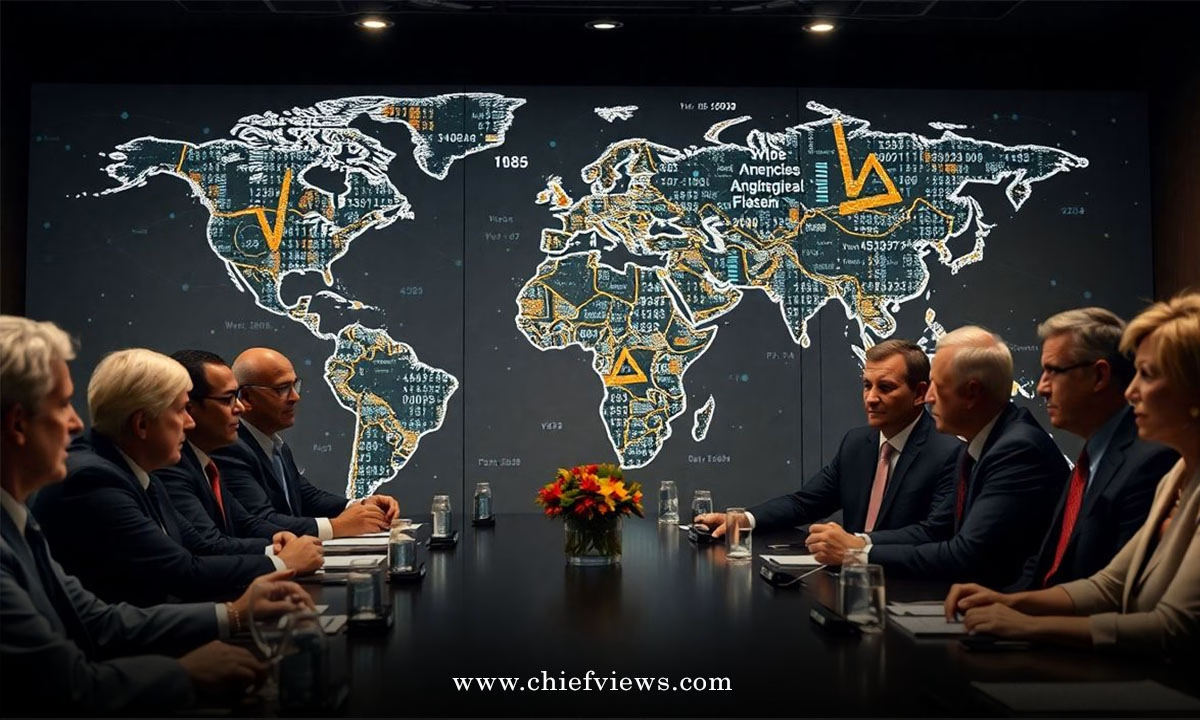
The Geopolitical Risk Landscape a COO Actually Faces in 2026
Three forces are colliding right now, and every COO I talk to is feeling at least two of them:
- Trade fragmentation. Tariff regimes and export controls are shifting faster than legal teams can update contracts. The U.S. Trade Representative’s office publishes active tariff actions, and honestly, checking it should be part of someone’s weekly routine [2].
- Supply chain nationalism. Countries are reshoring critical inputs — chips, rare earths, pharma ingredients — which means your “reliable” supplier might suddenly face export restrictions from their own government.
- Regulatory divergence. Data localization laws, sanctions lists, and labor rules are pulling in different directions across the U.S., EU, and Asia. One compliance framework doesn’t cover you anymore.
The WEF’s 2026 report also flags misinformation and societal polarization as top-five risks feeding into this instability [1]. That matters for a COO because unrest and disinformation campaigns can shut down a facility or a logistics corridor just as fast as a formal export ban.
Step-by-Step: Building Operational Resilience Into Your Org
Here’s the action plan. No theory. Just what I’d actually do if I walked into a COO role tomorrow and had to get this moving in 90 days.
- Map your exposure, not just your suppliers. List every supplier, facility, and logistics partner by country, then flag which ones sit in politically volatile regions or single-source categories. If you can’t finish this in a week, that’s your first red flag.
- Run a “what breaks first” stress test. Pick your top three geopolitical scenarios — a tariff spike, a port closure, a sanctions expansion — and trace the exact operational chain that snaps in each case.
- Build dual-sourcing for anything mission-critical. Not everything. Just the stuff that stops production if it disappears. Aim for two suppliers in two different geopolitical blocs.
- Create a decision-rights playbook. When a disruption hits at 2 a.m., who decides to reroute shipments, freeze spend, or activate backup vendors? Write it down. Don’t leave it to Slack chaos.
- Set trigger-based monitoring, not calendar reviews. Quarterly risk reviews are too slow for this environment. Tie alerts to specific thresholds — tariff announcements, sanctions list updates, currency swings past a set percentage.
- Pressure-test your cash and inventory buffers. Resilience costs money upfront. Know your number before a crisis forces you to guess it.
- Rehearse it. Run a tabletop exercise twice a year. Treat it like a fire drill, not a PowerPoint deck nobody reads.
Resilience Strategy Comparison: Cost, Speed, and Risk Reduction
Not every fix belongs in every playbook. Here’s how the major resilience levers stack up against each other.
| Strategy | Implementation Speed | Relative Cost | Risk Reduction | Best For |
|---|---|---|---|---|
| Dual/multi-sourcing | 3–9 months | Medium–High | High | Single-source, critical components |
| Nearshoring/reshoring | 12–24 months | High | High | Politically sensitive supply chains |
| Inventory buffer expansion | 1–3 months | Medium | Medium | Short-term shock absorption |
| Scenario planning/tabletops | 1–2 months | Low | Medium | Every organization, immediately |
| Contract renegotiation (force majeure, exit clauses) | 2–6 months | Low–Medium | Medium | Existing vendor relationships |
| Real-time geopolitical monitoring tools | 1 month | Low–Medium | Medium–High | Early warning across all risk types |
The kicker is that most companies pick one strategy and call it a program. Real resilience stacks two or three of these together, layered like insurance policies that overlap on purpose.
Common Mistakes & How to Fix Them
I’ve watched smart operators trip on the same rocks over and over. Here’s the pattern.
Mistake 1: Treating resilience as an IT or security project.
Operational resilience touches procurement, finance, legal, and HR just as much as IT. Fix it by putting the COO — not the CISO alone — in the chair that owns cross-functional risk decisions.
Mistake 2: Over-indexing on cost efficiency during calm periods.
Lean supply chains look great on a quarterly earnings call and terrible during a crisis. What usually happens is companies strip out redundancy right before they need it most. Build buffer capacity back in deliberately, even if it dents margin slightly.
Mistake 3: Ignoring second-order suppliers.
Your Tier 1 supplier might be fine. Their Tier 2 supplier, buried three layers deep in a contested region, might not be. Map two levels deeper than feels comfortable.
Mistake 4: No named decision-maker during a crisis.
Committees are great for planning. They’re terrible for speed. Assign one accountable owner per crisis scenario, full stop.
Mistake 5: Static risk assessments.
A risk map from January 2026 is stale by summer. Geopolitical conditions move like weather, not geology. Refresh assessments quarterly at minimum, and immediately after major policy shifts. The U.S. Department of Commerce’s Bureau of Industry and Security regularly updates export control rules, and that alone can reshape your risk map overnight [3].
Key Takeaways
- Operational resilience in 2026 means planning for permanent volatility, not a one-time disruption.
- Geoeconomic confrontation — tariffs, export controls, resource nationalism — now ranks as the top global risk, according to the WEF’s 2026 Global Risks Report [1].
- A COO guide to operational resilience in geopolitical shifts starts with exposure mapping, not software purchases.
- Dual-sourcing and nearshoring reduce risk most but cost the most and take the longest.
- Scenario planning and monitoring tools are cheap, fast wins every company should already have running.
- The biggest failure point isn’t strategy — it’s unclear decision rights during an actual crisis.
- Second-tier and third-tier suppliers deserve the same scrutiny as your direct vendors.
- Resilience is a living system. Review it quarterly, not annually.
Building real operational resilience isn’t about predicting the next geopolitical flashpoint — nobody’s got that crystal ball. It’s about building an operation that doesn’t buckle no matter which direction the next shock comes from. Start with the exposure map this week. Everything else in this guide builds off that one document.
FAQs
What’s the first step in a COO guide to operational resilience in geopolitical shifts?
Start with a full exposure map — every supplier, facility, and logistics route tagged by country and risk level. Without that map, every other resilience move is a guess.
How often should a COO update geopolitical risk assessments?
Quarterly at minimum, with immediate updates after major policy changes like new tariffs or export control rules. Conditions shift too fast for annual reviews to stay useful.
Does operational resilience always require reshoring supply chains?
No. Reshoring is one lever among several, and it’s expensive and slow. Many companies get strong risk reduction from dual-sourcing, inventory buffers, and better contract terms without moving a single factory.