




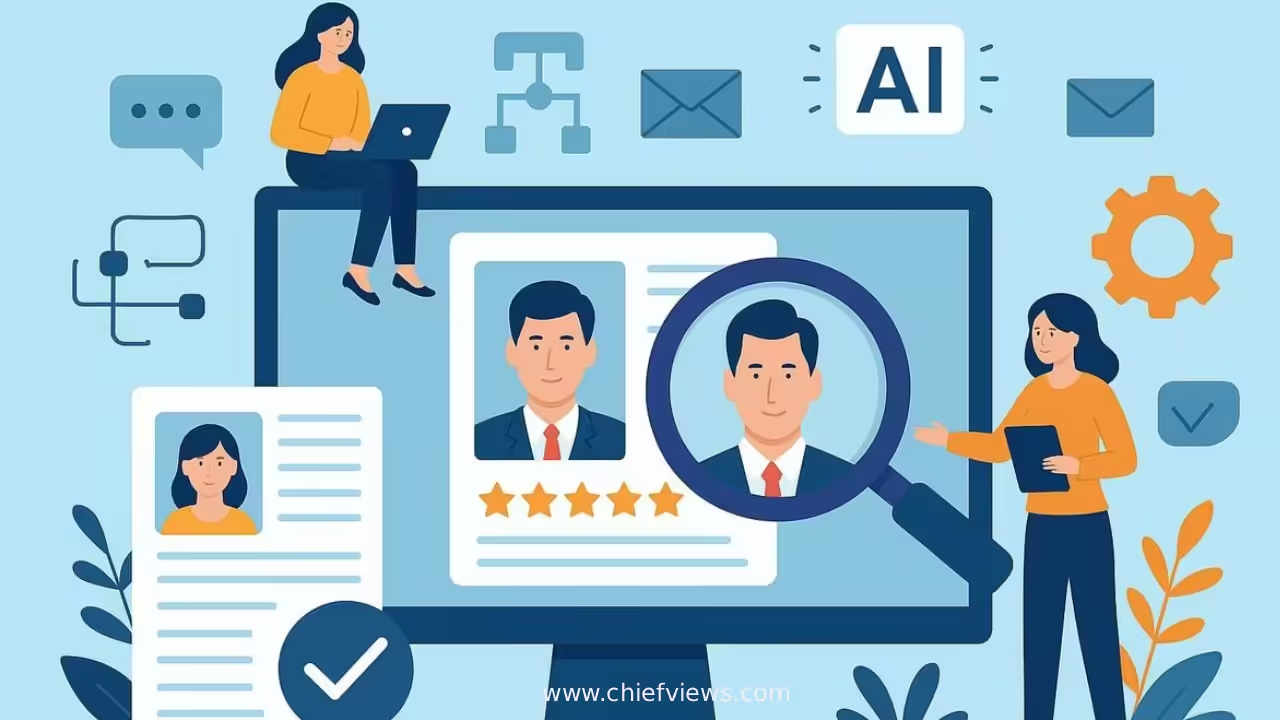
Best AI Tools for Talent Acquisition in 2026: Transform Your Hiring Process In today’s competitive talent market, organizations that master AI tools for talent acquisition gain a decisive edge. These platforms go far beyond simple resume screening—they source passive candidates, conduct intelligent interviews, reduce time-to-hire, and improve quality of hire at scale.
When implemented thoughtfully, these solutions form a critical part of harnessing AI to revolutionize HR operations, shifting HR from administrative work to strategic business partnership.
Why AI Tools for Talent Acquisition Matter in 2026
Talent acquisition teams face intense pressure: high application volumes, skills shortages, candidate expectations for fast and personalized experiences, and the need for data-driven decisions. Traditional methods can no longer keep up.
Modern AI tools for talent acquisition address these challenges by:
- Automating repetitive tasks (sourcing, screening, scheduling)
- Matching candidates on skills and potential rather than just keywords
- Delivering better candidate experiences through conversational AI
- Providing analytics that connect hiring decisions to business outcomes
Organizations using advanced AI recruiting solutions report faster hiring cycles, higher offer-acceptance rates, and improved diversity outcomes when bias-mitigation features are properly configured.



Key Benefits of AI-Powered Talent Acquisition
- Faster time-to-hire — AI agents can source, screen, and schedule in hours instead of weeks.
- Higher quality matches — Skills-based and potential-based matching outperforms traditional resume keyword search.
- Scalability — Handle high-volume or specialized hiring without proportional headcount increases.
- Improved candidate experience — 24/7 chatbots and personalized outreach keep candidates engaged.
- Better data and insights — Real-time analytics on pipeline health, diversity metrics, and recruiter productivity.
- Cost efficiency — Reduced reliance on external agencies and lower cost-per-hire over time.
These benefits directly support broader efforts in harnessing AI to revolutionize HR operations by freeing HR teams to focus on strategy, culture, and workforce planning.
Top AI Tools for Talent Acquisition in 2026
Here are some of the leading platforms, grouped by primary strength:
1. Sourcing & Outbound AI Agents
- hireEZ — Strong open-web sourcing with multi-channel outreach and autonomous AI phone screens. Excellent for passive candidate engagement.
- SeekOut — Deep talent search with advanced filters for technical, diversity, and specialized roles. Strong market intelligence features.
- Pin and HeroHunt.ai — Agentic sourcing platforms that automate search, ranking, and personalized outreach at scale.
- LinkedIn Hiring Assistant — Leverages LinkedIn’s massive professional dataset for highly relevant candidate recommendations and agent-style support.
2. End-to-End Talent Intelligence Platforms
- Eightfold AI — Skills-based talent intelligence that supports external hiring, internal mobility, and workforce planning. Features AI interviewers and multi-agent capabilities.
- Phenom and Beamery — Enterprise platforms focused on candidate relationship management, personalized experiences, and talent rediscovery.
3. Conversational AI & High-Volume Hiring
- Paradox (Olivia) — Leading conversational AI for screening, scheduling, and candidate engagement, especially strong in high-volume and frontline hiring (now part of the Workday ecosystem).
4. Modern ATS with Embedded AI
- Ashby, Greenhouse, and Gem — Combine robust applicant tracking with AI-powered sourcing, scheduling, note-taking, and analytics. Ideal for structured, data-driven hiring teams.
- Manatal and Workable — Accessible options for growing companies that want solid AI features without enterprise complexity.
5. Specialized Assessment & Interview Tools
- HireVue — AI-powered video interviewing and assessment.
- Platforms like Codility or Canditech for skills-based technical evaluations.
How to Choose the Right AI Tools for Talent Acquisition
Ask these questions before selecting a platform:
- What is your biggest bottleneck (sourcing, screening, scheduling, or quality of hire)?
- Do you need open-web sourcing or primarily ATS-driven workflows?
- What is your volume and complexity of roles?
- How important are skills-based matching, DEI analytics, and bias mitigation?
- What integrations do you require with your existing HRIS/ATS?
- What is your budget and preferred pricing model (per user, per job, or enterprise license)?
Start with a clear pilot focused on one or two high-impact use cases rather than trying to automate everything at once.
Best Practices for Implementing AI in Talent Acquisition
- Prioritize transparency and explainability so recruiters understand AI recommendations.
- Combine AI with human judgment—use AI for scale and humans for final decisions and relationship-building.
- Continuously audit for bias and ensure compliance with evolving AI and employment regulations.
- Train recruiters to work effectively with AI agents rather than against them.
- Measure success with both efficiency metrics (time-to-hire, cost-per-hire) and quality metrics (quality of hire, retention, diversity).
When done well, adopting these AI tools for talent acquisition becomes a foundational step in harnessing AI to revolutionize HR operations.
Challenges to Watch For
Even the best tools have limitations. Common issues include data quality dependence, potential for algorithmic bias if not carefully managed, candidate pushback on fully automated processes, and integration complexity. Always maintain a human-in-the-loop approach for critical decisions.
Conclusion: The Future of Talent Acquisition Is AI-Augmented
The most successful talent acquisition teams in 2026 treat AI not as a replacement for recruiters but as a powerful force multiplier. By carefully selecting and implementing the right AI tools for talent acquisition, organizations can hire faster, smarter, and more inclusively while elevating the strategic impact of the entire HR function.
Ready to take the next step? Explore how these tools fit into a broader strategy of harnessing AI to revolutionize HR operations and start with a focused pilot that delivers measurable results.
FAQs
1. What are the best AI tools for talent acquisition in 2026?
Some of the top AI tools for talent acquisition in 2026 include LinkedIn Hiring Assistant, hireEZ, Eightfold AI, SeekOut, Paradox (Olivia), Gem, and Ashby. The best tool depends on your specific needs—whether you focus on sourcing passive candidates, high-volume screening, skills-based matching, or end-to-end automation.
2. How do AI tools for talent acquisition improve hiring efficiency?
AI tools for talent acquisition automate time-consuming tasks such as candidate sourcing, resume screening, outreach, and interview scheduling. This can reduce time-to-hire by 30–70%, improve the quality of shortlists through skills-based matching, and free recruiters to focus on relationship-building and strategic decision-making.
3. Are AI tools for talent acquisition suitable for small and mid-sized companies?
Yes. While enterprise platforms like Eightfold and Phenom are powerful for large organizations, more accessible options such as Manatal, Workable, Gem, and hireEZ offer strong AI capabilities at lower price points, making them practical for growing companies that want to start harnessing AI in their hiring process.