








FinOps best practices 2026 start with one clear shift: FinOps is no longer just about the cloud bill. It is about managing the value of technology itself—especially as AI, SaaS, and hybrid estates collide.
- 98% of FinOps teams now actively manage AI spend, up from 31% just two years ago.
- 90% manage or plan to manage SaaS costs; 64% handle software licensing.
- 78% of FinOps practices report into the CTO or CIO, giving the discipline real architectural influence.
- Cloud waste sits at 29% of IaaS/PaaS spend—the first increase in five years.
- Mature teams move from reactive cleanup to proactive unit economics and automated guardrails.
These FinOps best practices 2026 turn cost visibility into sustained business value. Skip them and the same waste patterns simply reappear under new names—GPU hours, token consumption, idle agents.
Why FinOps Best Practices 2026 Look Different
AI changed the math. Training runs spike. Inference endpoints stay warm. Token costs hide inside larger cloud invoices. Traditional rightsizing still matters, but it is no longer enough.
What usually happens is this: engineering ships a new model, finance sees a surprise line item three weeks later, and the post-mortem starts with “we didn’t tag it properly.” The kicker is that 78% of FinOps teams now sit inside technology leadership. That gives them the leverage to influence architecture decisions before the spend happens—not after.
These FinOps best practices 2026 build on the foundation laid in the CIO guide to cloud modernization and cost optimization 2026. Modernization without FinOps discipline just moves the waste to a more expensive meter.



Core FinOps Best Practices 2026: The Operating Model
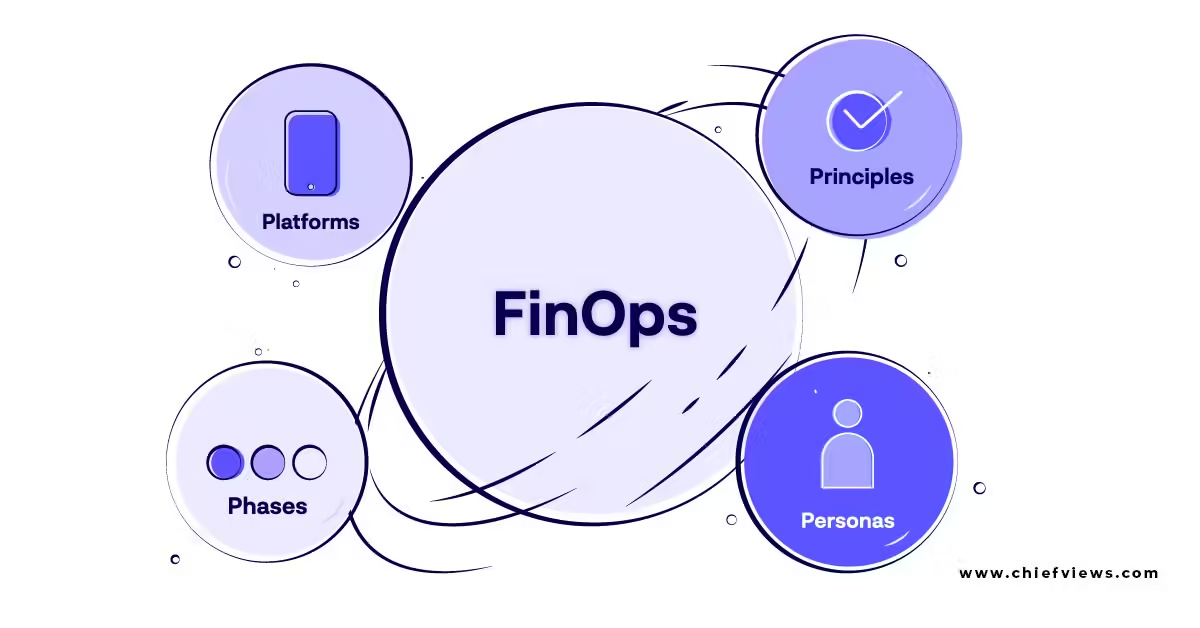
Successful teams treat FinOps as a continuous cycle—Inform, Optimize, Operate—applied across cloud, AI, SaaS, and hybrid environments.
Here’s a practical comparison of the maturity stages I see most often:
| Maturity Stage | Primary Focus | Typical Tools & Practices | Expected Impact | Common Gap |
|---|---|---|---|---|
| Crawl | Visibility & basic allocation | Native cost explorers, mandatory tagging | 5–10% waste reduction | Incomplete tags, delayed data |
| Walk | Rightsizing + commitments | Anomaly detection, savings plans, showback | 10–20% sustained savings | Manual reviews, limited automation |
| Run | Unit economics + AI governance | Cost-per-token, automated policies, FinOps-as-code | 15–30%+ with redirected innovation spend | Lack of business-value metrics |
Numbers like these align with McKinsey’s findings on untapped cloud savings and the FinOps Foundation’s latest survey of practitioners managing more than $83 billion in annual spend.
Step-by-Step Action Plan for FinOps Best Practices 2026
If you’re building or maturing the practice, follow this sequence. Jumping straight to advanced AI cost models without the basics usually backfires.
- Lock down tagging and ownership in the first 30 days.
Enforce a minimum viable tag set at provisioning time: cost-center, application, environment, owner, lifecycle. No tag, no resource. Role-based dashboards so engineering sees their apps and finance sees business units. - Create a single source of truth.
Native tools (AWS Cost Explorer, Azure Cost Management, Google Cloud Billing) are fine starters, but most teams need a multi-cloud or multi-technology layer once AI and SaaS enter the picture. Aim for near-real-time data, not 24-hour delayed reports. - Kill idle and orphaned resources weekly.
Automate non-production schedules. Delete unattached volumes and old snapshots. Most organizations still leave 10–15% of the bill sitting idle. - Right-size with utilization data, not guesses.
Look at 30–60 days of actual CPU, memory, and GPU usage. Set requests to P95 plus a modest buffer. Review quarterly. - Manage commitments intelligently.
Cover only the steady-state baseline with reserved instances or savings plans. Leave headroom for AI bursts. Review utilization monthly and coverage quarterly. - Extend the model to AI and SaaS.
Track cost per 1,000 tokens, cost per inference, and cost per model. Set tiered governance: mission-critical, standard, and experimental with hard caps. Apply the same ownership and showback rules to SaaS licenses. - Automate and embed.
Push cost policies into CI/CD. Use FinOps-as-code for guardrails. Make cost a standing item in architecture reviews and sprint retrospectives.
This sequence is the practical core of FinOps best practices 2026. It works because it sequences visibility before optimization and optimization before automation.
Common Mistakes & How to Fix Them
Mistake 1: Treating FinOps as a finance-only function.
What happens: Engineering ignores the reports.
Fix: Place the practice under the CTO/CIO with a dotted line to finance—exactly where 78% of teams now sit.
Mistake 2: Focusing only on rate optimization (discounts) while ignoring usage.
What happens: You get cheaper waste.
Fix: Balance rate (commitments) and usage (rightsizing, scheduling, cleanup) in every review cycle.
Mistake 3: Ignoring AI until the bill explodes.
What happens: Unmanaged training and inference dominate the invoice.
Fix: Separate AI workloads into their own cost centers from day one and apply token-level visibility.
Mistake 4: One-time cleanup projects.
What happens: Waste returns within months.
Fix: Build recurring cadences—weekly for engineering, monthly for business units, quarterly for architecture.
Mistake 5: Measuring only total spend instead of unit economics.
What happens: No one can tell whether the spend created value.
Fix: Track at least two unit metrics that the business actually cares about (cost per customer, per transaction, per inference).
How Top Teams Keep Momentum
In my experience, the organizations that stay ahead do three things consistently. They treat cost as an architectural decision, not a finance afterthought. They measure value delivered, not just dollars avoided. And they refuse to let any new technology land without a cost model attached.
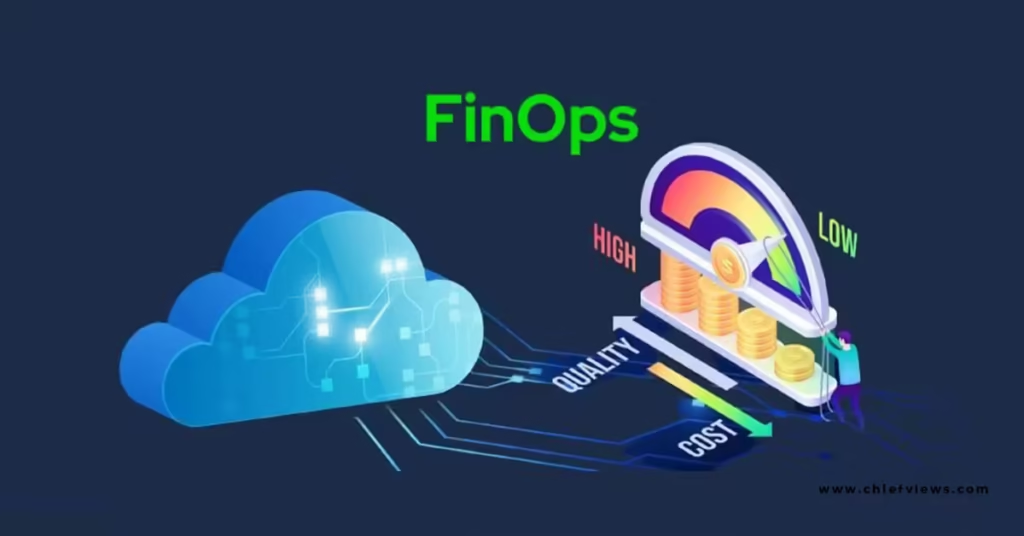
Think of FinOps like the governor on a high-performance engine. Without it the machine runs hot and burns fuel. With it you get power and control at the same time.
For the latest community data, review the FinOps Foundation’s State of FinOps 2026 report. Flexera’s 2026 State of the Cloud Report provides complementary insight on waste trends. McKinsey’s work on FinOps-as-code shows how to lock savings into the engineering workflow.
Key Takeaways
- FinOps has expanded from cloud cost management to technology value management—98% of teams now handle AI spend.
- Tagging, ownership, and a single source of truth remain the non-negotiable foundation.
- Balance rate optimization (commitments) with usage optimization (rightsizing and automation).
- Extend the same discipline to AI tokens, SaaS, and hybrid environments.
- Place FinOps under technology leadership for real architectural influence.
- Move from total-spend metrics to unit economics that the business understands.
- Automate guardrails so optimization becomes continuous, not episodic.
- Use the savings to fund the next wave of modernization and innovation.
The real payoff is simple. Teams that run these FinOps best practices 2026 stop fighting the bill and start using it as a strategic signal. Cost becomes transparent. Waste becomes visible. And every technology decision carries a clear economic consequence.
Your next move: pick one high-spend AI or SaaS workload this week, apply the tagging and ownership rules above, and run a 30-day visibility sprint. The data will show you exactly where to focus next.
FAQs
What are the most important FinOps best practices 2026 for AI workloads?
Tag every resource, track cost per token or per inference, separate experimental from production spend, and set hard caps on non-critical models until value is proven.
How do FinOps best practices 2026 differ from earlier cloud cost efforts?
The scope has widened beyond cloud to SaaS, licensing, private cloud, and AI. Influence has also moved upstream into architecture and technology selection decisions.
Where should a FinOps team sit in the organization according to FinOps best practices 2026?
Most mature teams report into the CTO or CIO organization, with a dotted line to finance. This structure gives them the authority to shape decisions before spend occurs.

