










Working capital optimization with AI is no longer a future play—it’s how sharp finance teams free cash that’s already sitting on the balance sheet in 2026.Here’s the quick read:
- AI targets the three levers of the cash conversion cycle (receivables, payables, inventory) with predictive scoring and automated decisions instead of spreadsheets and gut feel.
- U.S. firms still carry roughly $1.9 trillion in excess working capital opportunity, according to The Hackett Group’s latest survey data.
- Top performers treat AI as a decision-maker, not just a reporter, and run cash cycles nearly 24 days shorter than the bottom tier.
- Results show up fast: measurable DSO cuts, smarter DPO timing, and inventory turns that release real dollars within months.
- For beginners and intermediate teams, the barrier is no longer the technology—it’s clean data, clear governance, and the willingness to let the models act within guardrails.
That trapped cash is expensive when rates stay elevated. The companies pulling ahead in 2026 are the ones using AI to turn volatility into predictability.
Why Working Capital Optimization with AI Matters Right Now
Cash conversion cycles barely budged in 2025 for most U.S. public companies, landing around 38 days. Early payments from customers dried up. Inventory buffers grew under tariff and supply-chain pressure. The result? Billions sitting idle while growth still needs funding.
AI changes the equation by connecting AR, AP, inventory, and treasury data in real time. It scores which invoices will pay late, flags which early-payment discounts actually improve net cash position, and forecasts demand tightly enough to shrink safety stock without stockouts. What used to take quarterly reviews now runs daily.
In my experience, the biggest shift is cultural. Teams that only use AI for prettier dashboards see modest lifts. Teams that let it recommend and, within limits, execute payment timing or collection prioritization pull ahead on predictability. That’s the real edge.


How Working Capital Optimization with AI Actually Works
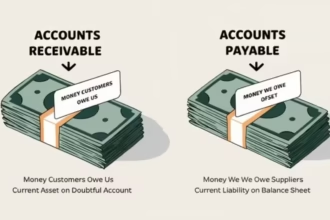
Working capital optimization with AI AI doesn’t invent new levers. It just runs the classic three—Days Sales Outstanding (DSO), Days Payable Outstanding (DPO), and Days Inventory Outstanding (DIO)—with far better signal and speed.
On receivables, models dig through payment history, dispute patterns, and external signals to rank accounts by likelihood and impact. Collectors stop spraying dunning emails and start focusing on the 20% of invoices that move the cash needle.
On payables, the system calculates the true cost of taking or skipping an early-payment discount against current cash forecasts and credit-line costs. No more blanket “pay everything on day 30” rules.
Inventory is where demand-sensing models shine. They pull POS data, supplier lead times, and macroeconomic indicators to set stock levels that actually match reality instead of last year’s average plus a fudge factor.
The kicker is cross-functional visibility. An AI agent can see that accelerating one large receivable frees enough cash to capture three high-ROI early-pay discounts next week. Siloed teams never make that trade-off cleanly.
Step-by-Step Action Plan for Getting Started
If you’re starting from spreadsheets or basic ERP reports, don’t try to boil the ocean. Here’s the sequence I’d run with a mid-market team:
- Clean the foundation (2–4 weeks)
Pull AR aging, AP open items, and inventory by SKU/location into one data lake or even a well-structured warehouse. Fix the obvious duplicates and mismatched payment terms first. Garbage in still equals garbage out. - Pick one high-impact use case
Most teams start with AR prioritization or cash forecasting because the data is cleaner and the ROI shows up in weeks. Inventory optimization usually needs tighter supply-chain data and comes second. - Pilot with clear decision rights
Define exactly what the AI can recommend versus what it can auto-execute (e.g., collection sequences under $50k, payment timing recommendations only). Put a human in the loop for anything above a dollar threshold. - Measure the right metrics weekly
Track DSO by customer segment, percentage of early-payment discounts captured, forecast accuracy (MAPE), and actual cash released—not just model precision scores. - Expand and connect the dots
Once one lever works, feed the improved cash visibility into the other two. Cross-functional optimization is where the bigger numbers appear. - Lock in governance
Assign a working-capital owner who sits between finance, supply chain, and sales. Without that, the models drift and the gains evaporate.
Do this sequence and you’ll usually see the first meaningful cash release inside 90 days. Stretch it across all three levers and the cumulative impact compounds.

Common Mistakes & How to Fix Them
I’ve watched the same errors kill momentum more than once.
Mistake 1: Treating AI as a reporting tool only.
Dashboards are nice. Decision rights are better. Fix: Explicitly decide which recommendations the model can act on within preset limits. Top performers in recent surveys do exactly that.
Mistake 2: Ignoring data quality until after go-live.
You’ll waste months. Fix: Budget the first sprint solely for data remediation. It’s unsexy and non-negotiable.
Mistake 3: Optimizing one lever while breaking another.
Stretching DPO too far damages supplier relationships and future terms. Fix: Build relationship-health scores into the AP model so it never recommends a move that tanks long-term cost.
Mistake 4: No single owner.
Finance, procurement, and sales all touch working capital. Without a clear accountable person, improvements die in the handoff. Fix: Name one working-capital lead with authority to force trade-offs.
Mistake 5: Chasing perfect forecasts instead of usable ones.
A 90% accurate forecast that drives action beats a 98% model that sits in a slide deck. Fix: Focus on directional accuracy and decision speed.
What the Numbers Actually Look Like
Working capital optimization with AI Here’s a realistic mid-market view based on patterns I’m seeing across implementations:
| Lever | Typical AI Action | Cash Impact Example ($100M Revenue Co.) | Time to First Results |
|---|---|---|---|
| DSO reduction | Prioritized collections + automated dunning | $0.8–1.4M released | 30–60 days |
| Early-pay discount capture | Dynamic payment timing | $80–200K annual benefit | 45–90 days |
| Inventory optimization | Demand sensing + safety-stock reset | $1–3M released | 60–120 days |
| Cash forecast accuracy | Multi-source predictive model | $0.5–2M buffer reduction | 30–45 days |
These ranges come from aggregated mid-market experience and published case patterns; your mileage will vary with data quality and process maturity. The point is the payback window is short when you focus.
For deeper benchmarking, the Hackett Group’s U.S. Working Capital Survey remains the clearest public view of the $1.7–1.9 trillion opportunity across large U.S. companies. On the practical execution side, KPMG’s guidance on deploying AI for working capital walks through predictive receivables and cash-flow agents in useful detail. And for the broader cash-excellence context, McKinsey’s work on early working-capital gains in transformations shows how small process and technology moves can free meaningful liquidity fast.
Key Takeaways
- Working capital optimization with AI succeeds when models move from insight to bounded action.
- Predictability now separates top performers more than raw tool adoption.
- Start with clean data and one use case—usually AR or forecasting.
- Cross-functional visibility turns modest single-lever gains into material cash release.
- Governance and a single owner matter as much as the algorithms.
- Measured DSO cuts of a few days and improved discount capture routinely free seven figures for mid-market firms.
- Inventory is the slowest lever but often the largest once demand sensing is solid.
- 2026 conditions (still-elevated rates, longer customer payment habits) make the opportunity larger, not smaller.
Working capital optimization with AI The cash is already on your balance sheet. The question is whether you’ll keep letting it sit there or put AI to work unlocking it. Pick one lever this quarter, set clear decision rights, and measure cash released—not model accuracy. That’s how the teams I respect are winning in 2026.
FAQs
How quickly can a mid-sized company see results from working capital optimization with AI?
Most teams that clean their data first and start with AR prioritization or cash forecasting see measurable DSO improvement or reduced cash buffers inside 60 days. Full three-lever impact usually lands inside six months.
Is working capital optimization with AI only for large enterprises?
No. Mid-market companies often move faster because they have fewer legacy systems and can give a single owner real authority. The $100M-revenue examples above are realistic for that segment.
What’s the biggest risk when implementing working capital optimization with AI?
Over-automating payment or collection decisions without relationship guardrails. Fix it by baking supplier and customer health scores into the models and keeping human approval above clear dollar thresholds.

