









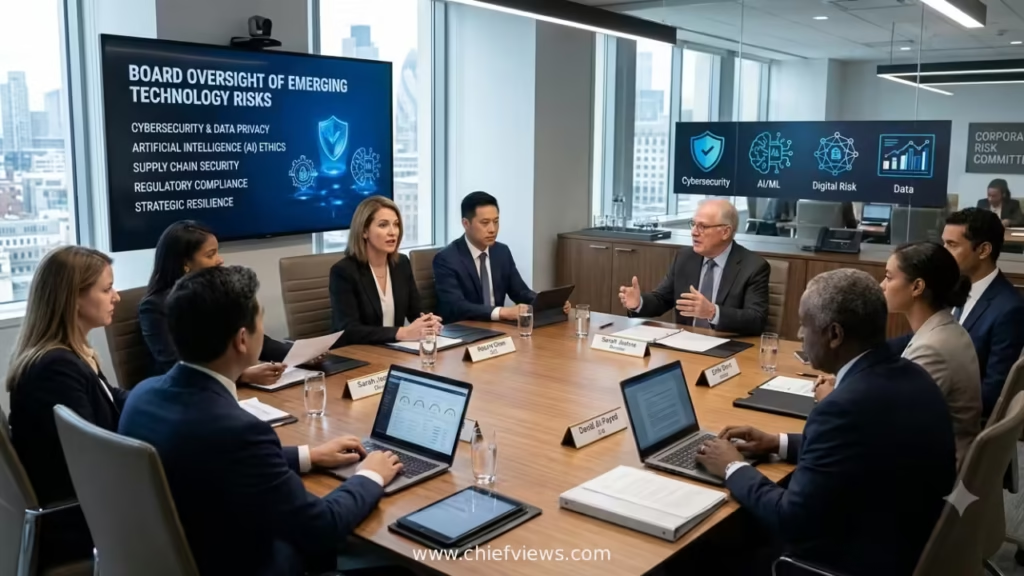
Board Oversight of Emerging Technology Risks Emerging technology no longer sits at the edge of the enterprise. Artificial intelligence, cloud concentration, connected devices, advanced analytics, and automated decision systems now shape how companies sell, hire, lend, diagnose, manufacture, and comply. The same tools that create advantage can also create legal exposure, operational fragility, reputational harm, and strategic misjudgment—often faster than traditional risk processes were designed to handle.
For boards, the question is no longer whether technology risk belongs on the agenda. It is whether directors can exercise informed oversight without becoming technologists, and without treating every new tool as either a miracle or a threat. Effective oversight is a governance discipline: clear ownership, credible information, independent challenge, and a willingness to slow decisions that management cannot explain.
This article sets out a practical framework for that discipline. It distinguishes what boards can reasonably know from what remains uncertain, and it avoids the false precision of invented benchmarks. Where regulation or standards are discussed, they are treated as directional context, not as a substitute for company-specific legal advice.
Why emerging technology risk is a board issue
Boards oversee strategy and risk. Emerging technology now sits in both. A model that prices insurance, a platform that routes customer service, or a vendor that hosts core systems can change the company’s risk profile as much as a major acquisition or a new market entry.
Three features make these risks different from many traditional operational risks.
Speed. Capabilities can move from pilot to production in months. Controls, training, and disclosure often lag.



Opacity. Some systems are difficult to explain even to their builders. Boards cannot oversee what management cannot describe in plain language: what the system does, what data it uses, where it can fail, and who is accountable when it does.
Interdependence. A single third-party model, cloud region, or identity provider can sit underneath multiple business lines. Concentration risk is easy to underestimate until an outage, a contract dispute, or a security incident makes it visible.
None of this requires every director to read model cards or penetration-test reports. It does require the board to insist that management treat technology risk as enterprise risk—owned, measured, escalated, and revisited—rather than as a specialist topic that appears only after something goes wrong.
What “emerging technology risk” actually includes
The phrase is broad on purpose. Boards get into trouble when they equate it with a single headline technology, usually artificial intelligence, and miss the surrounding system.
A useful map includes at least the following categories.
Artificial intelligence and automated decision-making. This covers generative tools, predictive models, recommendation engines, and workflow automation. Risks include inaccurate outputs, biased or unlawful decisions, leakage of confidential data into external tools, over-reliance by staff, and intellectual-property uncertainty around training data and outputs.
Cybersecurity and resilience. Emerging technology expands the attack surface: more identities, more application programming interfaces, more vendors, more always-on systems. Ransomware, business-email compromise, and supply-chain compromise remain core threats; new tools can amplify them.
Data governance and privacy. Models and analytics are only as lawful and reliable as the data beneath them. Collection, retention, cross-border transfer, consent, and secondary use are board-relevant when they affect customers, employees, or regulated decisions.
Third-party and concentration risk. Cloud providers, model vendors, data brokers, and implementation partners can become single points of failure. Contractual rights—audit, exit, incident notice, data deletion, model change notification—matter as much as technical architecture.
Operational and model risk. Systems drift. Inputs change. Staff work around controls. A tool that performed well in a pilot can degrade in production without anyone owning ongoing validation.
Strategic and competitive risk. Moving too slowly is also a risk. So is adopting a tool because competitors appear to be doing so, without a clear use case, cost model, or control design. Boards should oversee both omission and haste.
Human and cultural risk. Shadow use of consumer AI tools, unclear accountability between business units and technology teams, and incentive structures that reward speed over control are governance problems, not merely training problems.
Boards do not need a separate policy for every category. They do need a taxonomy that management uses consistently, so that risks are not renamed out of existence when they move from “innovation” to “operations.”
The oversight duty, without the mythology
In many jurisdictions, directors owe duties of care and loyalty and are expected to oversee the company’s systems for managing significant risks. The precise legal standard varies. In the United States, public discussion often centers on Delaware oversight concepts associated with the Caremark line of cases: boards can face liability when they utterly fail to implement reporting systems for mission-critical risks, or when they ignore red flags those systems produce. That is a high bar for personal liability. It is a low bar for good governance.
The practical lesson is simpler than the case law. If a technology is central to how the company makes money, serves customers, or meets legal obligations, the board should be able to show that:
- someone senior owns the risk;
- the board or a committee receives periodic, decision-useful information about it;
- management has defined risk appetite and escalation triggers;
- red flags are investigated, not explained away;
- the board has enough expertise, or access to expertise, to ask informed questions.
Regulatory expectations are moving in the same direction, though not uniformly.
The U.S. Securities and Exchange Commission’s cybersecurity disclosure rules require many public companies to describe their processes for assessing, identifying, and managing material cybersecurity risks, and to disclose the board’s oversight of those risks and management’s role. Material incidents have their own disclosure timing. The point for directors is not the form language. It is that cybersecurity governance is now something investors and plaintiffs’ lawyers can read.
In the European Union, the Artificial Intelligence Act establishes a risk-based regime for certain AI systems, with stricter obligations for high-risk uses and specific rules for general-purpose models. Implementation is phased, and the practical meaning for a given company depends on role (provider, deployer, importer), use case, and geography. Boards should not treat the Act as a checklist that replaces judgment, nor as a distant issue that only legal teams need to track. Other privacy, financial-services, sector, and consumer rules already constrain automated decisions in many industries.
Uncertainty remains. Enforcement priorities will evolve. Court interpretations of “materiality,” “high-risk,” and board process will differ by forum. Technical standards will lag product cycles. A board that waits for perfect regulatory clarity before building oversight will be late. A board that treats today’s guidance as permanent will overfit. The sound posture is documented, risk-based, and revisable.
Designing the governance structure
There is no single correct committee map. What matters is that oversight is explicit, skilled, and not duplicated into confusion.
Full board versus committee. Strategy, major investments, and risks that could affect viability belong with the full board. Detailed control design, audit findings, and regulatory mapping often belong in audit, risk, or a technology committee. The charter should say who owns what, including AI if AI is material to the business.
Expertise. One director with a technology background is not a control environment. It can help, if that director is used as a translator rather than as a substitute for management accountability. Boards should also consider periodic education, independent advisors for major decisions, and whether the nominating process treats technology and cyber fluency as recurring skills rather than a one-time recruit.
Management accountability. Oversight fails when the chief information officer, chief information security officer, chief data officer, general counsel, and business owners each assume someone else holds the residual risk. The board should know the single executive accountable for each material technology risk, and how disagreements between growth and control are escalated.
Three lines, adapted. Business owners operate the tools. Risk, compliance, security, and model-validation functions challenge them. Internal audit tests whether both layers work. For emerging technology, the second line is often underbuilt. Boards should ask whether challenge functions have the mandate, skills, and independence to slow a launch.
Risk appetite. Vague statements—“we have a low tolerance for cyber risk”—do not guide decisions. Better appetite statements name unacceptable outcomes: no unapproved external AI tools on confidential data; no automated denial of credit or benefits without human review where law or policy requires it; no single vendor whose failure would halt a defined critical process beyond a stated recovery objective. Appetite should be approved, not merely noted.
What informed oversight looks like in practice
Good board materials on emerging technology share a few traits. They are short enough to be read. They separate facts from estimates. They show trend and exception, not only status. They connect technology choices to customers, capital, and legal exposure.
A useful reporting pack for a material technology domain might include:
- an inventory of systems that are in production, in pilot, or prohibited, with business owner and risk tier;
- a plain-language description of the highest-risk use cases and the controls around them;
- open audit findings, regulatory inquiries, and incidents, with age and owner;
- third-party concentration: who could stop a critical process, and what the exit or workaround is;
- decisions requested of the board, as distinct from items presented for awareness.
Directors should be skeptical of dashboards that are entirely green. Emerging technology risk is not a maturity poster. It is a set of tradeoffs. A honest report says where the company is accepting risk, for how long, and why.
Example, clearly illustrative. A regional lender wants to use a vendor model to prioritize loan applications. Management’s paper says the pilot “improved efficiency.” A board exercising oversight would ask: efficiency relative to what baseline; whether protected-class outcomes were tested; whether adverse-action notices can still be explained; who validates the model after the vendor updates it; what happens if the vendor is acquired or the model is withdrawn; and whether compliance has sign-off authority or only a consultative role. None of those questions requires the board to inspect code. All of them test whether management understands the risk it is proposing to take.
A second illustrative example. A manufacturer connects shop-floor equipment to a cloud analytics platform to reduce downtime. The opportunity is real. So is the new path from an external network into operational technology that was previously isolated. Oversight here is about segmentation, vendor access, incident response that includes safety as well as data, and whether insurance and contracts match the new architecture. Calling the project “digital transformation” does not change the questions.
Artificial intelligence as the current stress test
AI deserves specific attention because it is being adopted unevenly, often by employees before the enterprise has a policy, and because its failure modes are easy to misunderstand.
Boards should separate three layers.
Use policy. Which data may be entered into external tools? Which decisions may be automated, assisted, or must remain human? Who approves a new use case? Consumer chat tools used on customer lists, source code, or unpublished financials are a governance failure even if no model was “deployed” by IT.
System risk. For tools the company builds or buys, what is the intended purpose, the data provenance, the testing done for accuracy and unfair outcomes, the monitoring for drift, and the record of human oversight? High-impact uses—credit, employment, healthcare, safety, access to essential services—warrant deeper assurance than internal productivity experiments.
Strategic exposure. Dependence on a small number of model providers, uncertainty about training-data rights, and the cost of computation are strategic issues. So is the chance that AI-generated content, deepfakes, or automated fraud will target the company or its customers. Boards should hear about defensive uses—detection, authentication, customer education—alongside adoption plans.
Public frameworks can help structure the conversation without pretending to settle it. The NIST AI Risk Management Framework, for example, organizes attention around governing, mapping, measuring, and managing AI risk. It is voluntary guidance, not a safe harbor. ISO and sector standards similarly offer vocabulary. The board’s job is to ask whether management has chosen a framework, tailored it, and can show evidence—not whether the company has purchased a certification as a substitute for judgment.
What remains uncertain should be labeled as such. The long-run liability regime for model outputs, the durability of current vendor terms, and the labor effects of automation are not settled. Boards can still require that management identify assumptions, assign owners, and revisit them. Uncertainty is a reason for tighter governance, not a reason to skip it.
Cyber, privacy, and the vendor stack
Emerging technology risk is often legacy risk in a new wrapper. Identity, patching, logging, backup, and privileged access still determine whether a novel system becomes an incident. Boards that fund AI strategy while starving basic security are not balancing innovation and control. They are accumulating unpriced risk.
Third parties deserve equal weight. Many “AI programs” are procurement decisions. Oversight questions include:
- What data leaves the company’s environment, and in what form?
- Can the vendor train on the company’s data? If the contract says no, how is that enforced?
- What notice does the company get of a security incident, a subprocessors change, or a material model change?
- Are audit rights real, or limited to a summary report the vendor chooses to share?
- If the contract ends tomorrow, can the company retrieve data and continue the critical process?
Privacy and cybersecurity reporting should not be siloed from technology strategy. A use case that cannot satisfy data-minimization, retention, or cross-border rules is not a deferred legal detail. It is a reason not to scale.
The SEC’s expectation that boards oversee cybersecurity risk management is one visible marker. Sector regulators in finance, health, energy, and critical infrastructure have their own. Directors should know which regimes apply and whether management’s incident-severity scale matches the company’s disclosure and notification duties. A mismatch—security calls an event “contained” while counsel would call it potentially material—is itself a red flag.
Questions that separate oversight from theater
Boards can use a stable set of questions. The value is in the follow-up, not the script.
- Which emerging-technology uses are material to strategy, customers, or compliance, and who owns each?
- What is prohibited, and how do we know the prohibition is working?
- What would a serious failure look like in customer impact, safety, legal exposure, and recovery time?
- What independent challenge occurred before the last major launch, and what was rejected or delayed?
- Where are we concentrated—on a cloud provider, a model vendor, an identity system, a data source—and what is the tested alternative?
- What incidents, near misses, audit findings, or regulator questions are open, and which are aging?
- Do incentives reward people for raising defects, or only for shipping?
- What will we re-evaluate in six months, and what would cause us to stop?
If management cannot answer in concrete terms, the right board response is not a technology tutorial. It is a request for a better system of accountability, with a date.
Metrics that inform, and metrics that mislead
Boards often ask for numbers. Numbers help when they measure exposure and control performance. They mislead when they measure activity.
More useful indicators, defined by the company rather than borrowed from a generic survey, include: portion of critical processes with tested recovery; time to revoke a departing employee’s access to sensitive systems; number of high-risk AI use cases without completed validation; age of overdue critical findings; percentage of material vendors assessed against the current control standard; volume of data classified as restricted that is approved for external-tool use (ideally a very short list).
Less useful indicators include tool counts, training-completion rates with no test of behavior, and maturity scores that never move except upward. If a metric cannot change a decision, it does not belong in the board pack.
No universal benchmark should be treated as a fact. Published surveys on “AI readiness” or “board cyber expertise” vary in method, sample, and sponsorship. Directors should prefer the company’s own trend lines, internal audit results, incident history, and external assurance over a headline percentage that cannot be traced.
Common failure modes
Board Oversight of Emerging Technology Risks Patterns repeat across industries.
Innovation theater. A lab, a steering committee, and a slide on “responsible AI” exist, but production systems have no owner and no monitoring.
Policy without enforcement. Employees use prohibited tools because the approved alternative is slow or absent. The board hears about the policy, not the workaround.
Vendor deference. Management treats a supplier’s security white paper as evidence. Independent testing, contract limits, and exit plans are thin.
Siloed assurance. Security reviews the infrastructure, legal reviews the contract, and no one reviews whether the decision the system makes is fair, explainable, or fit for purpose.
Red-flag rationalization. An outage, a biased outcome in testing, or a whistleblower complaint is described as isolated. Minutes do not show challenge.
Expertise theater. A single tech-savvy director is expected to bless complex programs. The rest of the board disengages.
Disclosure lag. Incident facts known to operators are slow to reach the disclosure committee. That gap is a governance defect even when the underlying event is contained.
Each failure is correctable. None requires a new bureaucracy as the first step. Most require clearer ownership and a board that will not accept reassurance as a substitute for evidence.
Building board capability over time
Board Oversight of Emerging Technology Risks Capability is a program, not a retreat. A practical sequence:
Educate against the company’s actual risks. A general AI briefing is less useful than a session on the two or three use cases already in production, taught by the owners and challenged by risk and legal.
Refresh charters. Name emerging-technology risk, including AI where relevant, in the board or committee mandate. Set a cadence: at least annual deep dives for material domains, and immediate escalation for defined triggers.
Align internal audit. Ask audit to test one high-risk technology process a year—not the policy, the practice. Examples include access to production models, vendor offboarding, or whether human review of automated decisions actually occurs.
Use external eyes selectively. Independent assessments help before scaled rollout of high-impact systems, after material incidents, and when management and the second line disagree. They are not a standing substitute for management’s job.
Revisit skills and succession. Technology fluency should appear in the board skills matrix beside finance, industry, and regulatory experience. It should also appear in the profiles of the executives the board evaluates.
Record the oversight. Minutes should reflect questions, dissents, and conditions of approval. Process is not a shield against bad outcomes, but the absence of process is difficult to defend.
A note on what boards should not do
Oversight is not management. Directors should not select vendors, design models, or rewrite security architectures in the boardroom. They also should not accept a division of labor in which management owns the upside of a technology and the board discovers the downside in a newspaper or a regulatory letter.
The line is practical. Management proposes, operates, and reports. The board sets appetite, tests whether information is credible, withholds approval when the case is incomplete, and follows through on conditions it sets. Crossing into design work obscures accountability. Staying so far above the facts that material risks are invisible is not restraint. It is neglect.
Conclusion
Board oversight of emerging technology risks is not a special project for the next innovation cycle. It is the ordinary work of governance applied to systems that now sit inside strategy, operations, and compliance. The technologies will change. The discipline does not: know what is material, assign owners, define what is unacceptable, demand evidence, escalate red flags, and revisit assumptions as facts change.
Directors do not need to predict the next platform. They need a structure that will still function when the current platform is obsolete. That structure is built from charters, expertise, independent challenge, honest reporting, and minutes that show the board was awake. Companies that treat emerging technology as a communications theme will eventually meet it as an incident. Companies that treat it as a governed risk can use it without pretending the risk is gone.
The standard to aim for is modest and demanding at once. Before a material technology scales, the board should be able to explain, in its own words, what the system does, how it can fail, who is accountable, and why the residual risk is acceptable. If it cannot, the right decision is not more optimism. It is more information, or a pause.

