






Bullseye Traction Framework is the single most powerful way to stop guessing which marketing channels will actually move the needle for your business. Created by Gabriel Weinberg and Justin Mares in their bestselling book Traction, this framework has quietly powered the growth of companies like DuckDuckGo, Mint, and countless YC startups that went from zero to millions without burning cash on shiny distractions.
If you’ve ever felt overwhelmed by the 19+ viable marketing channels screaming for your attention, the Bullseye Framework is your escape hatch.
What Exactly Is the Bullseye Traction Framework?
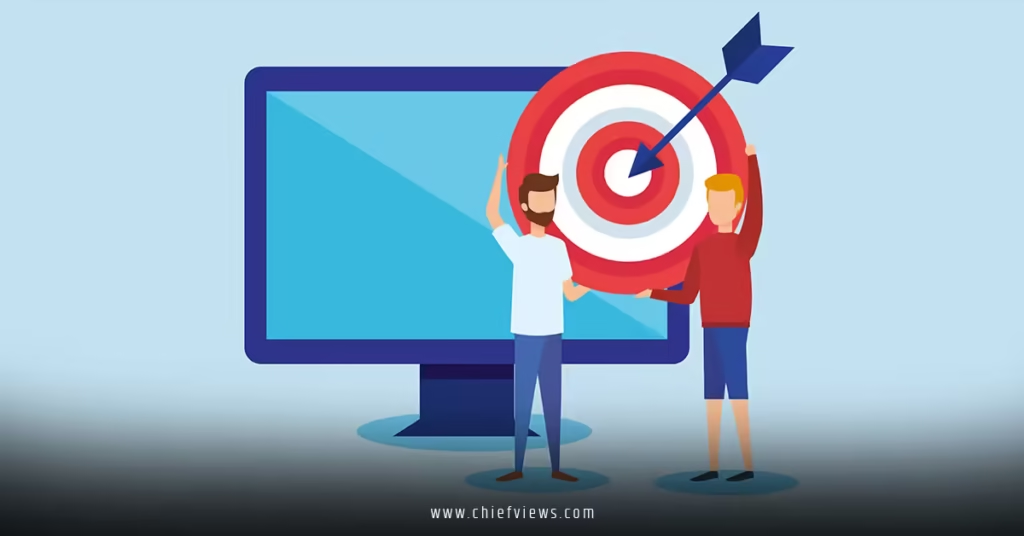
Imagine three concentric circles — like a dartboard or bullseye target.
- Outer Ring (What’s Possible?) → Brainstorm every realistic (and semi-realistic) growth channel for your business. SEO, TikTok ads, podcast sponsorships, direct mail, affiliate programs, billboard trucks… literally everything.
- Middle Ring (What’s Probable?) → Run fast, cheap, data-driven tests on every channel from the outer ring. Spend real money, but only enough to get statistically meaningful signals.
- Inner Ring (What’s Working NOW?) → Double, triple, and quadruple down on the 1–3 channels that clearly outperform everything else. This becomes your “traction channel” — the engine of your growth for the next 6–24 months.
That’s it. Three rings. Zero fluff. Pure focus.
This is why the Bullseye Traction Framework sits at the very heart of almost every successful data-driven growth marketing framework used by modern growth teams.


Why the Bullseye Traction Framework Beats Traditional Marketing Plans Every Time
Most marketing strategies fail because they start with tactics instead of testing. You pick SEO because “everyone says it’s good,” or you blow six figures on Facebook ads because your competitor did.
The Bullseye Framework flips the script: you test first, believe later.
You’re no longer married to a channel because of opinion, ego, or agency upsell. You’re married to the one or two channels your actual customers prove they love — with their wallets.
The 3 Rings of the Bullseye Traction Framework Explained Step-by-Step
Outer Ring: Brainstorm Like Crazy (The “What’s Possible?” Phase)
Goal: Generate 15–25 potential traction channels. Typical channels include:
- Content marketing & SEO
- Paid ads (Google, Meta, TikTok, LinkedIn, YouTube)
- Viral & referral marketing
- Affiliate programs
- PR and media outreach
- Community building (Reddit, Discord, Slack)
- Offline ads (billboards, direct mail, events)
- Business development & partnerships
- Email marketing
- Sales and outbound
Pro tip: Steal shamelessly. Look at your top 5 competitors and reverse-engineer every channel they’re using. Add those to your outer ring automatically.
Middle Ring: Run Cheap, Fast Tests (The “What’s Probable?” Phase)
This is where most people chicken out — and where winners separate from the pack.
Rules for middle-ring testing:
- Spend real money (no “organic only” delusions)
- Set a strict budget per test ($500–$5,000 depending on stage)
- Define success before you start (e.g., CPA under $150, or 8% conversion rate)
- Run the test for 2–4 weeks maximum
- Track everything in your analytics (this is why being inside a solid data-driven growth marketing framework is non-negotiable)
Example: DuckDuckGo spent just $1,000 testing Reddit ads early on. It became their #1 channel for years.
Inner Ring: Go All-In on Your Traction Channel (The “What’s Working?” Phase)
When a channel passes your middle-ring test with flying colors, you stop testing and start scaling.
You reallocate 80%+ of your marketing budget and headcount to that single channel until it shows signs of saturation. Then — and only then — you start testing the next outer-ring ideas again.
This relentless focus is why most breakout companies seem to “appear overnight.” They didn’t. They just obsessed over one channel longer than everyone else.
Real Companies That Owe Their Growth to the Bullseye Traction Framework
DuckDuckGo → Reddit Ads
Tested 19 channels. Reddit crushed everything. They scaled it for almost a decade before diversifying.
Mint.com → Content + PR
Aaron Patzer tested SEO, blogs, and PR stunts. A single launch on TechCrunch drove 100,000+ signups in days. They doubled down on PR and content until Intuit bought them for $170 M.
Gymshark → Instagram Influencers
Before it was “obvious,” Ben Francis tested Facebook ads, Google ads, and trade shows. Instagram nano-influencers in the fitness niche won. He went all-in and built a billion-dollar brand.
How to Implement the Bullseye Traction Framework in Your Business This Month
Week 1: Build Your Outer Ring
Run a 60-minute brainstorm with your team. Use the 19 channels from Traction as a starting point. Add 5–10 more that are unique to your industry.
Week 2–3: Execute 5–10 Middle-Ring Tests
Pick the 5–10 most promising channels. Launch small, trackable campaigns. No perfectionism allowed.
Week 4: Analyze and Choose Your Inner Ring
Look at cost per acquisition, LTV:CAC projections, and speed of scaling. Pick your winner(s). Kill or pause everything else.
Ongoing: The 20% Rule
Once you have a clear traction channel, keep 20% of your budget for continual outer/middle-ring testing. Markets change. Your next massive channel is waiting to be discovered.
Common Mistakes That Destroy the Bullseye Traction Framework
- Falling in love with too many channels (“We’re an omnichannel brand!” = code for unfocused)
- Testing without spending real money
- Declaring a channel dead after one poorly executed test
- Never graduating anything to the inner ring
- Ignoring the data because “we’re a creative brand”
The Bullseye Framework vs. Other Popular Systems
| Framework | Best For | Key Difference |
|---|---|---|
| Bullseye Traction | Finding your first scalable channel | Channel-focused |
| ICE/RICE | Prioritizing experiments | Experiment-focused |
| AARRR (Pirate Metrics) | Diagnosing funnel leaks | Stage-focused |
| Growth Accounting | Measuring retention vs. acquisition | Cohort-focused |
The truth? The Bullseye Traction Framework is the foundation. Once you nail your traction channel, you layer the others on top inside a broader data-driven growth marketing framework.
Final Verdict: Is the Bullseye Traction Framework Still Relevant in 2025?
More than ever.
With rising ad costs, cookie deprecation, and AI-generated content flooding the internet, the ability to rapidly test and find one unfairly advantaged channel is the ultimate competitive moat.
The companies winning right now aren’t the ones doing 19 things adequately. They’re the ones doing 1–2 things obsessively well — because the Bullseye Framework told them exactly where to aim.
Stop scattering your energy. Draw your three rings today, and fire your first arrow by the end of the week.
Your traction channel is waiting.