







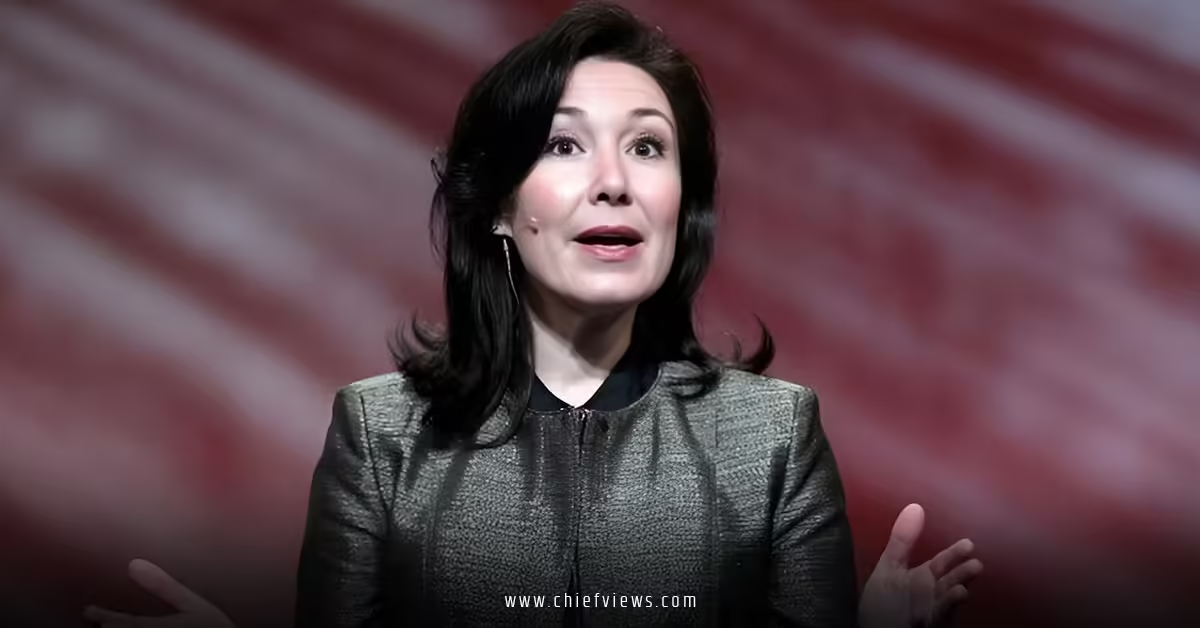
Safra Catz Oracle leadership legacy is one of the most underrated – yet most profitable – stories in modern tech history. She didn’t invent Oracle’s core products, she didn’t write a single line of code, and she never chased the spotlight like some Silicon Valley rock-star CEOs. Yet between 2014 and 2025, this former investment banker took a company that many had written off as a legacy has-been and transformed it into the fastest-growing hyperscale cloud player on the planet. By the time she handed the CEO baton to co-CEOs Clay Magouyrk and Mike Sicilia in September 2025, Oracle’s market cap had tripled, cloud revenue was growing 50%+ year-over-year, and the company had become the infrastructure backbone for frontier AI training. Not bad for someone who once told analysts, “I’m just here to make money for shareholders – nothing else.”
Let’s unpack the Safra Catz Oracle leadership legacy in all its ruthless, brilliant, and occasionally controversial glory.
From Wall Street Shark to Oracle Co-Pilot (1999–2014)
Safra Ada Catz didn’t stroll into Oracle – she was recruited them. In 1999, while still a managing director at Donaldson, Lufkin & Jenrette, she led the banking team that defended Oracle against a hostile takeover attempt. Larry Ellison was so impressed he basically said, “Come work for me instead.” She joined as an executive vice president and board member that same year.
Over the next decade, Catz became Ellison’s financial enforcer during the legendary “Applications Unlimited” acquisition spree. PeopleSoft ($10.3B), Siebel ($5.8B), Hyperion ($3.3B), BEA ($8.5B) – Catz was in the war room for every single one, negotiating terms, squeezing synergies, and terrifying target-company CEOs with her trademark stare-downs. By 2008 she was already the highest-paid female executive in America, pulling in $54 million that year alone.
When Mark Hurd joined as co-president in 2010, the Larry-Mark-Safra triumvirate was born. After Hurd’s sudden passing in 2019, Catz became sole CEO in all but name, even though she and Ellison playfully insisted they were “co-CEOs” for a while.

The Safra Catz Oracle Leadership Legacy in Numbers (2014–2025)
Here’s the part investors love to tattoo on their forearms:
- Oracle stock: +580% total return from Sep 2014 to Sep 2025 (outperforming the S&P 500 by ~3×)
- Cloud revenue: from ~$1B in 2016 → $20B+ run-rate by mid-2025
- Remaining Performance Obligations (RPO): exploded from $24B in 2020 to $138B by Q1 FY2026 – the clearest proof that customers are locking in for years
- Market cap: crossed $500B for the first time under her watch
- Total shareholder return during her CEO tenure: ~$120 billion in dividends and buybacks
She achieved all this while keeping non-GAAP operating margins above 45% – something even Microsoft and Google can only dream about at scale.

The Secret Sauce: How Safra Actually Did It
1. She Bet the Farm on Gen 2 Cloud – and Won
While AWS, Azure, and GCP were busy selling virtual machines, Catz and Ellison quietly built Oracle Cloud Infrastructure (OCI) from scratch with one obsession: be the best platform for running Oracle Database and for training massive AI models. Autonomous Database, heat-free data centers, bare-metal GPU clusters – every decision traced back to “How do we make customers never want to leave?”
2. She Weaponized the Installed Base
Instead of apologizing for having 430,000 database customers, she turned them into a $20B+ cloud migration pipeline. “Multicloud” wasn’t marketing fluff – it was a trojan horse to get OCI into every Fortune 500 data center.
3. She Mastered the Mega-Deal
OpenAI, xAI, Meta, Zoom, Uber, Nvidia partnerships – these weren’t won with slick PowerPoints. Catz personally flew to customer HQ’s (yes, even during COVID) and negotiated 10-year, billion-dollar commitments that made Wall Street’s jaw drop.
4. She Ran Oracle Like a Private Equity Portfolio Company
Cost cutting? Ruthless. Headcount discipline? Legendary. CapEx only if it directly moved the cloud needle. She once killed an entire product line mid-earnings call because margins were 150 basis points too low. Analysts were stunned. Stock went up.
The Controversial Side of the Safra Catz Oracle Leadership Legacy
Not everything was champagne and buybacks.
- Employees often described the culture under Catz as “fear-based.” Layoffs were sudden and deep, and stack-ranking never really went away.
- The 2016 NetSuite acquisition ($9.3B) triggered years of shareholder lawsuits alleging overpayment to benefit Larry Ellison (cleared in 2025, but the stain lingered).
- Her compensation – routinely $100M+ packages – made her a juicy target for governance critics.
Yet even detractors admit: the results were undeniable.
The Graceful Exit: September 2025 and Beyond
When Safra announced she was stepping down as CEO and moving to Executive Vice Chair, there were zero gasps of surprise in Redwood Shores. She had spent two years grooming the next generation and building a war chest of talent and cash. The co-CEO structure (Magouyrk + Sicilia) was vintage Catz: unconventional, bold, and engineered to prevent any single point of failure.
Crucially, she didn’t ride off into the sunset. As Executive Vice Chair, she still chairs the board’s finance and audit committee and works daily with Larry Ellison on strategy and M&A. Translation: Safra is still very much in the game.
And in a move that perfectly symbolizes continuity, she personally championed the promotion of 25-year Oracle veteran Douglas Kehring to principal financial officer – effectively handing him the financial reins to someone who understands every skeleton and treasure chest in the company. Curious how that transition is playing out? → Read the full breakdown here: Oracle COO Douglas Kehring role after Safra Catz CEO transition.
Final Verdict on the Safra Catz Oracle Leadership Legacy
Safra Catz didn’t seek to be loved. She sought to win – and she won bigger than almost anyone in enterprise tech history.
She took a company that was mocked as “the IBM of the 2010s,” turned it into the infrastructure darling of the GenAI era, delivered obscene shareholder value, and exited at the absolute peak without a single scandal sticking. That’s not just a successful CEO tenure – that’s a Hall-of-Fame career.
Larry Ellison summed it up best in the September 2025 all-hands:
“Safra didn’t just run Oracle. She rebuilt it – brick by brick, contract by contract, quarter by quarter – into the most valuable enterprise software company on Earth. And she made it look easy.”
For anyone studying great leadership, the Safra Catz Oracle leadership legacy isn’t just a case study.
It’s the masterclass.
Quick-Read FAQs About Safra Catz Oracle Leadership Legacy
How much wealth did Safra Catz create for Oracle shareholders?
Approximately $450 billion in market-cap gains from 2014–2025, plus $120B returned via dividends/buybacks.
Was Safra Catz the highest-paid female CEO ever?
Yes – multiple years above $100M total compensation, peaking at $138M in 2022.
Why did Safra Catz step down at the top of her game?
She called it “passing the baton at a moment of maximum strength” to a younger generation already proven in cloud and AI.
Is Safra Catz still involved at Oracle?
Absolutely – as Executive Vice Chair and chair of the finance committee, she remains one of the three most powerful people in the company alongside Larry Ellison and the co-CEOs.
Who is managing Oracle’s finances now that Safra stepped back from day-to-day CEO duties?
Long-time operations leader Douglas Kehring was promoted to principal financial officer. Full details → Oracle COO Douglas Kehring role after Safra Catz CEO transition


