





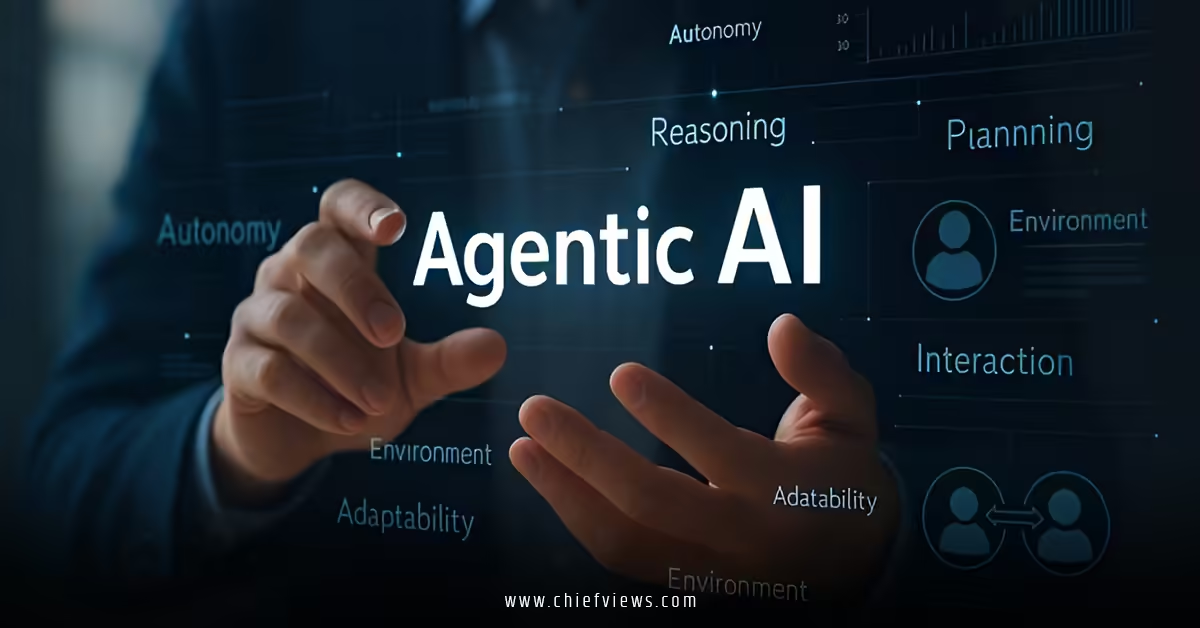
In January 2026, something profound is happening inside forward-thinking companies. Agentic AI isn’t just another tool—it’s quietly becoming the new digital workforce. These autonomous systems don’t wait for instructions; they plan, reason, adapt, and execute entire multi-step processes with minimal human oversight. If you’re wondering how this fits into the bigger picture, understanding agentic AI in business workflows is essential to grasping how CEOs can lead AI transformation in 2026—because agentic systems represent the practical engine driving that transformation.
Gone are the days of simple chatbots or basic automation. Today, agentic AI handles complex, goal-oriented tasks across departments, turning rigid processes into intelligent, adaptive flows. Let’s explore what this means, why it’s exploding now, and how businesses are putting it to work.
What Exactly Is Agentic AI?
Agentic AI refers to intelligent systems that act autonomously toward specific goals. Unlike traditional AI that responds reactively to prompts, agentic agents:
- Break down objectives into plans
- Use tools, APIs, and memory to gather information
- Make decisions in real time
- Execute actions across multiple systems
- Learn from outcomes and improve
Think of them as digital colleagues with initiative. They don’t just suggest—they do.
This leap comes from advances in large language models, better reasoning patterns (like ReAct, reflection, and planning), and protocols such as Model Context Protocol (MCP) that let agents securely connect to enterprise tools.
Here are a few visual examples of how agentic AI structures these autonomous workflows:



These diagrams show the shift from linear automation to dynamic, branching agentic processes—exactly the kind of architecture powering real business value today.
Why 2026 Is the Breakthrough Year for Agentic AI in Business
Gartner predicts that by the end of 2026, 40% of enterprise applications will include task-specific AI agents—up dramatically from less than 5% just a year ago. McKinsey reports that 23% of organizations are already scaling agentic systems in at least one function, with many more experimenting.
The market tells the same story: agentic AI is projected to grow from around $8 billion in 2025 to over $50 billion by 2030. Why the surge?
- Maturing technology: Better memory, tool use, and multi-agent collaboration
- Proven ROI: Faster processes, lower costs, fewer errors
- Workforce pressure: Talent shortages make autonomous execution a necessity
- Competitive urgency: Early adopters are gaining massive advantages
This acceleration directly ties into how CEOs can lead AI transformation in 2026—agentic AI provides the concrete mechanism to move from pilots to production-scale impact.
Real-World Applications: Agentic AI Transforming Key Business Workflows
Let’s look at where agentic AI delivers the biggest wins in 2026.
Customer Service & Support
Agents now own entire end-to-end customer journeys. They:
- Interpret complex inquiries across email, chat, and voice
- Pull data from multiple systems (CRM, billing, knowledge bases)
- Resolve issues autonomously
- Escalate only true exceptions to humans
Result? Average handling times drop 25-60%, and customer satisfaction climbs.
Supply Chain & Operations
In logistics, agentic systems monitor real-time signals (demand, weather, delays), rebalance inventory, negotiate with suppliers, and reroute shipments—all without constant human input.
One powerful visual of this orchestration in action:
Finance & Procurement
From processing insurance claims using mixed data (emails, images, policies) to reconciling anomalies across ledgers, agentic agents reduce manual effort dramatically while improving accuracy and fraud detection.
Sales & Marketing
Specialized agents qualify leads, personalize outreach, schedule meetings, and even negotiate initial terms—freeing reps to focus on high-value relationships.
Here’s another illustration of how agents collaborate across enterprise departments:

Key Benefits of Integrating Agentic AI into Business Workflows
- Massive Productivity Gains — Routine and complex tasks handled autonomously
- Speed & Agility — Real-time decisions without bottlenecks
- Cost Efficiency — Lower operational expenses through reduced manual labor
- Scalability — Handle volume spikes without proportional headcount growth
- Better Outcomes — Fewer errors, continuous learning, consistent execution
When implemented thoughtfully, these benefits compound into the kind of competitive moat that defines market leaders in 2026.
Challenges & How Smart Leaders Overcome Them
Of course, it’s not all smooth sailing. Gartner warns that over 40% of agentic projects could face cancellation by 2027 due to costs, unclear value, or weak governance.
Common pitfalls include:
- Poor data foundations
- Lack of bounded autonomy (guardrails)
- Resistance to workflow redesign
- Inadequate human oversight
Successful companies address these by starting small, redesigning processes around agents (not layering them on legacy systems), implementing strong governance (including “guardian agents”), and treating agents like new team members that need training and supervision.
The Leadership Imperative: How Agentic AI Fits into Broader AI Transformation
Mastering agentic AI in business workflows isn’t optional—it’s the practical pathway for how CEOs can lead AI transformation in 2026. Visionary leaders who:
- Appoint dedicated AI orchestration roles
- Invest in clean, real-time data architecture
- Foster cross-functional agent teams
- Prioritize trust, governance, and continuous upskilling
…are the ones building resilient, future-proof organizations.
Final Thoughts: Your Next Move in the Agentic Era
2026 is the year agentic AI stops being a futuristic concept and becomes core infrastructure. Businesses that embrace autonomous, goal-driven workflows will operate faster, smarter, and more efficiently than ever before.
The question isn’t whether agentic AI will transform your industry—it’s whether you’ll lead that change or follow. Start small, focus on high-impact workflows, govern responsibly, and watch your organization evolve into something truly intelligent.
The agentic future is here. Are you ready to orchestrate it?
FAQ :
1. What is the main difference between traditional automation and agentic AI in business workflows?
Traditional automation follows fixed, rule-based scripts — if X happens, always do Y. Agentic AI, on the other hand, can reason, plan multi-step processes, use tools dynamically, adapt to new information, and pursue goals with minimal human guidance. In 2026, this ability to handle complex, unstructured workflows is what makes agentic systems the core engine of how CEOs can lead AI transformation in 2026.
2. Which business functions are seeing the fastest adoption of agentic AI in workflows right now (early 2026)?
Customer support, procurement, finance operations (AP/AR reconciliation, claims processing), supply chain orchestration, and sales development are leading the pack. Companies are reporting 40–70% faster cycle times and 25–60% reduction in manual effort in these areas. Early movers using agentic AI here are gaining significant advantages in operational speed and cost efficiency — exactly the kind of pragmatic scaling that defines successful leadership in how CEOs can lead AI transformation in 2026.
3. How much does it typically cost to implement agentic AI in business workflows in 2026?
Costs vary widely depending on scope. Small pilot projects using off-the-shelf agent platforms (like CrewAI, LangGraph, or enterprise versions of OpenAI, Anthropic, or Microsoft agents) can start at $50,000–$150,000 for 3–6 months. Full enterprise deployments with custom agents, secure tool integrations, governance layers, and ongoing optimization often range from $500,000 to several million in the first year. Smart CEOs focus on high-ROI use cases first to prove value quickly — a key principle in how CEOs can lead AI transformation in 2026.
4. Is agentic AI going to replace a lot of jobs in business workflows in 2026–2027?
Not outright replacement — more like massive augmentation and role evolution. Agentic systems are taking over repetitive, rules-heavy, multi-step transactional work (data gathering, reconciliation, basic decision execution). This frees humans to focus on judgment, creativity, relationship-building, strategy, and exception handling. Organizations that communicate this shift transparently and invest in upskilling are seeing higher employee engagement — another critical success factor when figuring out how CEOs can lead AI transformation in 2026.
5. How does Agentic AI connect to the bigger picture of how CEOs can lead AI transformation in 2026?
Agentic AI is currently the most practical, high-leverage way for CEOs to deliver visible, scaled business impact from AI in 2026. While earlier years focused on experimentation and generative pilots, 2026 is the year of execution. Agentic systems turn AI from a productivity sidekick into the actual engine running core workflows — faster, cheaper, and more consistently than humans alone could manage. CEOs who master agent orchestration, data foundations, governance, and change management around agentic workflows are the ones creating unassailable competitive advantages right now.