




AI marketing automation stands out as the powerhouse that’s redefining how teams operate, personalize, and scale campaigns. Gone are the days of manual email drips and guesswork timing—now, intelligent systems predict customer behavior, craft hyper-relevant messages, and optimize in real time. For modern CMOs juggling tight budgets and sky-high expectations, mastering AI marketing automation isn’t optional; it’s essential for staying competitive.
This comprehensive guide dives deep into what AI marketing automation really means in 2026, the top tools driving results, emerging trends, and practical ways to implement it. Whether you’re leading a growing startup or steering an enterprise ship, you’ll walk away with actionable insights to boost efficiency and ROI. And if you’re exploring the broader landscape, check out our earlier deep dive on the best marketing tools for modern CMOs—many of the heavy hitters here overlap seamlessly.
What Exactly Is AI Marketing Automation in 2026?
Picture this: Traditional marketing automation was like setting a thermostat—once programmed, it runs steadily. AI marketing automation flips the script by making that thermostat smart: it learns from every interaction, adjusts temperatures (metaphorically, campaigns) on the fly, and even anticipates when someone might feel too cold (or ready to buy).
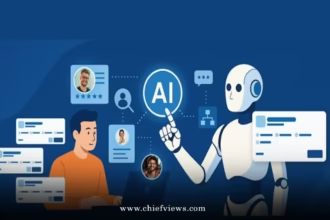
At its core, AI marketing automation combines rule-based workflows with machine learning, generative AI, predictive analytics, and natural language processing. Platforms now:
- Score leads based on real-time behavior
- Generate personalized content at scale
- Orchestrate omnichannel journeys autonomously
- Optimize campaigns continuously without constant human tweaks
According to industry reports, by 2026, around 80% of marketing automation will be AI-powered, delivering up to 27% higher conversion rates and 42% more content output for teams that embrace it fully. The shift isn’t just technological—it’s strategic, moving CMOs from reactive managers to proactive visionaries.


Why AI Marketing Automation Matters More Than Ever for CMOs
Ask any modern CMO: “What’s your biggest headache?” Chances are, it’s one of these—scaling personalization without exploding headcount, proving ROI in a cookieless world, or keeping up with fragmented customer journeys across channels.
AI marketing automation tackles all of them head-on. It frees teams from repetitive tasks so they focus on creative strategy and human connection. It delivers hyper-personalization that feels genuine, not creepy. And it provides predictive insights that turn data overload into clear, revenue-driving decisions.
In short, adopting the right AI marketing automation setup can be the difference between hitting targets and exceeding them spectacularly.
Top AI Marketing Automation Tools to Consider in 2026
Let’s get practical. Here are some of the standout platforms shaping AI marketing automation right now, with real strengths, ideal use cases, and honest caveats.
HubSpot Marketing Hub with Breeze AI
HubSpot remains a favorite for good reason—it’s an all-in-one inbound powerhouse that’s gotten seriously smarter with AI. Breeze AI handles content generation, predictive lead scoring, conversation intelligence, and workflow suggestions.
Pros: Seamless CRM integration, user-friendly for growing teams, excellent free-to-scale path. Cons: Can get pricey at enterprise levels; best for inbound-focused strategies. Best for: Mid-market CMOs building sustainable growth engines.
Many teams start here when exploring the best marketing tools for modern CMOs because it connects so many dots.
Klaviyo with K:AI
For eCommerce and direct-to-consumer brands, Klaviyo dominates AI marketing automation in flows, campaigns, and segmentation. K:AI automates personalization, predicts churn, and suggests optimizations.
Pros: Laser-focused on revenue impact, stellar for SMS/email synergy. Cons: Less ideal for pure B2B complex journeys. Best for: Brands where every send directly ties to sales.
ActiveCampaign
ActiveCampaign shines with powerful, conditional workflows enhanced by AI for campaign building and predictive sending. It’s affordable yet feature-rich.
Pros: Deep customization, strong automation logic, great value. Cons: Steeper learning curve for beginners. Best for: Teams wanting sophisticated automation without enterprise costs.
Adobe Marketo Engage
Enterprise-grade AI marketing automation with journey orchestration, ABM support, and predictive analytics.
Pros: Handles massive scale, deep B2B capabilities. Cons: Complex setup, higher investment. Best for: Large organizations with complex needs.
Salesforce Marketing Cloud with Einstein AI
Einstein powers content recommendations, engagement scoring, and journey optimization across channels.
Pros: Unmatched integration within Salesforce ecosystem, advanced AI. Cons: Overkill (and expensive) for smaller teams. Best for: Enterprises already in the Salesforce world.
Zapier for AI Orchestration
Not a traditional platform, but Zapier connects everything with AI-powered zaps, turning disparate tools into unified automation.
Pros: Extremely flexible, no-code friendly. Cons: Relies on underlying apps’ AI features. Best for: Custom workflows bridging multiple tools.
Other rising stars include Gumloop for no-code AI automations, Lindy for agentic workflows, and tools like Brevo or Omnisend for budget-conscious all-in-one solutions.

Key Trends Shaping AI Marketing Automation in 2026
The landscape evolves rapidly—here’s what forward-thinking CMOs are watching closely.
From Automation to Elevation
2026 marks the pivot from mere task automation to AI elevation—using intelligence to create better, more curated experiences rather than just more volume. AI agents handle orchestration while humans focus on strategy and creativity.
Hyper-Personalization at Scale
Predictive analytics and real-time data make every message feel one-to-one, boosting engagement dramatically.
Autonomous Campaign Optimization
AI tests variations, adjusts budgets, and refines targeting continuously—less manual A/B testing, more always-on improvement.
Privacy-First Intelligence
With regulations tightening, tools emphasize first-party data and consent-driven personalization.
Agentic Workflows and Multi-Modal AI
Expect more autonomous agents that plan, execute, and learn across text, image, and video.
How to Implement AI Marketing Automation Successfully
Ready to dive in? Start small:
- Audit your current stack—identify repetitive tasks ripe for automation.
- Pick one high-impact area (e.g., lead nurturing or email personalization).
- Choose a tool that integrates well (many link back to the best marketing tools for modern CMOs ecosystem).
- Train your team—AI works best with human oversight.
- Measure obsessively—track ROI, not just activity.
- Scale gradually, adding channels and complexity.
Pro tip: Use integration platforms like Zapier early to avoid silos.
Common Challenges and Smart Solutions
Challenge: Overwhelm from too many options. Solution: Prioritize based on your biggest pain point.
Challenge: Data privacy concerns. Solution: Opt for tools with strong compliance features.
Challenge: Keeping the human touch. Solution: Always review AI outputs—use it as a co-pilot, not autopilot.
The Future Outlook for AI Marketing Automation
Looking ahead, expect deeper integration of generative video/audio, more ethical AI governance, and seamless blending of marketing-sales-service automation. The winners will be teams that treat AI as an amplifier of human ingenuity.
Conclusion: Level Up with AI Marketing Automation Today
AI marketing automation has evolved from nice-to-have to must-have in 2026. Platforms like HubSpot, Klaviyo, and ActiveCampaign—along with orchestration tools like Zapier—empower CMOs to deliver personalized, efficient, and measurable results at unprecedented scale. By embracing these technologies thoughtfully, you don’t just keep up—you pull ahead.
Don’t wait for the perfect moment. Pick one tool, run a pilot, and watch the impact unfold. Your future self (and your revenue numbers) will thank you.
Ready to explore more? Dive back into the best marketing tools for modern CMOs for the full toolkit overview.
FAQs on AI Marketing Automation
What is the difference between traditional marketing automation and AI marketing automation?
Traditional automation follows fixed rules you set, while AI marketing automation learns, predicts, and adapts in real time for smarter, more dynamic campaigns.
Which AI marketing automation tool is best for small teams in 2026?
ActiveCampaign or HubSpot’s entry tiers offer powerful AI marketing automation features at accessible prices, with strong scalability as you grow.
How does AI marketing automation improve personalization?
It analyzes behavior, preferences, and context to deliver tailored content, timing, and offers—often boosting engagement by 20-30% or more.
Is AI marketing automation worth the investment for B2B companies?
Absolutely—predictive scoring, ABM orchestration, and journey intelligence drive higher-quality leads and shorter sales cycles in complex B2B environments.
Can AI marketing automation replace human marketers?
No—it augments them. The best results come from combining AI’s speed and scale with human creativity, empathy, and strategic oversight.