





Picture this: It’s 2026, and your enterprise’s supply chain isn’t just monitored—it’s proactively managed. An AI agent spots a potential delay in shipping, cross-references real-time weather data, reroutes inventory from an alternative warehouse, updates suppliers, notifies stakeholders, and logs everything for compliance—all without a single human ping. That’s not sci-fi; that’s agentic AI workflows in enterprise today, and they’re reshaping how large organizations operate at scale.
Agentic AI workflows represent the leap from passive tools (like chatbots or code assistants) to autonomous systems that plan, reason, act, and adapt. Unlike traditional automation, these workflows own outcomes end-to-end, making decisions in dynamic environments. As we hit 2026, enterprises are no longer asking “if” but “how fast” to deploy them. Gartner predicts that 40% of enterprise applications will embed task-specific AI agents by the end of 2026, up dramatically from under 5% just a year prior. McKinsey’s surveys show over 60% of organizations experimenting with AI agents, with many scaling them across functions.
Why the explosion now? Generative AI laid the foundation with content and insights, but agentic systems deliver action. They bridge the gap between intelligence and execution, turning AI from a helper into a digital coworker. If you’re exploring this space, understanding agentic AI workflows in enterprise is key to staying competitive—and it ties directly into how to build AI-native development platforms for enterprise 2026, where these workflows form the intelligent core.
What Exactly Are Agentic AI Workflows?
At its heart, an agentic AI workflow is a goal-oriented loop powered by AI agents. These agents don’t just respond to prompts; they break down complex objectives, select tools, execute steps, reflect on results, and iterate until success.
Key components include:
- Perception — Gathering context from data sources, APIs, or sensors.
- Planning & Reasoning — Decomposing goals using chain-of-thought or tree-of-thought logic.
- Tool Use — Calling external systems (databases, CRMs, cloud services).
- Action & Execution — Performing tasks autonomously.
- Reflection & Memory — Learning from outcomes to improve future runs.
- Orchestration — Coordinating multiple specialized agents in multi-agent systems.
Think of it like a virtual team: A “researcher” agent gathers data, a “planner” outlines steps, an “executor” runs actions, and a “supervisor” ensures alignment. This isn’t linear RPA; it’s adaptive intelligence handling ambiguity, exceptions, and long-running processes.
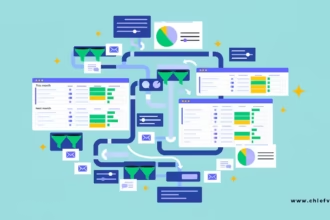

In enterprise settings, these workflows shine because they scale human-like decision-making without scaling headcount. Deloitte’s insights emphasize that true value emerges when organizations redesign operations around agents rather than layering them onto old processes.
Why Agentic AI Workflows Matter for Enterprises in 2026
Enterprises face relentless pressure: faster cycles, lower costs, better compliance, and personalized experiences. Traditional automation hits walls with variability and judgment calls. Agentic workflows smash through those barriers.
Benefits include:
- Massive efficiency gains — Automating multi-step processes that once required teams.
- Proactive operations — Agents anticipate issues instead of reacting.
- Scalability without burnout — Handle peak loads or 24/7 demands effortlessly.
- Human augmentation — Free employees for creative, strategic work.
Forrester notes that by 2026, enterprises will grapple with orchestrating “digital workforces,” where agents become role-based contributors. McKinsey highlights that reimagining workflows around agents yields far higher ROI than incremental tweaks. And with Gartner warning that over 40% of agentic projects could fail by 2027 due to poor governance or legacy mismatches, getting the foundation right is critical.
This is where linking back to how to build AI-native development platforms for enterprise 2026 becomes essential: These platforms provide the modular, governed environments where agentic workflows thrive natively.
Real-World Use Cases Transforming Enterprises
Agentic AI workflows are already delivering in production across industries.
Customer Service & Experience
An agent handles end-to-end support: It analyzes tickets, pulls CRM history, queries knowledge bases, drafts personalized responses, escalates if needed, and follows up for satisfaction. Salesforce’s Agentforce exemplifies this, turning agents into seamless collaborators that boost resolution times and CSAT.
Finance & Compliance
In banking, agents automate loan processing: Verify documents, assess risk via real-time data, flag anomalies, route approvals, and ensure regulatory adherence. IBM highlights phased adoption starting with low-risk steps to build trust.
Supply Chain & Operations
Agents optimize logistics: Monitor inventory, predict disruptions, renegotiate with suppliers, and adjust forecasts. Forbes predicts multi-agent systems will run entire production pipelines in 2026.
IT & DevOps
From incident response to code deployment: An agent triages alerts, diagnoses root causes, applies fixes, tests changes, and deploys—all while documenting for audits.
HR & Talent Management
Agents manage onboarding: Generate personalized plans, schedule trainings, handle paperwork, and monitor progress, evolving into full “digital employees.”
These examples show agentic workflows aren’t niche; they’re enterprise-wide game-changers when built thoughtfully.
How to Implement Agentic AI Workflows Successfully
Ready to dive in? Here’s a practical roadmap:
- Start with Clear Goals & Use Cases
Pick high-impact, well-defined processes. Avoid boiling the ocean—pilot one workflow (e.g., ticket resolution) before scaling. - Build or Choose the Right Foundation
Leverage platforms with strong orchestration, like those discussed in how to build AI-native development platforms for enterprise 2026. Tools from AWS Bedrock, Google Vertex, or open frameworks enable multi-agent setups. - Design Robust Architecture
- Use retrieval-augmented generation (RAG) for accurate context.
- Implement memory layers for long-term learning.
- Enable human-in-the-loop for high-stakes decisions.
- Focus on modularity for easy updates.
- Prioritize Governance & Security
Deloitte stresses redesigning for trust: Audit trails, explainability, role-based access, and compliance checks. Without this, adoption stalls. - Measure & Iterate
Track metrics like automation rate, error reduction, time saved, and business impact. Use feedback loops to refine agents. - Upskill Your Team
Shift mindsets from coding agents to orchestrating them. Foster collaboration between AI engineers, domain experts, and compliance teams.
Common pitfalls? Over-relying on legacy systems, skipping redesign, or neglecting data quality. Leading organizations succeed by treating agents as strategic assets.
Challenges and the Path Forward
No transformation is frictionless. Data silos, integration complexity, ethical risks, and cost overruns loom large. Gartner cautions that many projects falter without proper orchestration.
The fix? Adopt a phased, governed approach. Start small, prove value, then expand. As 2026 unfolds, enterprises mastering agentic AI workflows will outpace those still stuck in generative-only mode.
Conclusion: Embrace Agentic AI Workflows to Future-Proof Your Enterprise
Agentic AI workflows in enterprise aren’t a trend—they’re the next paradigm. By enabling autonomous, adaptive execution, they unlock productivity leaps, operational resilience, and innovation speed. In 2026, the winners won’t just use AI; they’ll orchestrate intelligent workflows that run the business.
If you’re building toward this future, remember: Strong agentic capabilities stem from solid AI-native platforms. Dive deeper into how to build AI-native development platforms for enterprise 2026 to create the ideal environment for these workflows.
The era of the agentic enterprise is here. Are you ready to let AI take the wheel?
For more insights, explore Gartner’s AI predictions, Deloitte’s Tech Trends on agentic AI, and McKinsey’s State of AI report.
FAQs
What makes agentic AI workflows different from traditional automation in enterprises?
Traditional automation follows rigid scripts, while agentic workflows use reasoning, planning, and adaptation to handle dynamic, complex tasks autonomously.
How do agentic AI workflows integrate with existing enterprise systems?
Through APIs, tool-calling mechanisms, and orchestration layers—often built on cloud-native platforms that support secure, governed access.
What industries benefit most from agentic AI workflows right now?
Finance, customer service, supply chain, IT operations, and healthcare see the fastest gains due to high-volume, multi-step processes with variability.
Can small to mid-sized enterprises adopt agentic AI workflows effectively?
Yes—start with cloud-based tools and focused pilots. The barrier is lowering as platforms mature and costs drop.
How does agentic AI workflows relate to building AI-native development platforms?
Agentic workflows are a core capability in AI-native platforms, requiring embedded orchestration, governance, and modularity for enterprise-scale success.