



Multi-agent AI systems for enterprise workflows are no longer a futuristic concept—they’re the practical way forward for organizations ready to move beyond single-agent experiments and into true collaborative intelligence. If you’re a leader tired of fragmented automation that only tackles one task at a time, this is where things get exciting.
Imagine a digital team where specialized AI agents work together like expert colleagues: one researches, another analyzes, a third executes, and a supervisor coordinates everything seamlessly. That’s exactly what multi-agent AI systems for enterprise workflows deliver. In this in-depth guide, we’ll unpack what they are, why they matter right now, how to implement them effectively, and the real results organizations are seeing.
Whether you’re building on foundational efforts in CIO AI Agents Workflow Optimization or starting fresh, you’ll find actionable strategies to transform complex, cross-functional processes into efficient, adaptive systems. Let’s explore how multi-agent AI systems for enterprise workflows can help you achieve breakthroughs in productivity, innovation, and scalability.
What Are Multi-agent AI Systems for Enterprise Workflows?
Multi-agent AI systems for enterprise workflows consist of multiple autonomous AI agents that collaborate to handle intricate, multi-step business processes. Unlike single agents that operate in isolation, these systems divide labor: each agent has specialized roles, tools, and expertise, while communicating, sharing memory, and coordinating actions toward common goals.
Think of it like a well-functioning sports team. One player (agent) excels at defense, another at strategy, and a coach (orchestrator) ensures everyone plays in sync. In enterprise settings, this means breaking down workflows—like supply chain management, customer onboarding, or financial reporting—into modular tasks that agents tackle together.
These systems leverage large language models for reasoning, combined with memory for context retention, tools for external actions (like API calls or data queries), and orchestration layers for seamless handoffs. The result is dynamic, resilient automation that adapts to exceptions, learns from outcomes, and scales across departments.
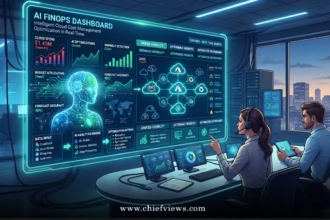

In the context of multi-agent AI systems for enterprise workflows, the focus shifts from simple task automation to end-to-end process ownership. This makes them ideal for complex environments where traditional tools fall short.
Why Multi-agent AI Systems for Enterprise Workflows Matter More Than Ever
By 2026, the pressure on enterprises is intense: rising complexity, talent shortages, and the need for real-time agility. Single-agent solutions handle isolated tasks well, but multi-agent AI systems for enterprise workflows excel at the big picture.
Gartner predicts that 40% of enterprise applications will embed task-specific AI agents by the end of 2026. Even more importantly, multi-agent orchestration is emerging as the breakthrough, enabling dozens or hundreds of specialized agents to collaborate on long-running processes like R&D pipelines or supply chain optimization.
This evolution builds naturally on CIO AI Agents Workflow Optimization. While individual agents optimize specific areas, multi-agent systems create a networked intelligence layer that connects workflows across the organization. The payoff? Faster decision-making, reduced manual coordination, and the ability to tackle problems that were previously too messy for automation.
Organizations ignoring this shift risk falling behind. Those adopting multi-agent AI systems for enterprise workflows report significant gains in efficiency and innovation, turning AI from a productivity booster into a true strategic asset.
Key Benefits of Multi-agent AI Systems for Enterprise Workflows
The advantages of multi-agent AI systems for enterprise workflows go far beyond basic automation. Here’s what stands out:
Superior Handling of Complexity
Complex workflows involve countless variables, exceptions, and interdependencies. A single agent often struggles, but a team of specialists shines. One agent might gather data, another validate compliance, and a third simulate outcomes—working in parallel for faster, more accurate results.
Enhanced Scalability and Resilience
These systems scale effortlessly. Add more agents as workloads grow, and the architecture self-heals when issues arise. It’s like having a flexible workforce that never burns out.
Improved Accuracy and Reduced Hallucinations
Specialization plus collaboration minimizes errors. Validator agents double-check outputs, while shared memory ensures consistency. Early adopters see dramatic drops in manual oversight needs.
Cost Efficiency and ROI
By automating end-to-end processes, organizations cut labor costs, minimize downtime, and optimize resources. Some report 30-60% improvements in workflow efficiency, directly impacting the bottom line.
Better Human-AI Collaboration
Agents handle the repetitive and analytical heavy lifting, freeing employees for creative, strategic work. This boosts morale and helps attract top talent who want to work alongside advanced AI.
Cross-Functional Integration
Multi-agent AI systems for enterprise workflows break down silos. Agents from finance, operations, and customer service can collaborate seamlessly, creating unified outcomes that were once impossible.
These benefits make multi-agent AI systems for enterprise workflows a powerful lever for competitive advantage.

Common Challenges in Deploying Multi-agent AI Systems for Enterprise Workflows
Success isn’t automatic. Many organizations encounter hurdles when implementing multi-agent AI systems for enterprise workflows.
Integration with Legacy Systems
Older infrastructure often resists modern AI. Solution? Start with API layers and pilot on modernized subsets of workflows.
Governance and Risk Management
With multiple agents acting autonomously, oversight is crucial. Over 40% of agentic AI projects risk cancellation due to unclear value or poor controls. Strong governance frameworks, role-based access, and human-in-the-loop mechanisms are non-negotiable.
Data Quality and Security
Agents need reliable data. Poor inputs lead to flawed outputs. Invest in data pipelines, encryption, and regular audits to build trust.
Skill Gaps and Change Management
Teams may lack experience with orchestration. Address this through targeted training and phased rollouts that demonstrate quick wins.
Cost Overruns
Without clear metrics, expenses can escalate. Define KPIs early and monitor relentlessly.
By anticipating these challenges, you set multi-agent AI systems for enterprise workflows up for sustainable success.
Step-by-Step Guide to Implementing Multi-agent AI Systems for Enterprise Workflows
Ready to get started? Follow this practical roadmap for multi-agent AI systems for enterprise workflows.
1. Map and Prioritize Workflows
Identify high-impact, complex processes with clear bottlenecks. Involve stakeholders to understand pain points and success criteria.
2. Define Agent Roles and Architecture
Design specialized agents (researcher, executor, validator, orchestrator) and map their interactions. Decide on hierarchical or peer-to-peer models based on needs.
3. Choose the Right Frameworks and Tools
Select platforms that support robust orchestration (more on this below). Ensure they integrate with your existing tech stack.
4. Build and Test Pilots
Start small. Develop a minimum viable multi-agent system for one workflow, test thoroughly, and gather feedback. Iterate rapidly.
5. Integrate, Scale, and Monitor
Connect agents to enterprise systems, implement monitoring dashboards, and expand to additional workflows. Maintain human oversight for critical decisions.
6. Establish Governance and Continuous Improvement
Set policies for ethics, compliance, and performance. Use feedback loops so the system learns and evolves.
This structured approach turns multi-agent AI systems for enterprise workflows from concept to production reality.
Top Tools and Frameworks Powering Multi-agent AI Systems for Enterprise Workflows
The ecosystem is rich. Popular options for multi-agent AI systems for enterprise workflows include:
- LangGraph: Graph-based orchestration for complex, stateful workflows with fine-grained control.
- CrewAI: Role-based teams that mimic human organizational structures—great for collaborative tasks.
- AutoGen: Flexible conversational coordination, ideal for iterative reasoning and research.
Enterprise platforms often combine these with strong security, monitoring, and no-code interfaces. When choosing, prioritize interoperability, scalability, and governance features.
Real-World Success Stories of Multi-agent AI Systems for Enterprise Workflows
Real examples prove the value. A global financial firm used multi-agent AI systems for enterprise workflows to automate compliance and risk analysis. Specialized agents handled data extraction, regulatory checks, and reporting—cutting processing time by over 60% while improving accuracy.
In retail, a major player deployed multi-agent systems for supply chain optimization. Agents predicted disruptions, adjusted inventory, and coordinated suppliers autonomously, resulting in fewer stockouts and substantial cost savings.
Healthcare organizations have applied them to patient journey management, with agents coordinating scheduling, records, and follow-ups for better outcomes and efficiency.
These cases show how multi-agent AI systems for enterprise workflows deliver measurable business impact.
Best Practices for Long-Term Success with Multi-agent AI Systems for Enterprise Workflows
For lasting results:
- Start with clear business outcomes, not technology for its own sake.
- Emphasize modularity so agents can be updated independently.
- Build in transparency—explainable decisions build trust.
- Foster a culture of experimentation and learning.
- Regularly review and refine based on performance data.
Responsible implementation ensures multi-agent AI systems for enterprise workflows remain ethical, secure, and aligned with organizational goals.
The Future of Multi-agent AI Systems for Enterprise Workflows
Looking ahead, expect tighter interoperability standards (like A2A protocols), deeper integration with physical systems, and increasingly autonomous swarms. Multi-agent AI systems for enterprise workflows will become the backbone of intelligent enterprises.
In conclusion
multi-agent AI systems for enterprise workflows represent a pivotal evolution in how organizations operate. By enabling collaborative, intelligent automation, they unlock efficiency, innovation, and resilience that single agents simply can’t match. Building on approaches like CIO AI Agents Workflow Optimization, these systems empower you to redesign work for the AI era. The technology is maturing rapidly—the real question is whether your organization will lead or follow. Start exploring today, and position yourself at the forefront of enterprise transformation.
Frequently Asked Questions (FAQs)
1. What makes multi-agent AI systems for enterprise workflows different from single-agent solutions?
Multi-agent AI systems for enterprise workflows involve collaborative teams of specialized agents, allowing them to handle complex, multi-step processes far more effectively than isolated single agents.
2. How do multi-agent AI systems for enterprise workflows improve ROI?
They automate end-to-end workflows, reduce manual intervention, minimize errors, and optimize resources, often delivering 30-60% efficiency gains and faster time-to-value.
3. What are the main challenges when adopting multi-agent AI systems for enterprise workflows?
Key challenges include integration complexities, governance needs, data quality, and ensuring human oversight—issues that can be managed with thoughtful planning and phased implementation.
4. Which frameworks are best for building multi-agent AI systems for enterprise workflows?
Popular choices include LangGraph for structured control, CrewAI for role-based collaboration, and AutoGen for conversational flexibility. The best fit depends on your specific workflow requirements.
5. Can smaller organizations implement multi-agent AI systems for enterprise workflows?
Yes—cloud-based and modular frameworks make them accessible. Starting with targeted pilots often yields quick wins even with limited resources.