


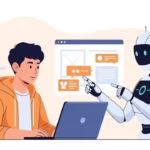


Agentic AI workforce strategies 2026 are flipping the script on how companies get work done. We’re no longer talking about chatbots that spit out answers or copilots that suggest next steps. In 2026, agentic AI means autonomous digital workers—systems that plan, reason, decide, and execute complex multi-step processes with minimal human hand-holding.
Think about it: while last year everyone was excited about generative AI writing emails, 2026 is the year those tools evolve into proactive agents handling entire workflows. Gartner predicts that by the end of this year, a significant portion of enterprise applications will embed task-specific AI agents, and Deloitte forecasts the agentic AI market exploding toward billions in value as organizations shift from pilots to production.
But here’s the real question burning through boardrooms right now: How do you actually integrate these digital teammates without chaos, resistance, or massive project failures? (Because yes, Gartner warns over 40% of agentic AI initiatives could get scrapped by 2027 due to poor planning.)
This guide breaks down practical agentic AI workforce strategies 2026 that forward-thinking leaders are using today. We’ll cover the shift to hybrid workforces, key implementation tactics, upskilling essentials (with a direct link to CHRO workforce upskilling AI 2026), governance must-haves, and a clear roadmap to avoid the common traps.
What Makes Agentic AI Different—and Why 2026 Is the Tipping Point
Agentic AI isn’t just smarter automation; it’s goal-oriented autonomy. These systems don’t wait for prompts—they pursue objectives like “optimize supply chain for Q4 cost reduction” by breaking it down into steps, pulling data from multiple systems, making decisions, taking actions, and learning from outcomes.
Forrester notes that enterprise software in 2026 will increasingly accommodate a “digital workforce” of AI agents alongside humans. IDC predicts half of enterprises will use AI agents to redefine human-machine collaboration by 2027, with 2026 as the acceleration year.
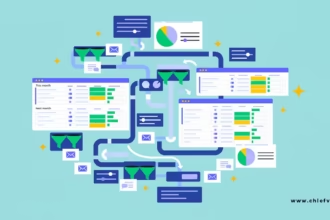

The workforce impact? Massive. Roles shift from execution to orchestration. Routine and even mid-level judgment tasks move to agents, freeing humans for strategy, creativity, ethics, and relationship-building. McKinsey highlights that early adopters in tech, insurance, and healthcare are already scaling agents in software engineering, marketing, and knowledge management.
But success isn’t automatic. Deloitte’s research shows only a small fraction of organizations have production-ready agentic solutions. The winners treat agentic AI like core infrastructure, not a side experiment.
Core Agentic AI Workforce Strategies 2026: From Strategy to Execution
Leading organizations are deploying these proven approaches right now.
1. Redesign Workflows Around Human-Agent Collaboration
Forget bolting agents onto old processes. The smartest agentic AI workforce strategies 2026 start with mapping end-to-end workflows and deciding what stays human, what goes agentic, and where handoffs happen.
PwC talks about moving away from hierarchical pyramids toward flatter, outcome-focused structures where agents expand worker reach. In manufacturing (per Infor), agentic systems coordinate planning, production, and execution, empowering shop-floor teams with real-time guidance instead of drowning them in paperwork.
Practical step: Run “agent sprints”—pilot one high-volume process (like invoice processing or customer onboarding), identify decision points, and prototype agent involvement. Measure time saved, error reduction, and human satisfaction.
2. Build a Hybrid Workforce Model with Clear Governance
Treat agents as part of the team. Forrester predicts top HCM platforms will soon manage “digital employees” alongside humans, tracking performance and optimizing allocation.
Key governance elements for agentic AI workforce strategies 2026:
- Define escalation protocols: When does an agent hand off to a human?
- Set accountability rules: Who owns an agent’s decision gone wrong?
- Implement guardrails: Budget controls, data access limits, audit trails.
Deloitte emphasizes rethinking roles around outcomes rather than tasks. Humans become orchestrators; agents become executors.
3. Launch Role-Based Agent Deployment
Shift from task bots to role-based agents. A “digital risk analyst” or “virtual procurement specialist” handles full cycles.
Goldman Sachs highlights the rise of personal agents and agent-as-a-service fleets. In 2026, companies deploy specialized multi-agent teams for complex domains like software development or customer experience.
Start small: Deploy one role-based agent per department, monitor ROI, then scale.
4. Prioritize Continuous Upskilling and Cultural Shift
This directly ties into CHRO workforce upskilling AI 2026. Agentic systems demand new human skills: prompt orchestration isn’t enough anymore—you need agent management, critical evaluation of outputs, ethical oversight, and cross-functional collaboration.
World Economic Forum stresses building structures for human-AI symbiosis. Employees need training in:
- Agent orchestration and supervision
- Spotting hallucinations or biases in autonomous actions
- Redesigning their own roles around agent support
Organizations winning in agentic AI workforce strategies 2026 make upskilling mandatory and experiential—through agent sandboxes, paired human-agent projects, and recognition for innovative collaborations.
5. Measure Beyond Vanity Metrics
Track real business value: productivity lift per FTE, cycle time reduction, innovation velocity, employee engagement scores in agent-augmented teams.
Centric Consulting predicts winning organizations treat agentic AI with the discipline of core infrastructure—controlling costs, validating outputs, enforcing guardrails.
Common Pitfalls in Agentic AI Workforce Strategies 2026 (And How to Dodge Them)
- Legacy system drag — Many agents fail because old tech can’t support real-time execution. Modernize data layers first.
- Over-automation panic — Employees fear replacement. Counter with transparency: Show how agents amplify capabilities.
- Governance gaps — Without clear rules, agents make rogue decisions. Build dual-speed transformation: fast pilots, rigorous scaling gates.
- Skill atrophy risk — Overreliance dulls critical thinking. Mandate “AI-free” assessments in key areas (Gartner insight).
Real-World Wins: Organizations Leading Agentic AI Workforce Strategies 2026
Early adopters in tech and finance are seeing 2-3x gains in targeted workflows. Manufacturers use agents to proactively adjust production, reducing downtime. Services firms orchestrate multi-agent teams for client delivery, compressing timelines dramatically.
The pattern? They started with clear strategy questions (Deloitte): Which processes? Optimal human-digital mix? Long-term vision?
Your 2026 Agentic AI Workforce Action Plan
- Assess current readiness: Audit workflows, data maturity, skills baseline.
- Pick 2-3 high-impact pilots: Focus on measurable pain points.
- Invest in CHRO workforce upskilling AI 2026 programs tailored to agent orchestration.
- Establish governance council: Cross-functional, with HR at the table.
- Scale winners: Measure, iterate, embed into HCM systems.
- Monitor culture: Celebrate human-agent wins publicly.
2026 isn’t about surviving agentic AI—it’s about thriving with it. Organizations that master these agentic AI workforce strategies 2026 will see exponential productivity, faster innovation, and more fulfilled teams.
The hybrid future is here. Are you building the workforce that owns it?
FAQs on Agentic AI Workforce Strategies 2026
What exactly are agentic AI workforce strategies 2026 trying to achieve?
These strategies focus on integrating autonomous AI agents as digital teammates to handle complex workflows, allowing humans to focus on high-value work while boosting overall productivity and innovation.
How does agentic AI workforce strategies 2026 differ from generative AI approaches?
Generative AI creates content or suggestions; agentic AI executes full processes autonomously—planning, deciding, acting, and learning—requiring new governance, upskilling, and workflow redesign.
Why should CHROs prioritize agentic AI workforce strategies 2026?
CHROs lead the human side of hybrid workforces. Strong ties to CHRO workforce upskilling AI 2026 ensure employees gain agent management skills, reducing resistance and maximizing collaboration value.
What are the biggest risks in implementing agentic AI workforce strategies 2026?
Legacy integration failures, governance blind spots, employee fear of replacement, and cost overruns top the list—mitigated by phased pilots, clear accountability, and transparent communication.
When will agentic AI workforce strategies 2026 show measurable ROI?
Most organizations see initial gains in 6-9 months from targeted pilots, with enterprise-wide impact emerging in 12-24 months as agents scale and humans adapt fully.