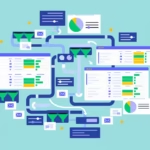






data governance frameworks serve as the essential blueprint that organizations use to manage, protect, and maximize the value of their information assets. Think of these frameworks as the traffic rules for your company’s data highway—without them, chaos ensues with mismatched data quality, compliance nightmares, and missed opportunities. But with a solid framework in place, you unlock reliable insights, smoother operations, and confident AI adoption.
This guide explores what data governance frameworks really mean, the most popular ones in use today, how they tie directly into CIO leadership in data strategy and organizational clarity, and practical steps to implement them effectively. Whether you’re a beginner just starting out or a seasoned leader refining your approach, you’ll walk away with actionable ideas to make data work harder for your business.
What Exactly Are Data Governance Frameworks?
At its heart, a data governance framework is a structured set of policies, processes, roles, and standards that define how data is handled across an organization. It answers key questions: Who owns the data? How do we ensure it’s accurate and secure? Who can access it, and for what purpose?
Unlike ad-hoc rules, these frameworks provide consistency. They cover everything from data quality checks and metadata management to privacy compliance and ethical usage. In 2026, with regulations tightening and AI exploding, strong frameworks aren’t nice-to-have—they’re survival tools.
Why does this matter? Poor governance leads to “garbage in, garbage out” scenarios, costing companies millions in bad decisions or fines. Good frameworks flip the script, turning data into a trusted strategic asset.
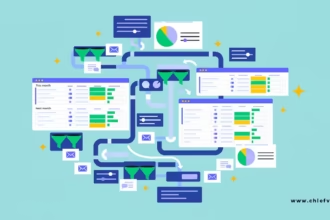


Why Data Governance Frameworks Matter More Than Ever in 2026
Fast-forward to now: Generative AI tools are everywhere, employees pull data without oversight, and regulations like GDPR, CCPA, and emerging AI laws demand transparency. Organizations face mounting pressure to prove their data is trustworthy.
Effective data governance frameworks reduce risks, boost compliance, and fuel innovation. They help cut down on data silos, improve decision speed, and support scalable AI projects. Leaders who ignore this risk falling behind—while those who invest see real ROI through better analytics and operational efficiency.
Ever wondered why some companies thrive on data while others struggle? It often boils down to governance. Clear frameworks create organizational clarity, ensuring everyone—from executives to analysts—understands data’s role.
Popular Data Governance Frameworks You Should Know
Several established models guide organizations worldwide. Here’s a breakdown of the heavy hitters.
DAMA-DMBOK: The Comprehensive Bible of Data Management
The Data Management Body of Knowledge (DAMA-DMBOK), from DAMA International, remains the gold standard. It covers 11 knowledge areas, including data governance, quality, architecture, and security.
This framework shines for its depth. It treats governance as one pillar in a bigger ecosystem, emphasizing best practices for policies, stewardship, and lifecycle management. Many enterprises adopt it as their foundational reference because it’s vendor-neutral and adaptable.
If you’re building from scratch, start here—it’s like having a detailed playbook for your entire data journey.
DCAM: Focused on Capability and Maturity
The Data Management Capability Assessment Model (DCAM), developed by the EDM Council, targets maturity assessment. It organizes capabilities into categories like strategy, architecture, quality, and operations.
Financial services love DCAM for its regulatory alignment, but any industry can use it to benchmark progress. It helps leaders identify gaps and prioritize improvements, making it perfect for phased rollouts.
COBIT: IT-Centric Governance with Data Emphasis
COBIT (Control Objectives for Information and Related Technologies) from ISACA started in IT but evolved to cover broader information governance. It excels in risk management, compliance, and control.
Organizations already using IT governance frameworks find COBIT easy to integrate. It’s less purely “data-focused” than DAMA but strong for enterprises prioritizing audit and controls.
Other Notable Approaches
Tools like Collibra, Informatica, and IBM often embed their own frameworks, blending elements from the above with automation. Hybrid models—combining centralized control with federated execution—are gaining traction in 2026 for balancing agility and oversight.
The Crucial Link: Data Governance Frameworks and CIO Leadership in Data Strategy and Organizational Clarity
Here’s where it gets strategic. CIO leadership in data strategy and organizational clarity directly shapes how governance frameworks succeed.
CIOs sit at the intersection of technology and business. They champion frameworks that align data practices with company goals, breaking down silos and fostering clarity. Without strong CIO involvement, governance efforts often fizzle—becoming IT-only projects that lack buy-in.
In practice, CIOs:
- Define vision: They tie governance to outcomes like faster insights or reduced risk.
- Assign roles: From data owners to stewards, ensuring accountability.
- Drive adoption: Through training, tools, and executive sponsorship.
- Measure impact: Using KPIs like data quality scores or compliance rates.
When CIOs lead with clarity, frameworks transform from paperwork into enablers of innovation. This connection makes CIO leadership in data strategy and organizational clarity indispensable for turning governance into a competitive edge.
For more on this dynamic, explore Gartner’s insights on data governance.

Key Components of Effective Data Governance Frameworks
No matter the model, strong frameworks share core elements.
Policies and Standards
These are the rules: data classification, quality thresholds, retention policies.
Roles and Responsibilities
Clear ownership—data owners for domains, stewards for operations, councils for oversight.
Processes and Workflows
From issue resolution to change management, processes keep things running smoothly.
Technology Enablement
Modern tools automate enforcement—catalogs for discovery, lineage tracking, quality monitoring.
Metrics and Monitoring
Track success with dashboards showing compliance, quality trends, and usage.
Best Practices for Implementing Data Governance Frameworks in 2026
Ready to get practical? Follow these steps drawn from real-world successes.
Start small with a pilot—pick one domain (like customer data) to prove value.
Secure executive sponsorship, especially from the CIO, to drive cross-functional support.
Automate where possible—AI-driven tools handle routine checks, freeing humans for high-value work.
Foster a collaborative culture—train users, celebrate wins, and make governance feel enabling, not restrictive.
Prioritize AI readiness—include model explainability and bias monitoring in your framework.
Regularly review and adapt—data landscapes change fast.
Check out Harvard Business Review on data management for deeper leadership perspectives.
Common Challenges and How to Overcome Them
Resistance to change? Communicate benefits clearly—show how governance saves time.
Resource constraints? Start lean, focus on high-impact areas.
Tool overload? Choose platforms that integrate well, like those from Collibra or Alation.
Complexity in large orgs? Use federated models for balance.
With persistence and strong CIO leadership in data strategy and organizational clarity, these hurdles become stepping stones.
Conclusion
Data governance frameworks aren’t just compliance checkboxes—they’re strategic enablers that provide the clarity and trust needed for data-driven success. By adopting proven models like DAMA-DMBOK or DCAM, aligning them with business goals, and leveraging strong CIO leadership in data strategy and organizational clarity, organizations can turn chaotic data environments into powerful assets.
Don’t wait for a crisis. Assess your current setup, involve leadership, and build a framework that scales. The payoff? Trusted data, empowered teams, and a real edge in 2026 and beyond. Your future self (and your bottom line) will thank you.
FAQs
What is the difference between DAMA-DMBOK and DCAM data governance frameworks?
DAMA-DMBOK offers broad, comprehensive best practices across data management, while DCAM focuses on capability maturity assessment, especially useful for regulated industries.
How does CIO leadership in data strategy and organizational clarity influence data governance frameworks?
CIO leadership in data strategy and organizational clarity ensures frameworks align with business objectives, secures resources, and promotes adoption across teams for maximum impact.
Which data governance framework is best for beginners?
Start with DAMA-DMBOK for its clear, foundational guidance—it’s accessible and provides a solid roadmap without overwhelming complexity.
What role do tools play in modern data governance frameworks?
Tools like Collibra, Alation, and Informatica automate discovery, lineage, and compliance, making frameworks more efficient and scalable in practice.
How can organizations measure the success of their data governance frameworks?
Track metrics like data quality scores, compliance rates, issue resolution time, and business value delivered—regular audits keep progress on track.