





Agentic AI orchestration is rapidly becoming the must-have layer for any organization serious about scaling generative AI beyond simple chatbots or single-task automations. If you’ve read the CTO guide to generative AI 2026, you already know that agentic systems represent the big leap forward—AI that doesn’t just respond but plans, decides, acts, and collaborates autonomously. But here’s the real kicker: deploying one agent is cool; getting dozens or hundreds to work together without chaos? That’s where orchestration becomes your secret weapon.
Picture this: Instead of a lone superhero AI trying to handle everything, you have a coordinated team of specialists—each agent focused on its superpower—working under a smart conductor that routes tasks, resolves conflicts, enforces rules, and keeps humans in the loop when needed. That’s agentic AI orchestration in action. In 2026, it’s shifting from nice-to-have to non-negotiable for enterprises chasing real ROI from AI.
In this deep dive, we’ll unpack what agentic AI orchestration really means, why it’s exploding now, the key frameworks and platforms powering it, practical implementation steps, challenges CTOs face, and where it’s headed next. Let’s get into it.
What Exactly Is Agentic AI Orchestration?
At its core, agentic AI orchestration is the coordination layer that manages multiple autonomous AI agents to achieve complex, shared goals. Unlike traditional workflow tools that follow rigid scripts, orchestration here handles dynamic, goal-oriented behavior.
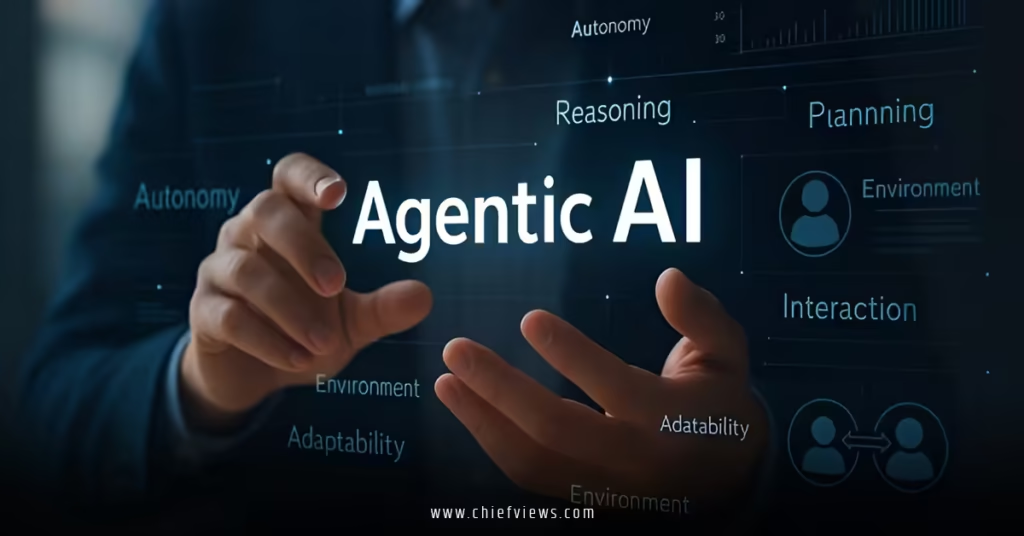
Agentic AI refers to systems that pursue objectives with minimal supervision—they reason, plan multi-step actions, use tools (APIs, databases, external services), learn from outcomes, and even collaborate with other agents or humans.
Orchestration adds the enterprise glue:


- Task decomposition — Breaking big goals into subtasks assigned to specialized agents.
- Routing and coordination — Deciding which agent handles what, managing handoffs, and resolving dependencies.
- State management — Tracking progress across long-running workflows, including memory and context sharing.
- Governance & guardrails — Enforcing policies, compliance, security, human oversight, and error recovery.
- Monitoring & optimization — Observing performance, logging decisions, and iterating on the system.
Think of it like a conductor leading an orchestra. Individual musicians (agents) are talented, but without coordination, you get noise. With a skilled conductor, you get symphony-level results.
Leading analysts predict the autonomous AI agent market could hit $8.5 billion in 2026, potentially climbing higher with strong orchestration—up to 15-30% more value unlocked through better coordination.
Why Agentic AI Orchestration Matters in 2026
We’re past the pilot phase. Enterprises now deploy agents in production, but isolated agents create “agent sprawl”—duplication, inconsistencies, security holes, and skyrocketing costs.
Orchestration solves this by turning fragmented experiments into scalable, governed systems. Key drivers in 2026:
- Multi-agent collaboration explosion — Gartner forecasts 40% of enterprise apps will embed AI agents by end-2026. Most valuable work requires teams of agents, not solo acts.
- From human-in-the-loop to human-on-the-loop — Advanced setups let agents run autonomously with humans supervising exceptions only.
- ROI pressure — Poor orchestration leads to 40%+ of agentic projects failing by 2027 due to complexity, costs, or risks. Good orchestration flips that.
- Industry-specific momentum — Supply chains use agents for real-time rerouting; software dev shifts engineers to “agent orchestrators”; customer experience delivers hyper-personalized journeys.
In short: Orchestration isn’t overhead—it’s the multiplier that turns agentic AI from promising to profitable.
Core Components of Effective Agentic AI Orchestration
Building reliable orchestration requires these building blocks:
1. Agent Discovery & Onboarding
Catalog available agents, define capabilities (via protocols like MCP or A2A), and register them dynamically.
2. Planning & Decomposition Engines
Use planners (ReAct-style, hierarchical, or graph-based) to break goals into executable steps.
3. Communication Protocols
Standardized ways for agents to message, share context, and negotiate (e.g., inter-agent protocols).
4. Runtime Environment
Stateful execution with memory layers, tool access, and rollback capabilities.
5. Governance Layer
Policy engines for compliance, audit trails, escalation paths, and kill switches.
6. Observability Stack
Real-time dashboards, decision tracing, performance metrics, and feedback loops for continuous improvement.
Top Frameworks and Platforms for Agentic AI Orchestration in 2026
The ecosystem has matured fast. Here’s a practical roundup of leaders:
- LangGraph — Tops production lists for its graph-based state machines. Perfect for controllable, stateful multi-agent flows. Handles cycles, branching, and human interruptions gracefully.
- CrewAI — Role-based “crews” of agents make it intuitive for collaborative tasks like research or support. Strong in team orchestration with built-in delegation.
- AutoGen (Microsoft) — Excellent for multi-agent conversations and self-reflection loops. Scalable and integrates well with enterprise tools.
- UiPath Agentic Orchestration — Enterprise-grade with RPA heritage. Unifies agents, robots, and humans in long-running processes with heavy governance.
- Semantic Kernel (Microsoft) — Plugs agents into .NET ecosystems; great for hybrid AI-traditional software.
- Beam AI / Others — Emerging all-in-one hubs combining creation, orchestration, and integrations.
Many CTOs adopt hybrid stacks—open-source frameworks for flexibility plus managed platforms for governance and scale. Avoid lock-in by prioritizing interoperability.
For deeper strategic context on scaling these systems, refer back to the comprehensive CTO guide to generative AI 2026, which covers the broader agentic shift.
Step-by-Step: Implementing Agentic AI Orchestration
Ready to move from theory to execution? Here’s a realistic playbook:
- Start Small, Prove Value
Pick one high-impact process (e.g., customer onboarding or code review). Build a 2-4 agent crew. - Choose Your Stack
Prototype with LangGraph or CrewAI. Test orchestration patterns like hierarchical (supervisor + workers) or peer-to-peer. - Integrate Tools & Memory
Connect agents to APIs, databases, search. Add persistent memory for context across sessions. - Layer Governance Early
Define policies, add human approval gates, implement logging and red-teaming. - Deploy & Monitor
Run in shadow mode first. Measure time saved, accuracy, cost per task. - Scale & Optimize
Expand to more processes. Use observability to refine routing and prune underperformers. - Build Internal Expertise
Train “AI orchestration specialists”—the hottest role emerging in 2026.
Common Challenges and How to Overcome Them
- Agent Sprawl & Inconsistency → Use a central registry and standardized protocols.
- Hallucinations in Decisions → Combine RAG, tool validation, and multi-agent verification.
- Cost Explosion → Optimize with smaller models for subtasks and caching.
- Security & Compliance → Enforce zero-trust access, audit every action.
- Human-AI Handover Friction → Design clear escalation paths and explainable decisions.
The Road Ahead: Agentic Orchestration in Late 2026 and Beyond
By late 2026, expect orchestration platforms to evolve into full “AI control planes”—enterprise-wide layers managing identity, access, billing, and cross-department workflows.
We’ll see more “autonomous workflow loops” where agents self-improve, and physical AI (robotics + agents) enters warehouses and factories.
The winners? Organizations treating orchestration as strategic infrastructure, not a feature.
Agentic AI orchestration isn’t just tech—it’s how forward-thinking companies turn AI from cost to competitive advantage in 2026. If you’re a CTO or tech leader, start experimenting today. The gap between leaders and laggards is widening fast.
What process in your organization could benefit from a coordinated agent team? Drop a comment—I’d love to hear your use cases.
FAQs
What is the difference between agentic AI and agentic AI orchestration?
Agentic AI refers to autonomous, goal-driven agents. Agentic AI orchestration is the coordination layer that manages multiple agents, ensuring they collaborate effectively toward complex outcomes.
Why is agentic AI orchestration essential according to the CTO guide to generative AI 2026?
The [CTO guide to generative AI 2026] highlights that isolated agents lead to sprawl and limited ROI. Orchestration unlocks multi-agent scale, governance, and measurable business value.
Which frameworks are best for beginners in agentic AI orchestration in 2026?
CrewAI for role-based teams and LangGraph for flexible graph workflows top the list for their balance of power and ease.
How does agentic AI orchestration impact enterprise ROI?
Strong orchestration can boost value 15-30% by reducing failures, enabling collaboration, and optimizing resource use—turning pilots into production wins.
What risks come with poor agentic AI orchestration?
Agent sprawl, security breaches, inconsistent decisions, high costs, and project cancellations—issues many enterprises face without proper coordination.