


Ever wondered what happens when AI stops just answering questions and starts actually doing the work across an employee’s entire journey—from first application to final exit interview?
In 2026, that’s no longer sci-fi. Agentic AI—autonomous systems that reason, plan, decide, and execute multi-step tasks with minimal human hand-holding—is quietly reshaping the employee lifecycle. We’re talking about AI agents that don’t wait for instructions; they pursue goals like “fill this critical role with the best internal candidate” or “ensure new hire productivity hits 90% by week 4” and then go make it happen.
This shift ties directly into broader CHRO priorities harness AI revolutionize HR 2026, where leaders are moving beyond basic chatbots to build hybrid human-AI workforces that deliver faster, smarter, and more personalized talent outcomes.
Ready to see what the most advanced deployments look like right now? Let’s walk through the real, high-impact agentic AI use cases across the full employee lifecycle in 2026.
What Makes Agentic AI Different in HR Right Now
Before diving into specifics, quick reality check: Most “AI in HR” until recently was generative—think resume parsers or chat-based Q&A. Agentic AI flips the script.
These agents:

- Maintain memory of past interactions and company context
- Break down complex goals into steps
- Use tools (APIs, calendars, HRIS systems) to take action
- Learn from outcomes and adapt without constant reprogramming
- Escalate to humans only when truly needed (ethics, nuance, legal edge cases)
By mid-2026, adoption has surged—many enterprises report 40-60% of routine HR workflows now touched by agents, freeing humans for strategy, culture-building, and complex coaching.
This evolution is central to CHRO priorities harness AI revolutionize HR 2026, as it turns HR from a support function into a proactive, outcome-driving engine.
1. Talent Acquisition: From Sourcing to Offer – The Full Recruiting Agent Swarm
Recruitment remains ground zero for agentic wins in 2026.
Modern setups deploy a team of specialized agents working together:
- Sourcing Agent — Continuously scans internal talent pools, external platforms, and niche communities; proactively engages passive candidates with personalized outreach.
- Screening & Ranking Agent — Parses applications, scores against dynamic job requirements (including emerging skills), runs initial video/text assessments, and flags bias risks.
- Scheduling & Coordination Agent — Books interviews across time zones, sends reminders, reschedules autonomously if conflicts arise.
- Offer & Negotiation Agent — Drafts tailored offers based on market data, internal equity, candidate preferences; even handles basic counter-offer loops before human approval.
Real outcome? Time-to-hire drops 40-60% in many cases, while quality-of-hire metrics improve because agents optimize for long-term fit rather than just speed.
One leading platform in 2026 orchestrates this end-to-end, reducing recruiter workload on admin by up to 70% so they focus on candidate experience and hiring manager partnership.
2. Onboarding: Personalized, Zero-Touch First 90 Days
Gone are the generic welcome emails and endless forms.
In 2026, the Onboarding Orchestrator Agent takes over the moment an offer is accepted:
- Pulls employee data to customize paperwork (tax, benefits, local compliance)
- Provisions IT access, orders equipment, books orientation sessions
- Creates hyper-personalized 30/60/90-day plans based on role, prior experience, learning style
- Delivers micro-learning modules, schedules check-ins, tracks completion
- Monitors sentiment via pulse surveys and nudges managers if engagement dips
- Escalates only for exceptions (visa issues, accommodation requests)
Result: New hires report 30-50% faster time-to-productivity, while HR teams handle complex cases instead of chasing paperwork.
This seamless transition is a cornerstone of CHRO priorities harness AI revolutionize HR 2026, turning onboarding from a cost center into a retention accelerator.
3. Performance Management & Development: Continuous Coaching Agents
Annual reviews? Mostly relics in forward-leaning 2026 organizations.
Agentic systems now power ongoing performance loops:
- Goal-Tracking Agent — Aligns individual objectives to company goals, breaks them into actionable steps, monitors progress in real time via integrated tools (project management, sales CRM).
- Feedback & Coaching Agent — Collects multi-source input (peer comments, system data), generates balanced insights, suggests development actions, even drafts 1:1 agendas.
- Skills Gap & Upskilling Agent — Scans role requirements vs. employee profile, recommends personalized learning paths, enrolls in courses, tracks completion, and adjusts career maps dynamically.
- Career Mobility Agent — Matches employees to internal opportunities, prepares application materials, simulates interview prep, and notifies when stretch roles open.
Managers get augmented—not replaced—with agents handling data crunching so conversations focus on growth and motivation.
4. Employee Experience & Support: 24/7 Autonomous HR Service Desk
The always-on Employee Support Agent has become table stakes.
It handles:
- Benefits enrollment and changes
- Leave requests with policy checks and approvals
- Payroll queries and corrections
- Policy explanations with context-aware answers
- Ticket routing for complex issues
- Proactive interventions (e.g., “I notice you’re eligible for parental leave—want to start the process?”)
When integrated with sentiment analysis, these agents spot trends early—burnout signals, engagement drops—and trigger manager alerts or wellness resources.
Employee satisfaction scores climb because support feels instant and accurate.
5. Offboarding & Alumni Management: Clean, Compliant Exits
Often overlooked, offboarding gets agentic treatment in 2026:
- Exit Orchestrator Agent — Coordinates knowledge transfer, revokes access, processes final pay, handles equipment return
- Generates exit surveys, analyzes feedback for trends
- Maintains alumni networks, re-engagement for boomerang hires
- Ensures compliance across jurisdictions (especially global teams)
Smooth exits protect employer brand and open doors for future talent return.
6. Workforce Planning & Retention: Predictive Agents Looking Ahead
The most strategic layer—agents forecast and act:
- Predict flight risk using behavioral + external signals
- Model succession scenarios
- Simulate headcount impacts of business changes
- Recommend retention interventions (counter-offers, role adjustments)
These proactive agents help CHROs stay ahead of talent shortages.
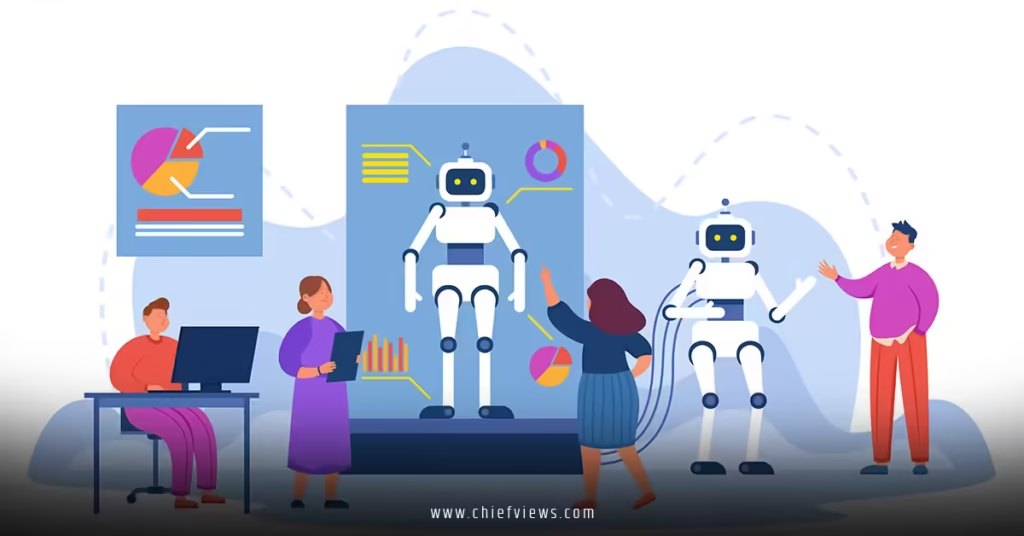
Governance, Trust & The Human-AI Partnership
No discussion of agentic AI in 2026 is complete without the guardrails.
Leading organizations enforce:
- Clear “humans in the loop” for high-stakes decisions
- Regular bias audits and explainability logs
- Employee rights around AI usage
- Agent performance scorecards (just like humans)
Trust remains the currency—when employees see agents as helpful teammates rather than threats, adoption soars.
Conclusion: Your 2026 Agentic AI Roadmap Starts Today
Agentic AI use cases in the employee lifecycle 2026 aren’t about replacing people—they’re about amplifying human potential at every touchpoint.
From lightning-fast recruiting to personalized growth paths and predictive retention, these autonomous agents deliver the speed, scale, and intelligence that define winning talent strategies.
This transformation sits at the heart of CHRO priorities harness AI revolutionize HR 2026. The question isn’t whether agentic AI will change HR—it’s already happening. The real question: Will your organization lead the change or chase it?
Start small: Pilot one high-pain lifecycle stage (recruiting or onboarding usually wins fastest ROI). Measure obsessively. Scale what works. In twelve months, you’ll wonder how you ever managed without your digital talent teammates.
The future of work is hybrid. Make sure your HR strategy reflects that reality.
External High-Authority Links
- Gartner – AI in HR Trends 2026
- Forbes – AI Agents Every HR Leader Needs in 2026
- Deloitte – Agentic AI Strategy 2026
Frequently Asked Questions
What exactly are agentic AI use cases in employee lifecycle 2026?
They span autonomous recruiting swarms, personalized onboarding orchestrators, continuous performance coaching agents, 24/7 employee support, smart offboarding, and predictive workforce planning—delivering end-to-end automation with human oversight.
How do agentic AI use cases in employee lifecycle 2026 connect to CHRO priorities harness AI revolutionize HR 2026?
These use cases are core execution levers for CHROs aiming to build AI-first talent systems, accelerate skills development, personalize experiences at scale, and create trust-based governance—directly advancing revolutionary HR transformation.
Which employee lifecycle stage sees the biggest impact from agentic AI in 2026?
Talent acquisition and onboarding typically show the fastest ROI (40-70% time savings), followed closely by employee support and performance management due to high volume and repetition.
Is agentic AI safe for sensitive HR decisions in 2026?
Yes—with strong governance. Leading adopters use bias audits, explainability tools, human escalation for edge cases, and transparent policies to maintain trust and compliance.
How quickly can a mid-size company implement agentic AI use cases in employee lifecycle 2026?
Many achieve meaningful pilots in 3-6 months by starting with one vendor-integrated agent (recruiting or support), then expanding. Full lifecycle coverage often takes 12-18 months with iterative scaling.