




AI FinOps Framework Implementation Guide :
AI FinOps framework implementation guide starts with per-request cost capture at your AI gateway—this single layer determines whether you control spend or let it drift unchecked. Without it, every optimization effort operates blind.
Quick Snapshot: What You Need to Know
- Per-request tagging is non-negotiable: Every AI inference call must be tagged with feature, tenant, team, and request type at the gateway level[logiciel]
- Build time is 1-2 weeks: If you have a gateway already, this is a 1-2 week engineering investment[logiciel]
- Daily dashboards beat monthly reports: Cost visibility refreshed daily catches anomalies before they compound[logiciel]
- Named owner required: Assign an engineer whose job is to argue against cost drift—this role is the multiplier[logiciel]
- Weekly cadence is mandatory: 30-minute reviews with engineering + finance prevent cost drift from slipping through cracks[logiciel]
Why AI FinOps Framework Implementation Guide Matters in 2026
AI FinOps Framework Implementation Guide : Enterprise generative AI spending hit $37 billion in 2025, up 3.2x from $11.5 billion in 2024. Inference spending alone is projected to hit $20.6 billion in 2026, capturing 55% of all AI cloud infrastructure spend.[logiciel]
Here’s the problem: per-token costs collapsed by some measures 280-fold, but workloads grew faster. AI cost is now the single fastest-growing line in most engineering budgets. CFOs are asking for it as a standing agenda item in weekly—not quarterly—reviews.[logiciel]
Only 14% of 200 U.S. finance chiefs surveyed by RGP said they’ve seen a clear, measurable impact from their AI investments to date. The gap between spending and seeing results is where AI FinOps closes the loop.[cfo]


This is where CFO strategies for AI integration cost optimization and financial resilience in 2026 meet execution. You can’t have financial resilience without the framework to track, optimize, and forecast AI spend accurately.
The 5-Layer AI FinOps Framework Explained
AI FinOps Framework Implementation Guide : High-performing enterprises have all five layers of AI FinOps in place. Most teams have one or two. Here’s what each layer does and why it matters.
Layer 1: Per-Request Cost Capture (Week 1-2)
Every AI inference call gets tagged with feature, tenant, team, and request type at the gateway level. The cost gets attributed to the right business unit at the moment of capture, not reconstructed from logs later.[logiciel]
Without this foundation, every other layer operates on guesswork. The build effort is a 1-2 week engineering investment if you have a gateway already.[logiciel]
What to implement:
- Install a gateway if you don’t have one (Kong, Apigee, or custom)
- Add custom tags to every request:
feature=,tenant=,team=,request_type= - Capture cost at the moment of inference, not after billing arrives
- Store tagged data in a queryable database (BigQuery, Snowflake, or similar)
Layer 2: Daily Dashboard (Week 3-4)
The captured cost feeds a dashboard refreshed daily showing cost by feature, by tenant, and by team. There’s an anomaly indicator. There’s a trend.[logiciel]
The dashboard is owned by a named person in engineering—not finance. That role didn’t exist on most engineering teams 18 months ago. It exists now on the teams the CFO trusts.[logiciel]
What to implement:
- Build a dashboard that refreshes daily (Looker, Tableau, or custom)
- Show cost by feature, tenant, team, and request type
- Add anomaly detection (simple threshold alerts work fine to start)
- Assign a named owner in engineering—this is critical
Layer 3: Per-Request Cost Optimization Tracking (Week 5-8)
When you implement prompt caching, tier routing, or retrieval tuning, the dashboard tracks the impact. Anthropic’s caching delivers up to 90% savings on cached prompts. OpenAI’s automatic caching produces around 50% on cached calls.[logiciel]
Programs without this tracking deploy optimizations and never know if they worked.[logiciel]
What to implement:
- Tag every optimization change with a date and expected savings
- Track before/after cost per request for each optimization
- Build a simple log of what worked and what didn’t
- Connect optimization results to the daily dashboard
Layer 4: Multi-Scenario Forecast (Week 9-12)
The forecast runs three scenarios: half current usage, current usage, double current usage. Each scenario gets a cost projection over 90 days and 12 months.[logiciel]
CFOs don’t need point estimates; they need bounds. The three-scenario forecast bounds the answer.[logiciel]
What to implement:
- Build a simple spreadsheet or BI model with three scenarios
- Project 90-day and 12-month costs for each scenario
- Update as dashboard data accumulates (monthly minimum)
- Share with finance before budget reviews
Layer 5: Weekly Operating Cadence (Week 13+)
The cost dashboard gets reviewed weekly by engineering, with finance present. The review takes 30 minutes. The output is decisions: which optimization to ship next, which feature has the worst unit economics, which usage pattern is driving the variance.[logiciel]
Programs without the cadence let cost drift compound.[logiciel]
What to implement:
- Schedule a protected 30-minute review every week
- Engineering leads, finance attends
- No cancellations—if you skip three weeks, the discipline breaks
- Document decisions and track follow-through
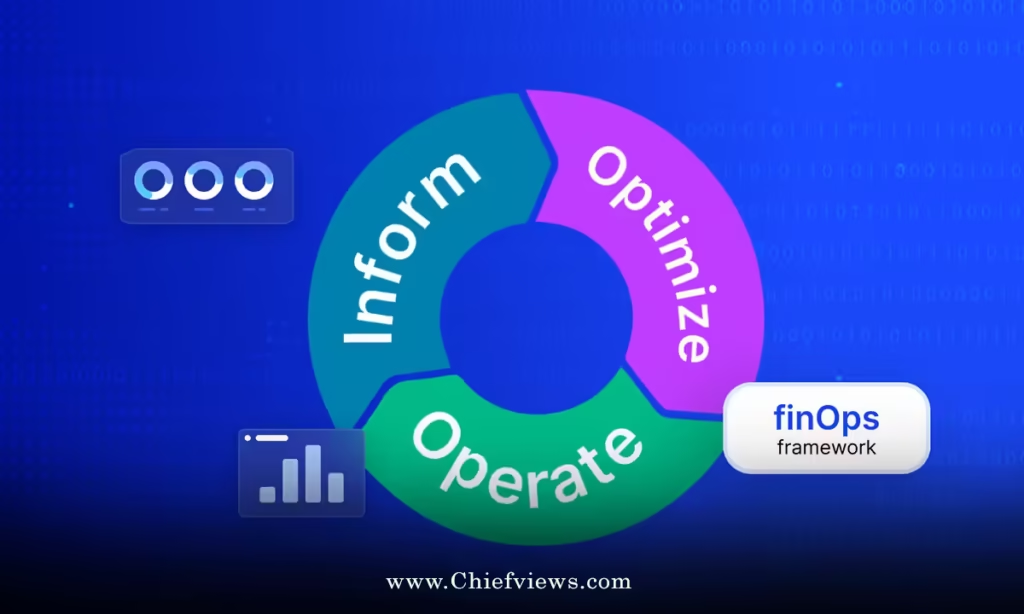
Implementation Timeline: 13 Weeks to Full AI FinOps
| Week | Layer | What You Build | Deliverable |
|---|---|---|---|
| 1-2 | Per-request capture | Gateway tagging + database | Every AI call tagged with feature/tenant/team [logiciel] |
| 3-4 | Daily dashboard | Cost dashboard + anomaly alerts | Daily-refresh dashboard owned by engineer [logiciel] |
| 5-8 | Optimization tracking | Before/after tracking for changes | Dashboard shows optimization impact [logiciel] |
| 9-12 | Multi-scenario forecast | 3-scenario 90-day + 12-month model | Budget bounds for half/expected/double usage [logiciel] |
| 13+ | Weekly cadence | 30-minute weekly review | Engineering + finance review cost weekly [logiciel] |
Common Mistakes That Sabotage AI FinOps
Mistake 1: No named owner for AI costs
The cost dashboard exists but nobody reviews it. Variances accumulate.[logiciel]
Fix: Assign a named engineer whose role partly exists to argue against cost drift. This role is the multiplier.[logiciel]
Mistake 2: Relying on cloud billing tools alone
Cloud billing tools give you cost by service, not by your feature, tenant, or team. The gap is real and important to the CFO.[logiciel]
Fix: Build per-request capture at your gateway with custom tags.[logiciel]
Mistake 3: Skipping the weekly cadence
After three months of skipped reviews, the program is operating without the discipline that produces outcomes.[logiciel]
Fix: Schedule a protected 30-minute review every week. No cancellations.[logiciel]
Mistake 4: Building too much before shipping
Teams spend months building the perfect dashboard before showing it to anyone. By then, cost drift has already compounded.
Fix: Ship Layer 1 and 2 in 4 weeks. Add sophistication later.
Mistake 5: Finance owns the dashboard
Finance lacks the context to argue against cost drift at the feature level. Engineering must own it.
Fix: Assign engineering ownership. Finance attends the weekly review.[logiciel]
Tools and Technologies for AI FinOps Implementation
Gateway Options:
- Kong Gateway (open source + enterprise)
- Apigee (Google Cloud)
- AWS API Gateway
- Custom gateway using FastAPI or Express
Dashboard Options:
- Looker (best for enterprise)
- Tableau (widely adopted)
- Power BI (Microsoft shops)
- Custom Grafana or Metabase instance
Database Options:
- BigQuery (GCP shops)
- Snowflake (snowflake-native analytics)
- Redshift (AWS shops)
- PostgreSQL (smaller teams)
Caching Tools:
- Anthropic prompt caching (up to 90% savings)[logiciel]
- OpenAI automatic caching (~50% savings)[logiciel]
- Bedrock caching (AWS)
- Custom Redis/Memcached layer
How AI FinOps Fits Into Broader CFO Strategies
AI FinOps is the execution layer for <strong>CFO strategies for AI integration cost optimization and financial resilience in 2026</strong>. Without it, CFOs are flying blind on their fastest-growing cost line.
The connection is direct: 56% of CFOs rank enterprise-wide cost optimization among their top five priorities for 2026. AI cost is now a majority of innovation spend in many enterprises. You cannot optimize what you cannot measure.[quantumfbi]
Forty-nine percent of North American CFOs rank digital transformation of finance as their top 2026 priority. AI FinOps is the bridge between that transformation and measurable financial outcomes.[linkedin]
Key Takeaways
- Per-request capture is mandatory: Tag every AI call at the gateway—this is the foundation[logiciel]
- Build in 13 weeks: Full 5-layer framework from zero to weekly cadence[logiciel]
- Name an owner: An engineer must own the dashboard and argue against drift[logiciel]
- Weekly cadence beats quarterly: Catch cost drift in the same week it starts[logiciel]
- Cloud billing tools aren’t enough: They don’t tag by feature/tenant/team[logiciel]
- Caching saves 50-90%: Anthropic delivers up to 90% on cached prompts[logiciel]
- Three scenarios, not one: Half/expected/double usage gives CFOs budget confidence[logiciel]
- Engineering owns it: Finance attends, but engineering leads the review[logiciel]
FAQs
Q: How long does it take to implement an AI FinOps framework?
A: Full 5-layer implementation takes 13 weeks from zero to weekly cadence. Per-request capture alone takes 1-2 weeks if you have a gateway.[logiciel]
Q: What’s the ROI on implementing AI FinOps?
A: Programs without per-request tracking deploy optimizations and never know if they worked. With tracking, you can defend optimization investment and achieve 50-90% savings through caching.[logiciel]
Q: Who should own the AI cost dashboard?
A: A named person in engineering—not finance. That role’s job is partly to argue against cost drift. Finance attends the weekly review but doesn’t own the dashboard.[logiciel]