






An AI Marketing Strategy Framework helps marketers use data, automation, and predictive insights to improve targeting, content, media, and conversions without wasting budget. If the goal is to scale smarter in 2026, this is the operating model that makes AI actually useful.
Why an AI marketing framework matters
Most teams do not fail because they lack AI tools. They fail because the tools are scattered, the data is messy, and nobody owns the strategy.
An AI marketing framework solves that by giving structure to how AI gets used across planning, execution, and optimization. It helps teams move faster, test more, and make better decisions with less guesswork.
This also connects directly to how AI is changing the CMO role in 2026 with data-driven growth strategies, because the modern CMO is no longer just managing campaigns. The role is becoming more about growth systems, data discipline, and measurable business outcomes.
What is an AI marketing strategy framework?
An AI marketing strategy framework is a repeatable system for using AI across the marketing function. It defines where AI fits, what problems it solves, what data it needs, and how results get measured.
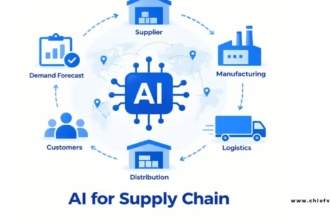


Think of it like a control panel, not a magic wand. The framework keeps AI tied to business goals instead of random experimentation.
At its best, it covers:
- Audience understanding.
- Content creation and optimization.
- Media planning and bidding.
- Lead scoring and nurturing.
- Customer retention and personalization.
- Reporting and forecasting.
Core pillars of the framework
1. Data foundation
AI is only as good as the data it learns from. If your CRM, web analytics, ad platforms, and email data do not line up, your outputs will be shaky.
Clean, connected, and current data should be the first priority. No shortcut beats this step.
2. Clear business goals
Do not use AI just because it sounds modern. Tie it to one or two measurable goals such as:
- Lowering customer acquisition cost.
- Improving conversion rates.
- Increasing retention.
- Growing qualified pipeline.
Without a goal, AI becomes noise with a dashboard.
3. Use-case selection
Start with tasks where AI can save time or improve decisions quickly. Good early use cases include:
- Audience segmentation.
- Subject line testing.
- Content brief generation.
- Predictive lead scoring.
- Budget allocation insights.
These are high-leverage areas because they touch performance directly.
4. Human oversight
AI should assist decision-making, not replace it. Marketers still need to review outputs for accuracy, brand voice, compliance, and commercial sense.
That human layer is what keeps the strategy sharp.
5. Measurement and iteration
A framework only works if it learns. Track what improves, what fails, and what needs to be adjusted.
If something is not moving the metric, cut it. Fast.
Answer-ready table: AI marketing framework at a glance
| Framework Area | What It Does | Example Use Case | Primary KPI |
|---|---|---|---|
| Data foundation | Connects marketing data sources | CRM + analytics sync | Data accuracy |
| Audience intelligence | Finds high-value segments | Behavioral clustering | Conversion rate |
| Content optimization | Improves content output and relevance | AI-assisted briefs | Engagement rate |
| Media optimization | Improves spend efficiency | Bid and budget recommendations | CAC / ROAS |
| Personalization | Tailors messages by behavior | Dynamic email journeys | CTR / retention |
| Forecasting | Predicts future outcomes | Pipeline and demand modeling | Revenue impact |
Step-by-step framework for beginners
Step 1: Audit your data
Check where your data lives and whether it is reliable. Start with CRM, analytics, ad platforms, and email.
If the numbers disagree, fix the source problem before adding more AI.
Step 2: Pick one use case
Choose one workflow that is repetitive and measurable. Content ideation, lead scoring, or campaign reporting are good starting points.
One use case is enough to prove value.
Step 3: Define success metrics
Decide what improvement looks like. That could be:
- Faster production time.
- Better conversion rates.
- Lower ad waste.
- Higher retention.
Be specific. Vague goals do not help.
Step 4: Build a test plan
Run a small experiment with one team or one channel first. Compare results against your current process.
This keeps risk low and learning fast.
Step 5: Scale what works
Once the use case shows value, expand it into adjacent workflows. Do not scale chaos.
Common mistakes to avoid
- Using AI for everything at once.
- Starting with tools instead of strategy.
- Ignoring data quality.
- Skipping human review.
- Measuring vanity metrics instead of revenue impact.
These mistakes are common because AI feels easy to deploy and hard to govern. The fix is discipline.
How this connects to the CMO role
The strongest AI marketing framework supports the broader shift happening in leadership. It gives CMOs a repeatable way to turn AI into growth, not just efficiency.
That is why the phrase how AI is changing the CMO role in 2026 with data-driven growth strategies matters here. It captures the bigger picture: marketing leadership is moving from campaign management to data-led growth orchestration.
In practical terms, that means CMOs need to:
- Make better decisions faster.
- Connect marketing to revenue.
- Align teams around one source of truth.
- Use AI to scale judgment, not replace it.
SEO benefits of this framework
An AI marketing strategy framework is also strong for SEO because it naturally supports better planning, better content mapping, and stronger topical authority. It helps teams identify search intent, create useful content clusters, and optimize based on performance data.
That means your content is not just optimized for search engines. It is built to help users make decisions.
Final takeaway
If you want AI to deliver real marketing value, build the framework first. Tools come and go, but structure creates consistency.
Use AI to sharpen targeting, speed up execution, and improve decisions. That is where the payoff lives.
Would you like me to turn this into a full 1500-word blog post with FAQs, meta description, and internal links?
FAQs
1. What is an AI marketing strategy framework?
It’s a structured plan for using AI across marketing tasks like segmentation, content, personalization, and optimization so every move ties back to a clear business goal.
2. How does an AI marketing strategy framework support growth?
It helps teams make faster, data-backed decisions, reduce wasted spend, improve targeting, and scale what works across channels.
3. How is this connected to how AI is changing the CMO role in 2026 with data-driven growth strategies?
It reflects the same shift: CMOs are moving from campaign managers to growth leaders who use AI and data to drive revenue, retention, and smarter execution.