




AI operating model for enterprises is the phrase every CIO, COO, and CFO is quietly typing into their search bar right now — usually right after their third failed AI pilot. And that’s not an accident. Most companies don’t have an AI problem. They have an operating model problem wearing an AI costume.
Here’s the blunt truth: buying tools doesn’t build capability. Structure does. Governance does. Clear ownership does. Without those, even the best agentic AI system turns into an expensive science experiment nobody wants to defend in the budget review.
Quick summary — what you need to know:
- An AI operating model defines who owns AI decisions, how workflows get redesigned, and how risk gets managed at scale.
- Enterprises without a formal model see far more stalled pilots than those with clear governance structures.
- Deloitte’s State of Generative AI research found governance and talent gaps — not technology limitations — are the top barriers to scaling AI in the enterprise [1].
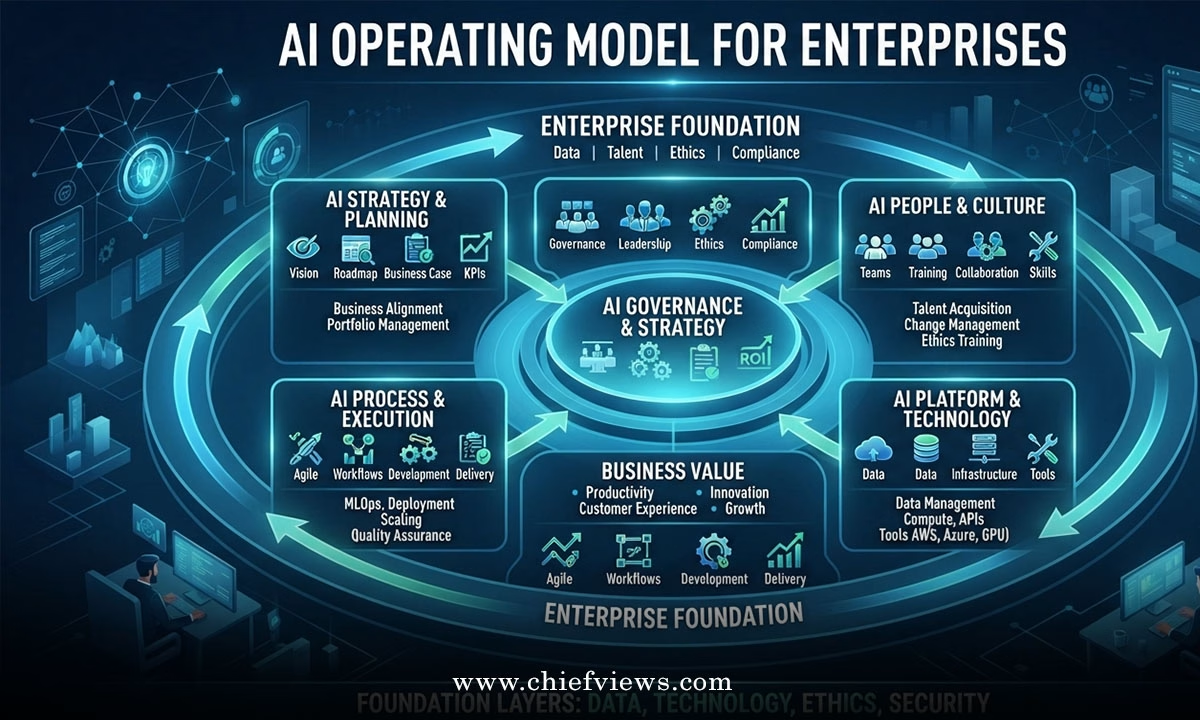
- A working model has four legs: governance, talent, infrastructure, and workflow redesign — kick one out and the whole thing wobbles.
- Getting this right is exactly how a COO can optimize workflow efficiency with agentic AI without creating chaos across departments.
What an AI Operating Model Actually Is
Strip away the consulting jargon and it’s simple. An AI operating model is the org design, decision rights, and processes that determine how AI actually gets built, deployed, and governed inside a company.
It’s not a tech stack. It’s not a chatbot license. It’s the scaffolding that decides who approves a new agentic workflow, who owns the risk if it fails, and who measures whether it’s actually working.
Companies skip this step constantly. They hand IT a budget, buy a platform, and hope structure emerges on its own. It rarely does.



Why Most Enterprises Get This Wrong
The pattern repeats everywhere: excitement, a flashy pilot, a press release — then silence six months later. What happened?
No clear owner. No governance council. No consistent way to measure ROI across departments. Gartner has pointed out that a huge share of AI projects fail to move past pilot stage for exactly these structural reasons, not technical ones [2].
What I’d tell any exec sponsor: your AI operating model needs to exist before your first production deployment, not after your third failed one. Retrofitting governance onto a live mess is brutal.
The Four Pillars of an AI Operating Model for Enterprises
Think of this like the four legs of a table. Skip one, and everything tips over eventually.
1. Governance and Decision Rights
Someone has to own the “yes” and the “no.” Without a governance council or a clearly named accountable executive, every AI initiative becomes a turf war between departments.
The NIST AI Risk Management Framework offers a solid, publicly available structure for building this out — covering risk categorization, oversight roles, and audit processes [3].
2. Talent and Skills Architecture
You don’t need an army of data scientists. You need translators — people who understand both the business problem and what the AI can realistically do. That’s a rarer skill than it sounds.
3. Infrastructure and Data Readiness
An AI operating model built on messy, siloed data is a house built on sand. Data pipelines, access controls, and integration standards need to exist before agents start making decisions off that data.
4. Workflow Redesign
This is where the real payoff hides. It’s not enough to bolt AI onto an existing process. The workflow itself needs rethinking — which is precisely where a lot of operations leaders start focusing their energy, especially around how COO can optimize workflow efficiency with agentic AI at the department level before scaling company-wide.
Centralized vs. Federated vs. Hybrid Operating Models
Enterprises usually pick from three structural flavors. Each has trade-offs worth knowing before you commit.
| Model Type | Structure | Best For | Main Risk |
|---|---|---|---|
| Centralized | Single AI center of excellence owns all decisions | Smaller enterprises, tight regulatory environments | Slow to respond to department-specific needs |
| Federated | Each business unit runs its own AI initiatives independently | Large, diverse enterprises with distinct business lines | Inconsistent governance and duplicated effort |
| Hybrid | Central governance and standards, decentralized execution | Most mid-to-large enterprises in 2026 | Requires strong coordination between center and units |
Most enterprises land on hybrid eventually. Full centralization gets too slow. Full federation gets too messy. Hybrid gives you standards without strangling speed.
Step-by-Step Action Plan for Building an AI Operating Model
Beginners tend to overcomplicate this. Here’s the practical sequence.
- Name an accountable executive. One person, not a floating committee, who owns AI outcomes company-wide.
- Stand up a governance council. Pull representatives from legal, IT, operations, and risk — not just data science.
- Audit your data readiness. Know what’s usable now versus what needs cleanup before any agent touches it.
- Pick two to three lighthouse workflows. Same principle that applies when figuring out how COO can optimize workflow efficiency with agentic AI — start narrow, prove value, then expand.
- Define escalation and override rules. Every AI-driven decision needs a documented human checkpoint for exceptions.
- Build a scaling playbook. Document what worked in your pilot so the next department doesn’t start from zero.
Common Mistakes Enterprises Make — and How to Fix Them
Mistake 1: Building the model after the tech is already live.
Fix: Pause new deployments until governance catches up. It’s uncomfortable, but cheaper than cleaning up a mess later.
Mistake 2: Confusing an AI operating model with a tech vendor’s platform.
Fix: The vendor sells tools. The model is yours to design — ownership, risk, and workflow redesign don’t come in a software license.
Mistake 3: Letting every department run its own AI rules.
Fix: Set enterprise-wide standards for risk tiers and approval thresholds, even in a federated structure.
Mistake 4: No feedback loop from pilots to strategy.
Fix: Build a quarterly review where lighthouse project results directly shape the next round of investment decisions.
Mistake 5: Underinvesting in change management.
Fix: Employees resist what they don’t understand. Training and transparent communication matter as much as the technology rollout itself.
Where This Is Heading
The enterprises pulling ahead in 2026 aren’t necessarily the ones with the flashiest AI stack. They’re the ones who treated the operating model as the actual product, and the technology as just one input into it.
Here’s a question worth sitting with: if your best AI engineer left tomorrow, would your AI initiatives survive? If the answer’s no, you don’t have an operating model — you have a dependency on one person’s judgment. That’s fragile, and boards are starting to ask about it directly.
Key Takeaways
- An AI operating model is the governance, talent, infrastructure, and workflow structure behind every AI initiative — not the tools themselves.
- Governance gaps, not technology limits, are the top reason enterprise AI projects stall.
- Hybrid models — centralized standards, decentralized execution — fit most large enterprises best in 2026.
- Start with lighthouse workflows and prove value before scaling company-wide.
- Data readiness has to come before agentic deployment, not after.
- Named ownership beats committee ownership every time.
- Workflow redesign is where the real ROI lives, closely tied to how a COO can optimize workflow efficiency with agentic AI at the operational level.
- Change management and training determine adoption as much as the technology does.
Building an AI operating model isn’t glamorous work. It’s the unglamorous scaffolding that decides whether your flashy pilot becomes a durable capability or a cautionary tale in next year’s budget meeting. Start with governance, name an owner, pick your lighthouse workflow — and let the results build the case for everything that comes after.
FAQs
How is an AI operating model different from an AI strategy?
A strategy defines what you want to achieve with AI. The operating model defines who executes it, how decisions get made, and what governance keeps it accountable — strategy without the model is just a wish list.
Can a small or mid-sized enterprise build an AI operating model without a dedicated AI team?
Yes. Start with a lightweight governance council of existing leaders — IT, operations, and legal — rather than waiting to hire a full AI department first.
Does an AI operating model need to be rebuilt for every new AI tool an enterprise adopts?
No. A well-built model is tool-agnostic — it sets standards for risk, ownership, and workflow redesign that apply whether you’re deploying a new chatbot or a full agentic AI system.