









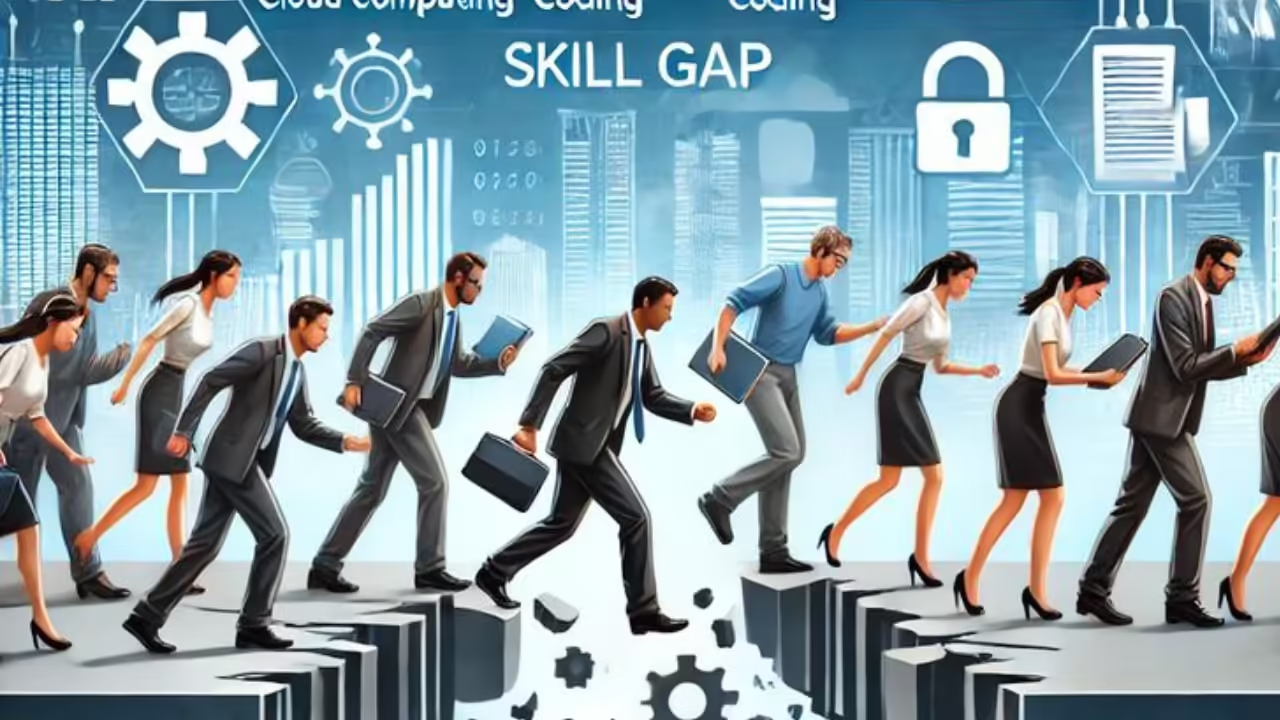
AI skills gap enterprise impact hits harder than most leadership teams admit. Delayed roadmaps, inflated hiring costs, and stalled AI projects are not abstract risks—they show up in missed revenue and competitive lag.
Quick reality check:
- More than 90% of organizations face critical AI and IT skills shortages by 2026, according to IDC projections, with global losses estimated around $5.5 trillion from product delays, weakened competitiveness, and lost business.
- Deloitte’s 2026 State of Generative AI in the Enterprise survey of thousands of C-suite leaders found insufficient worker skills as the single biggest barrier to integrating AI into existing workflows.
- Skill requirements in AI-exposed roles are changing more than twice as fast as in other roles.
- Many companies invest in basic AI literacy while advanced capabilities—managing agents, workflow redesign, evaluation frameworks—remain scarce.
- The gap drives higher external hiring premiums and raises the stakes for retention, directly amplifying the challenges of managing AI talent costs and rehiring risks.
The AI skills gap is no longer an HR problem. It is an enterprise performance problem.
Why the Gap Keeps Widening in 2026
AI skills gap enterprise impact Demand for production-ready AI skills—agent orchestration, fine-tuning, evaluation systems, MLOps, and domain-specific integration—far outstrips supply. Foundational literacy programs help employees use chat interfaces. They do little for the harder work of shipping reliable systems at scale.
Enterprises report the same pattern: AI tools arrive faster than the people who can govern, evaluate, and operationalize them. Project timelines stretch. Teams lean on a handful of specialists. Those specialists become single points of failure. When they leave, knowledge walks out the door and the next hiring cycle starts at a higher price.
The cost is not primarily payroll. IDC frames the $5.5 trillion figure around delayed products, impaired competitiveness, and lost business. Every month a critical AI role sits open subtracts from the roadmap. Competitors who close the gap faster capture the advantage.

How the Skills Gap Shows Up in Real Operations
AI skills gap enterprise impact Open roles stay open longer. Time-to-hire for specialized AI talent routinely stretches to 8–12 weeks or more in tight markets. Meanwhile, existing teams absorb extra load, increasing burnout risk and turnover.
Upskilling efforts often miss the mark. Many organizations report investing in training, yet workers say programs fail to map to actual job tasks. Basic prompting gets coverage. Advanced skills—directing agentic systems, validating outputs under real constraints, redesigning processes around AI—do not.
Role redesign lags even further. A large share of companies still treat AI as a bolt-on tool rather than a reason to rethink how work gets done. The result is productivity theater: people use AI for small tasks while core workflows remain unchanged and the skills gap persists.
This cycle feeds higher compensation pressure. Scarce skills command premiums. Organizations that cannot build internally end up competing in the external market, which raises the cost of both acquisition and the eventual rehire cycle when attrition hits.
Practical Impact on Enterprise Performance
- Project delays and missed revenue. AI initiatives slip because the right combination of domain knowledge and technical skill is missing.
- Higher total cost of talent. External hires carry premiums; internal specialists become expensive to replace.
- Weakened competitive position. Organizations that close the gap faster ship features, improve operations, and capture market share while others still search for people.
- Morale and retention pressure. High-performers carry disproportionate load and often leave when growth opportunities feel limited.
- Risk of skill erosion. Over-reliance on AI tools without deliberate practice can dull the judgment and problem-framing skills enterprises still need.
Closing the Gap: What Actually Works
Treat the skills gap as a systems problem, not a training calendar problem.
- Separate literacy from capability. Give everyone basic fluency. Invest heavily in a smaller group that can own production systems, evaluation, and agent orchestration.
- Tie learning to shipping. Require upskilling programs to produce a measurable output— a production feature, an evaluation framework, a redesigned workflow—within a defined window. Training without delivery is theater.
- Protect time and create ownership. People need protected capacity to experiment and clear ownership of outcomes. Without both, even strong training fails.
- Build internal mobility before external search. Map adjacent skills already inside the company. Move people into AI-adjacent roles with structured support rather than defaulting to external hires for every need.
- Redesign roles, not just add tools. The highest-performing organizations combine human strengths with AI capabilities and rewrite job descriptions accordingly. Fluency alone is not enough.
- Track the real metrics. Measure time-to-value on AI initiatives, retention of critical skills, and the fully loaded cost of open roles—not just number of people trained.
AI skills gap enterprise impact These steps reduce dependence on expensive external talent and lower the probability of costly rehiring cycles later. They form the practical foundation for managing AI talent costs and rehiring risks over a multi-year horizon.

Comparison of Common Approaches
| Approach | Speed to Impact | Cost Profile | Risk Level | Best For |
|---|---|---|---|---|
| External specialist hiring | Fast | High (premiums + ramp) | High attrition / knowledge loss | Urgent production gaps |
| Broad literacy programs | Medium | Moderate | Low short-term, limited depth | Company-wide baseline |
| Targeted upskilling + shipping | Medium-Fast | Lower long-term | Medium (requires design) | Building durable capability |
| Role redesign + internal mobility | Slower initial | Lowest long-term | Lower once established | Sustainable competitive edge |
AI skills gap enterprise impact Most enterprises need a mix. Relying solely on external hiring escalates costs. Relying solely on broad training rarely produces production-ready skills.
Key Takeaways
- The AI skills gap is a revenue and competitiveness issue first, a talent issue second.
- IDC’s $5.5 trillion estimate reflects delayed products and lost business, not just salaries.
- Insufficient skills remain the top barrier to meaningful AI integration according to Deloitte’s 2026 enterprise survey.
- Basic literacy is necessary but far from sufficient for production systems.
- Organizations that tie learning to shipping outcomes and redesign roles close the gap faster and at lower long-term cost.
- Internal capability building is the most effective way to reduce exposure to external market premiums and rehiring cycles.
- Track time-to-value and retention of critical skills, not headcount trained.
AI skills gap enterprise impact The enterprises that treat the AI skills gap as a core operating constraint—and act on it with the same rigor they apply to technology investment—will pull ahead. Those that treat it as a secondary training issue will keep paying the premium in delayed projects and higher talent costs. Start by mapping the specific production skills your roadmap actually requires this year, then decide which ones you will build internally versus buy. That single clarity reduces both the skills gap and the downstream pressure of managing AI talent costs and rehiring risks.
FAQs
What is the biggest enterprise impact of the AI skills gap in 2026?
Delayed AI initiatives and lost competitive ground. The financial damage shows up more in missed revenue and slower product cycles than in pure payroll.
Can training programs alone close the AI skills gap?
Rarely. Programs that stop at literacy leave advanced production skills scarce. The highest-return efforts combine targeted upskilling with real ownership and role redesign.
How does the AI skills gap connect to higher talent costs?
Scarcity drives premiums. Organizations that cannot build capability internally compete in a tight external market, raising both acquisition costs and the eventual cost of replacement when people leave.

