




AI upskilling for mid-market organizations isn’t a nice-to-have anymore—it’s the divide between staying relevant and watching your best people walk out the door. Mid-sized companies, with 100–999 employees and $50M–$1B in revenue, face unique pressures. You can’t throw endless budgets at the problem like Fortune 500s. But you can’t ignore it like startups either.
The stakes? Your team needs to wield AI as a force multiplier, not fear it as a job killer. Done right, this builds a moat around your talent pool. Done wrong, you bleed high-performers to competitors who are getting it right.
Here’s the reality check: 78% of mid-market leaders report skills gaps blocking AI adoption, per the latest Deloitte State of AI in the Enterprise. But only 22% have structured upskilling programs. That’s your opening.
Why Mid-Market Organizations Need AI Upskilling Yesterday
The Brutal Truth in Three Points
• AI is eating routine work alive. Data processing, basic analysis, content drafting, scheduling—gone. Your mid-market edge was agility and customer focus. Without upskilling, you lose both.
• Talent is voting with their feet. Skilled workers want organizations that invest in their future. They stay where they grow. They leave where they stagnate.


• Budget reality forces smarter choices. You don’t have $10M for enterprise learning platforms. You need high-impact programs that deliver ROI in 6–12 months.
This ties directly into broader strategies like hybrid talent retention frameworks for CHROs post-2025 AI shift, where upskilling becomes the anchor keeping your people committed through transformation.
The Mid-Market AI Skills Gap: What It Looks Like in 2026
Mid-market organizations aren’t building their own LLMs or training models from scratch. You’re deploying them.
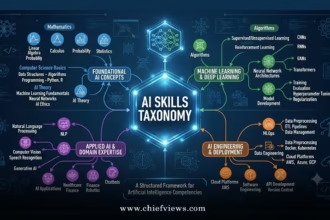
That means your people need prompt engineering, AI workflow design, data literacy, ethical AI decision-making, and human-AI collaboration skills. Not abstract theory—practical application to your industry.
Common Gap Profiles:
- Sales teams drowning in manual lead qualification, missing AI-powered personalization.
- Finance still doing spreadsheets manually while competitors use AI forecasting.
- Marketing generating generic content instead of AI-amplified, hyper-targeted campaigns.
- Operations scheduling by gut instead of predictive optimization.
- Customer support answering repetitive queries instead of focusing on complex resolutions.
The fix? Targeted upskilling that connects learning to revenue impact.
AI Upskilling for Mid-Market Organizations: The 5-Pillar Framework
Pillar 1: Role-Specific AI Competency Mapping (Start Here)
Don’t guess. Map every role to AI impact.
Quick Audit Process:
- List core tasks for each department.
- Tag tasks as: AI-automated, AI-augmented, human-only.
- Identify 3–5 high-leverage skills per role (e.g., “Sales: AI lead scoring + personalized outreach”).
- Prioritize by revenue/customer impact.
Example: A mid-market SaaS company mapped their Customer Success Manager role. Found 35% of time spent on case triage and basic research—perfect for AI. Upskilling target: AI case classification + research summarization. Result: 28% faster resolution times.
Pillar 2: Bite-Sized, High-Impact Learning (No LMS Bloat)
Mid-market can’t afford 6-month certification marathons. Focus on micro-skills that deliver immediate value.
Winning Format:
- 3–6 week sprints per skill cluster.
- 2 hours/week maximum (carved from low-value tasks).
- 80% hands-on projects, 20% instruction.
- Real tools: ChatGPT Enterprise, Claude Team, Google Gemini Workspace, industry-specific platforms.
Sample Sprint: “AI-Powered Sales Acceleration”
Week 1: Prompt engineering basics + lead scoring
Week 2: Personalized outreach generation + A/B testing
Week 3: Objection handling with AI research
Week 4: Pipeline forecasting integration
Week 5: Live project deployment + measurement
Pillar 3: Project-Tied Application (Learning That Sticks)
Pure training fails 90% of the time. Learning-by-doing succeeds.
The Model:
- Identify a live business problem.
- Assign 3–5 people with baseline skills.
- Give them AI tools + sprint training.
- Deploy solution in production.
- Measure impact (revenue, time saved, customer satisfaction).
- Showcase success organization-wide.
Real example: Mid-market manufacturer upskilled their supply chain team on predictive inventory AI. Deployed in Q3 2025. Reduced stockouts by 42%, saved $1.2M annually. Team stayed, requested more training.
Cost & ROI Breakdown: Mid-Market Reality Check
| Program Scale | Investment | Time to Deploy | Expected ROI (12 Months) | Key Success Factor |
|---|---|---|---|---|
| Pilot (1 Dept, 10 People) | $15K–$25K | 8–12 weeks | 3–5x (time savings + revenue lift) | Manager buy-in + live project |
| Department Rollout (50 People) | $75K–$125K | 4–6 months | 4–7x | Cross-functional coordination |
| Organization-Wide (200+ People) | $250K–$400K | 9–12 months | 5–10x | CHRO sponsorship + measurement rigor |
| Perpetual Model (Ongoing) | $50K–$80K/year | Continuous | 8–15x | Internal champions + content refresh |
Note: ROI driven by 20–40% productivity gains + 15–25% retention improvement. Source: Gartner AI Upskilling Benchmarks 2026.

Step-by-Step Implementation for Mid-Market CHROs
Step 1: Secure Executive Alignment (Week 1)
Pitch Template: “AI upskilling delivers 4–7x ROI in mid-market. Our competitor X just announced 30% productivity gains. Without this, we risk talent flight and capability gaps. Pilot costs $20K, pays for itself in 4 months.”
Get CEO + department head sign-off.
Step 2: Launch Skills Audit (Weeks 1–3)
Form cross-functional team (1 per department + 1 data person). Complete role mapping. Prioritize top 3 departments by impact/risk.
Step 3: Select Tools & Partners (Weeks 3–5)
Mid-Market Sweet Spot:
- Anthropic Claude Team for team collaboration ($30/user/month).
- OpenAI Enterprise for custom models ($60/user/month).
- Course Hero or Udacity Enterprise for structured content ($15K–$50K/year).
Avoid overkill. Start with what 80% of your use cases need.
Step 4: Run Pilot Sprint (Weeks 6–12)
Pick one high-impact department. Run the 6-week sprint format. Deploy real project. Measure everything.
Step 5: Scale with Champions (Months 4+)
Promote pilot graduates as internal champions. Run parallel sprints across departments. Create “AI Center of Excellence” with 2–3 full-time equivalents.
Common Pitfalls (And How to Dodge Them)
Pitfall 1: “Everyone Needs Everything” Syndrome
You train marketing on supply chain AI. Waste of time.
Fix: Role-specific mapping. Laser focus.
Pitfall 2: Training Without Deployment
People learn prompt engineering, never use it. Skills atrophy.
Fix: Mandatory project deployment. No project graduation.
Pitfall 3: Manager Resistance
“Managers block time allocation, call it ‘non-essential.'”
Fix: Tie 20% of manager bonus to team skill completion rates.
Pitfall 4: Tool Overload
Everyone gets 17 different AI tools. Chaos.
Fix: Standardize 2–3 enterprise tools + department-specific add-ons.
Pitfall 5: Measuring the Wrong Thing
“90% completion rate!” But no business impact.
Fix: Track time saved, revenue generated, customer outcomes. Tie to P&L.
Tying It Back: Retention Through Capability
AI upskilling isn’t just about productivity. It’s your strongest retention lever.
When people see clear paths to mastery—tied to real business impact—they stay. They refer friends. They become your advocates.
This dovetails perfectly with hybrid talent retention frameworks for CHROs post-2025 AI shift. Upskilling provides the what (skills), retention frameworks provide the why (belonging, security, growth).
Organizations doing both? They’re pulling ahead. 25% lower turnover. 35% higher internal promotion rates. Talent magnetism.
Key Takeaways
• AI upskilling for mid-market organizations demands role-specific mapping—generic training wastes your limited budget.
• Micro-sprints + live projects deliver 4–7x ROI in 6–12 months. Theory without application is dead weight.
• Standardize 2–3 enterprise tools first. Tool sprawl kills adoption.
• Manager accountability is non-negotiable—tie their incentives to team upskilling success.
• Measure business outcomes, not completion rates—time saved, revenue gained, customers delighted.
• This builds your talent moat—skilled people stay, attract more skilled people.
• Pilot first, then scale—prove value with one department before organization-wide commitment.
Get Started Today
Pick your highest-impact department. Run the skills audit this week. Launch your first sprint next month.
Mid-market moves fast when it moves together. Your competitors are already starting. The window closes quickly.
Frequently Asked Questions
What’s the fastest way to see ROI from AI upskilling for mid-market organizations?
Pilot with sales or customer success—highest revenue impact, fastest deployment. Focus on lead qualification, personalization, or case triage. Expect 20–30% productivity lift in 8–12 weeks.
How do I fund AI upskilling without a massive budget?
Repurpose 10–15% of your L&D budget + savings from AI automation (time freed from routine tasks). Mid-market pilots cost $15K–$25K and pay back in 4–6 months through productivity alone.
What if my team resists AI upskilling—how do I overcome it?
Start with wins. Show early pilot results (real numbers: time saved, deals closed). Create internal champions. Frame as career acceleration, not job replacement. Tie to clear promotion paths.