


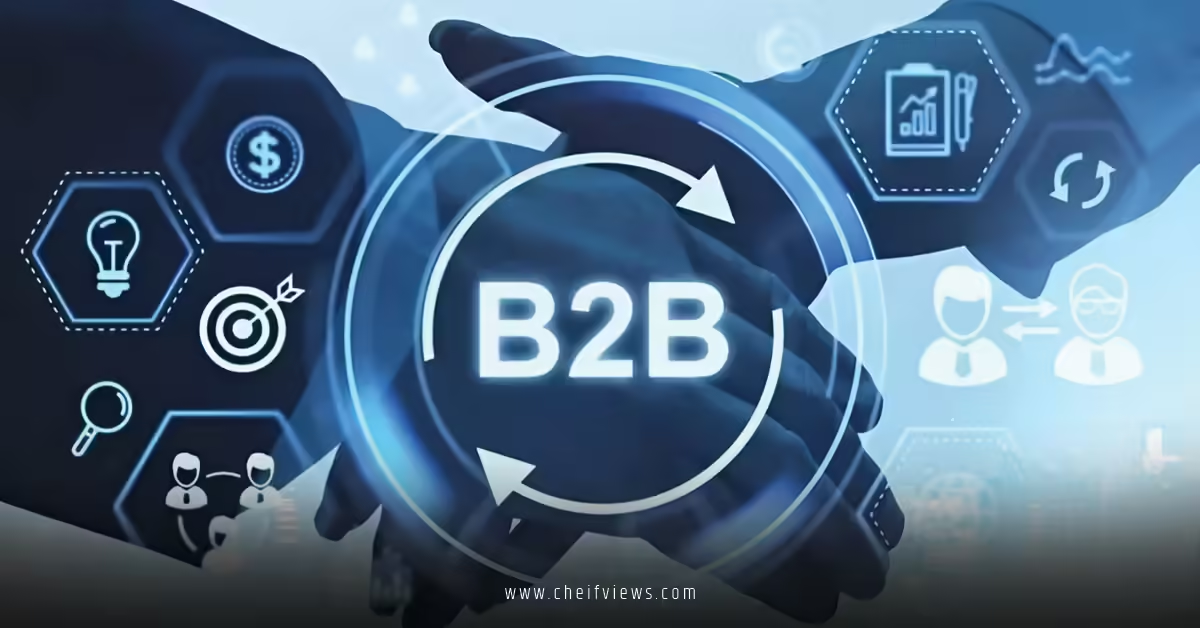
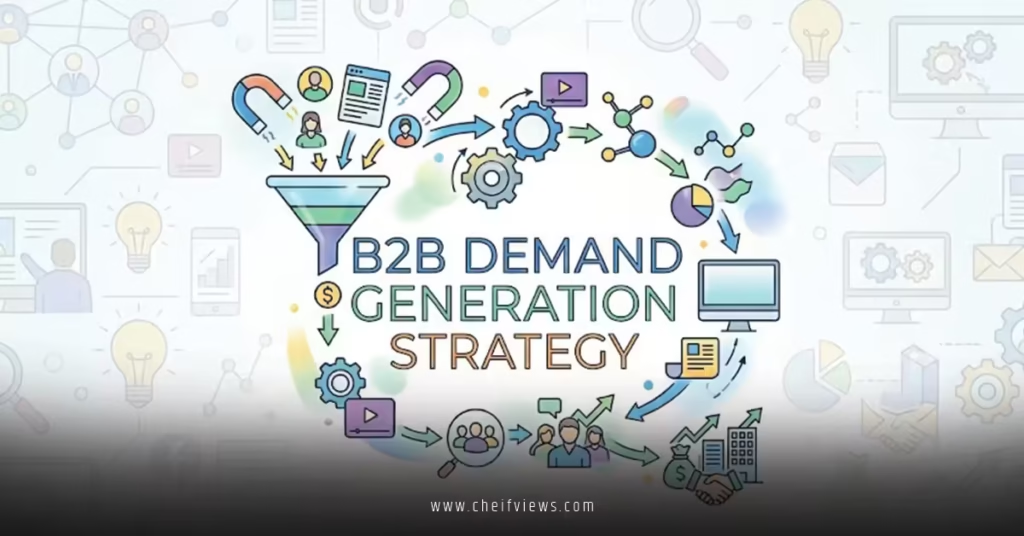
A strong B2B demand generation strategy is how you stop “running campaigns” and start running a revenue engine. It’s the system that turns strangers into sales-ready opportunities your reps actually want to work.
In this guide, you’ll get a clear, practical framework you can plug into your business—whether you’re just getting serious about demand gen or tightening up a half-working system that’s leaking pipeline.
What Is a B2B Demand Generation Strategy?
A B2B demand generation strategy is a structured, measurable plan for:
- Reaching your ideal customers
- Educating them on their problem and your solution
- Capturing in-market demand
- Turning interest into qualified pipeline and revenue
It’s not a single campaign, channel, or tactic. It’s the coordinated way you use channels, content, data, and sales alignment to drive opportunities consistently.
In practice, the best B2B demand gen strategies do three things really well:
- Focus relentlessly on the right accounts and buyers
- Use content to move those buyers through each stage of awareness
- Measure everything against pipeline and revenue—not vanity metrics
If you want to go deeper on the analytics and measurement side, it’s worth tying your strategy into a data driven demand generation best practices CMO framework so you can defend every dollar and double down on what works.

The Core Building Blocks of a Strong B2B Demand Generation Strategy
Before you worry about channels and campaigns, lock in the foundations.
1. Define a Sharp ICP and Buying Committee
Vague targeting kills ROI. Specific targeting prints money.
Your Ideal Customer Profile (ICP) should cover:
- Company size, revenue band, industry
- Tech stack and current tools
- Typical pains, risks, and triggers
Then map the buying committee:
- Who feels the pain first?
- Who researches options?
- Who signs the contract?
Each of these roles needs different messaging and different proof.
2. Map the Buyer Journey
Your buyers don’t wake up and go straight to “book demo.”
You’ll normally see these stages:
- Unaware – They don’t know they have a problem
- Problem aware – They feel pain, aren’t sure what’s causing it
- Solution aware – They know categories and approaches
- Vendor aware – They’re comparing suppliers
- Decision – They’re weighing risk and fit
Your B2B demand generation strategy should map content and offers to each stage so you’re not pitching a demo to someone who just realized they have a problem yesterday.
3. Align with Sales (for Real)
If Sales isn’t bought in, it’s not a demand gen strategy. It’s just marketing noise.
You need agreement on:
- What a “good” lead/account looks like
- The difference between MQL, SQL, and opportunity
- Handoff rules (SLAs) and follow-up expectations
Then you meet regularly—at least monthly—to review:
- Which leads/opportunities are converting
- Which campaigns are generating real pipeline
- What messaging resonates in late-stage deals
This feedback loop is where you find your biggest wins.
Channel Mix: Where B2B Demand Gen Actually Happens
A strong B2B demand generation strategy uses a mix of “demand creation” and “demand capture” channels.
Demand Creation Channels
These build awareness and desire before someone hits the market:
- LinkedIn ads and thought leadership
- Podcasts and guest appearances
- Webinars, virtual events, and live demos
- Upper-funnel content (guides, reports, industry POVs)
These won’t always show clear last-click ROI, but they’re the reason your brand shows up on shortlists later.
Demand Capture Channels
These grab in-market buyers who are already looking:
- Google search ads on high-intent keywords
- SEO content targeting commercial and transactional queries
- Review sites and directories
- Website conversion flows (pricing pages, demo pages, trials)
This is where you want tight tracking, strong offers, and fast follow-up from Sales.
Mid-Funnel Nurture & Acceleration
Once they know you, don’t let them drift.
- Email nurture sequences based on behavior
- Case studies, ROI stories, and product walkthroughs
- Retargeting ads tailored to stage and segment
- ABM plays for target accounts (coordinated ads + SDR outreach)
This is how you turn soft interest into real opportunities.
Step-by-Step B2B Demand Generation Strategy (You Can Actually Execute)
Here’s a simple blueprint you can implement over the next 90–180 days.
Step 1: Audit Your Current Funnel and Performance
Start with reality, not wishful thinking.
- Pull 6–12 months of data from your CRM
- Look at: leads, MQLs, SQLs, opportunities, and revenue by channel
- Identify:
- Which channels actually create pipeline
- Where conversion rates fall off
- Which segments close faster or at higher ACV
This tells you what to keep, what to fix, and what to stop.
Step 2: Set Clear, Revenue-Backed Goals
Think in pipeline, not just leads.
For example:
- Target: $5M in new ARR next year
- Win rate: 25%
- Needed pipeline: $20M
Then set targets by segment and channel:
- How much pipeline from inbound?
- From outbound plus marketing?
- From events and partners?
Tie your goals to sales capacity so you’re not generating more “leads” than reps can reasonably handle.
Step 3: Build a Focused Channel Plan
Pick a few core motions, not 12 half-baked plays.
For a typical B2B SaaS or services company, a starter mix might be:
- Paid search for bottom-of-funnel demand capture
- SEO + content for compounding inbound
- LinkedIn for targeted awareness and demand creation
- Email and retargeting for nurture and acceleration
- 1–2 flagship webinar or event series for high-intent engagement
Document, in one page per channel:
- Objective (awareness, pipeline, expansion)
- Audience
- Key offers
- Budget and timelines
- Primary metrics
Then hold each channel accountable to opportunities and revenue, not just vanity metrics.
Step 4: Design Content Around the Real Buyer Journey
No more random blog posts.
Build a content matrix:
- Rows: buyer stages (unaware → decision)
- Columns: personas (economic buyer, technical buyer, champion, user)
For each intersection, list:
- 1–2 topics
- Format (blog, guide, case study, webinar, calculator, comparison page)
- CTA (next best action for that stage)
This becomes your content roadmap for the next 3–6 months.
Step 5: Instrument, Track, and Attribute
A B2B demand generation strategy is only as good as its measurement.
Make sure you have:
- Clean UTM tagging and strict naming conventions
- Forms that capture both firmographic data and “How did you hear about us?”
- Integrated CRM + marketing automation + analytics
- Dashboards that show:
- Pipeline and revenue by channel and campaign
- Conversion rates between each stage
- CAC and payback by motion
Once this is in place, you can plug directly into a data driven demand generation best practices CMO framework and get serious about budget allocation and optimization.
Step 6: Test, Learn, and Iterate
You’re not aiming for a “perfect strategy.” You’re aiming for a learning machine.
Every quarter:
- Pick 3–5 tests (not 30)
- Define what you’re testing: offer, audience, message, format, channel
- Set a clear success metric (e.g., cost per opportunity, demo conversion rate, win rate impact)
- Kill or scale based on results
Over time, this gives you a portfolio of proven plays you can run with confidence.
Example: Simple B2B Demand Gen Strategy Snapshot
Here’s how a lean-but-serious strategy might look in practice.
| Component | What You Do | Primary Metrics | Time Horizon |
|---|---|---|---|
| Paid Search (Demand Capture) | Bid on high-intent keywords, direct to focused demo/pricing pages | Cost per opportunity, pipeline generated, win rate | Short-term (0–3 months) |
| SEO & Content | Create buyer-focused content and comparison pages mapped to journey | Organic traffic, SQLs, pipeline from organic | Mid–long term (3–12+ months) |
| LinkedIn Ads | Target ICP with problem-aware and solution-aware messaging | Engagement, direct opportunities, branded search lift | Mid-term (3–6 months) |
| Webinars / Events | Run topic-specific sessions with strong offers and Sales alignment | Attendees, SQLs, opportunities created | Mid-term (3–6 months) |
| Email & Nurture | Segmented sequences based on behavior and lifecycle stage | Engagement, reactivation, multi-touch influenced pipeline | Ongoing |
Common Mistakes in B2B Demand Generation Strategy
You don’t need to make these the hard way.
Mistake 1: Chasing Leads, Ignoring Pipeline
Thousands of “leads” don’t matter if Sales can’t close any of them.
Fix it by:
- Raising qualification standards
- Optimizing for opportunities and revenue
- Making SQL and opportunity creation your primary success metrics
Mistake 2: Spreading Budget Too Thin Across Channels
Trying everything means you master nothing.
Fix it by:
- Picking a few core channels based on historical performance and ICP behavior
- Setting minimum spend levels needed to actually learn
- Pausing or cutting underperforming channels ruthlessly
Mistake 3: No Real Feedback Loop with Sales
If you only hear from Sales when there’s a problem, your strategy will never stabilize.
Fix it by:
- Running joint pipeline reviews (Marketing + Sales)
- Analyzing closed-won and closed-lost reasons together
- Iterating your targeting, messaging, and offers based on real deal feedback
Mistake 4: Weak Measurement and Attribution
If you can’t see what works, you can’t scale it.
Fix it by:
- Standardizing tracking and naming across campaigns
- Blending system attribution with self-reported attribution
- Aligning reporting with a data driven demand generation best practices CMO style dashboard that ties every major motion to revenue
How to Evolve Your B2B Demand Generation Strategy Over Time
Once the basics are in place and you’re generating consistent pipeline, you can move into more advanced plays.
- Account-Based Marketing (ABM): Coordinate ads, outbound, and content around a defined list of high-value accounts.
- Intent Data: Use third-party and first-party signals to prioritize outreach and customize plays.
- Lifecycle & Expansion: Build campaigns for onboarding, adoption, upsell, and retention—not just net-new logos.
- Revenue Operations Partnership: Work with RevOps to improve forecasting, scoring models, and revenue reporting.
The strategy should get sharper every quarter as your data gets better and your team learns which levers actually move revenue.
Key Takeaways
- A B2B demand generation strategy is a system for creating and capturing demand, not a one-off campaign calendar.
- Everything starts with a tight ICP, mapped buying committee, and clear buyer journey.
- Channels should be split into demand creation, demand capture, and nurture/acceleration—and measured against opportunities and revenue.
- The best results come from focused channels, not spraying budget across every possible platform.
- Sales alignment and feedback aren’t “nice to have”; they’re the engine that tunes your messaging and targeting.
- Solid tracking, attribution, and dashboards let you plug your plan into a data driven demand generation best practices CMO framework and defend your budget.
- Treat your demand gen motion as an ongoing experiment portfolio—learn fast, kill weak plays, and scale proven ones.
FAQs
1. What is a B2B demand generation strategy?
A B2B demand generation strategy is a structured plan to attract the right buyers, educate them, capture interest, and turn that interest into qualified pipeline and revenue.
2. How does data driven demand generation best practices CMO improve B2B demand gen?
It helps a CMO measure what actually drives pipeline, cut waste, improve attribution, and make budget decisions based on revenue instead of vanity metrics.
3. What’s the biggest mistake in B2B demand generation strategy?
Chasing lead volume instead of pipeline quality. If Marketing and Sales aren’t aligned on what a good opportunity looks like, the funnel usually fills up with noise.