










CFO guide to balancing AI ROI with cost optimization starts with a hard truth most finance leaders already feel in 2026: AI spend is climbing fast while clear, board-ready returns lag. Boards want proof. Token bills arrive without matching value stories. The winners treat AI like a capital portfolio, not a blank check.
Here’s the quick overview of what this guide delivers:
- Why traditional SaaS budgeting fails for AI and how to fix the unit economics
- A practical framework that links every AI dollar to measurable business outcomes
- Step-by-step actions any mid-market or enterprise finance team can run this quarter
- Common traps that kill ROI and the exact fixes that restore control
- Tools and metrics that turn cost optimization into a repeatable operating rhythm
AI now sits on the CFO agenda for a reason. Deloitte data shows 60 percent of finance leaders expect AI costs and technical complexity to rise substantially through 2027. At the same time, McKinsey’s latest global survey finds only about 6 percent of organizations qualify as AI high performers—those attributing at least 5 percent of EBIT to AI with significant impact. The gap is real. The fix is discipline.
Why the old playbook breaks on AI spend
Software used to be headcount-driven. Licenses scaled with seats. AI scales with usage, context length, agent loops, and model choice. One poorly scoped agentic workflow can burn thousands in tokens before anyone notices.
Accenture research put a sharp number on the problem: four out of five dollars of AI token spend lack a quantified link to business outcomes. Only about one dollar in five currently maps to a verifiable financial return. That is not a technology failure. It is a measurement and governance failure.
In my experience, the companies that pull ahead do three things differently. They baseline before they deploy. They track fully loaded total cost of ownership, not just the model invoice. And they treat AI projects as a portfolio of bets with different risk and payback profiles—exactly the way Gartner advises CFOs to rethink ROI.


Gartner analysts have been clear: stop hunting for a single ROI formula. Productivity use cases, targeted process fixes, and selective transformational bets each carry distinct cost curves and value shapes. Force them all through the same spreadsheet and you undervalue the long-horizon work while overfunding the shiny pilots.
Building the CFO guide to balancing AI ROI with cost optimization framework
Start with visibility. Without a single source of truth for AI spend across cloud, software, tokens, and human oversight, every conversation turns into a guess.
Next, demand outcome metrics at the point of funding. Cycle time reduction, cost avoided, conversion lift, error rate drop, or capacity freed—pick the ones that matter to the business case and instrument them from day one. IBM Apptio and similar platforms now help connect each initiative to those proof metrics and track them over time.
Then apply stage-gate funding. Release capital in tranches. Pilot success unlocks the next tranche. Miss the targets and the project stops or pivots. This is the approach 27 percent of finance leaders already use for large tech investments, according to recent Deloitte findings.
Finally, install FinOps-style accountability for AI. Chargebacks to business units once a use case moves to production. Central budgets stay for true experiments. Visibility into who is consuming what forces better decisions at the prompt level.
Practical metrics that survive board scrutiny
| Metric Category | Example Measures | Typical Time Horizon | Best Use Case Type |
|---|---|---|---|
| Cost Avoidance | Hours redeployed × loaded labor rate; process cost reduction | 3–9 months | High-volume transactional automation (AP, reconciliation) |
| Speed & Capacity | Close cycle compression; forecast refresh time | 6–12 months | FP&A and decision support |
| Risk & Quality | Error rate drop; compliance exceptions prevented | 6–18 months | Controls and audit workflows |
| Revenue / Growth | Conversion lift; new capacity for higher-value work | 12–24 months | Customer-facing or sales-enablement agents |
| Full TCO | Tokens + infrastructure + oversight + change management | Ongoing | All production AI |
This table is not theoretical. Teams that match the metric to the use case stop arguing about “AI value” and start managing numbers.
Step-by-step action plan for the next 90 days
- Inventory every AI initiative with annual spend above a clear threshold (many use $250K). Capture owner, current cost drivers, and stated outcome metric. Most finance teams discover 30–40 percent of spend has no documented success definition.
- Build a lightweight AI TCO model. Include model/token costs, infrastructure, data preparation, human review loops, and ongoing governance. Understating TCO is the single fastest way to create fake ROI.
- Rank the portfolio. Kill or pause anything that cannot name a measurable outcome within one quarter. Protect the high-confidence, high-volume automation plays. Keep a small, protected experimental envelope.
- Install real-time cost visibility for the top consumers. Prompt caching, model routing (right-size the model to the task), and usage dashboards routinely cut unit costs 20–30 percent when teams can see the numbers. McKinsey analysis confirms thoughtful consumption management delivers those ranges.
- Move production workloads to business-unit chargeback. Keep central funding only for true pilots. This single shift changes behavior faster than any policy memo.
- Schedule quarterly portfolio reviews with the same rigor applied to capital projects. Scale what works. Sunset what does not. Reallocate the savings into the next high-ROI bets.
What I would do if I walked into a mid-sized U.S. company tomorrow: freeze new AI spend above a set threshold for 30 days while the inventory and TCO models get built. Then reopen the gates with the new rules. Momentum returns quickly once the noise is gone.
Common mistakes & how to fix them
Mistake one: treating AI like another SaaS line item. Token economics and agent loops do not behave like seat licenses. Fix: budget for consumption and outcomes, not headcount.
Mistake two: measuring only productivity hours saved. Boards now want EBIT impact or clear risk reduction. Fix: expand the value shapes—cost avoided, capacity freed for higher-value work, faster decisions, error prevention.
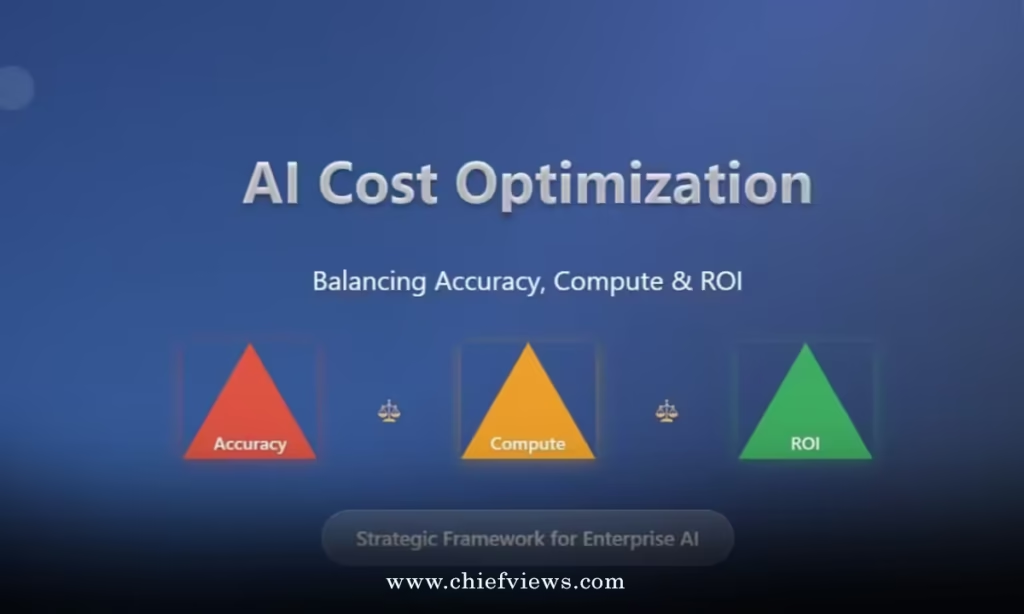
Mistake three: running every use case on the most expensive frontier model. That is the Ferrari-for-every-trip problem. Fix: route tasks to the cheapest model that meets quality thresholds. The savings compound fast.
Mistake four: no baseline before go-live. Without a pre-AI measurement, every later claim looks like storytelling. Fix: capture the baseline numbers before the first production token is spent.
Mistake five: leaving cost ownership in IT while value ownership sits in the business. Fix: joint accountability and chargebacks once the use case is live.
How the CFO guide to balancing AI ROI with cost optimization plays out in practice
The organizations pulling ahead treat AI cost optimization as an architectural requirement, not a retrospective finance exercise. They match model to task. They build cost controls into the agentic workflows themselves. They give engineers and analysts real-time visibility into the burn rate. Uber’s experience, shared publicly in 2026, showed that prompt caching, model-setting optimization, and usage dashboards flipped rising token costs into declining ones.
The same discipline shows up in finance-specific deployments. High performers free 30 percent or more of team capacity for advisory work, automate large shares of reporting, and improve predictive power of models by 50 percent or more—numbers that BCG has documented in leading AI-first finance functions.
One fresh way to think about it: AI spend behaves like a high-performance race car. You can keep pouring fuel in and never win if the suspension, tires, and driver are wrong. Cost optimization is the chassis work that lets the engine actually deliver lap times.
Key Takeaways
- AI spend is rising while proven ROI remains scarce for most organizations; only a small minority currently qualify as high performers.
- Traditional SaaS budgeting fails because AI costs are usage-driven and nonlinear.
- Full TCO, outcome metrics defined at funding, and stage-gate capital release form the core control system.
- Model routing, prompt caching, and real-time visibility routinely deliver 20–30 percent unit-cost reductions.
- Portfolio thinking—different bets with different payback profiles—beats the single-ROI formula.
- Chargebacks and joint business-IT ownership change behavior faster than policy alone.
- Quarterly rebalancing of the AI portfolio turns cost optimization into a compounding advantage.
The real benefit is simple. Finance stops being the department that says “no” to AI and becomes the function that makes AI pay. That shift strengthens the CFO’s influence and protects the enterprise from budget surprises that reach the board.
Start this week with the inventory. Name the owners. Demand the outcome metrics. The rest follows.
FAQs
What is the fastest way for a mid-market company to apply the CFO guide to balancing AI ROI with cost optimization?
Begin with a 30-day inventory of every AI initiative over a set spend threshold, attach a single primary outcome metric to each, and pause new funding until those metrics exist. That single discipline usually surfaces the biggest waste quickly.
How does the CFO guide to balancing AI ROI with cost optimization handle token cost volatility?
Treat tokens as a variable cost that must be instrumented and optimized in real time. Route tasks to the lowest-cost capable model, cache stable prompt context, and give users visibility into their burn rate. These steps routinely cut consumption 20–30 percent without sacrificing quality.
Why do so many AI projects still miss ROI targets even when the technology works?
Measurement gaps and incomplete TCO models are the usual culprits. Teams track license or token invoices while ignoring data prep, human oversight loops, and change management. Correct the cost side and the value side becomes measurable.

