




Hey there, fellow HR enthusiasts and business leaders—let’s talk about something that’s keeping every forward-thinking CHRO up at night (or exciting them, depending on the coffee intake). CHRO priorities for AI and human talent in 2026 are all about striking that perfect balance: unleashing the power of artificial intelligence while ensuring your human workforce remains the irreplaceable heart of your organization.
Imagine AI as the brilliant, tireless intern who handles repetitive tasks at lightning speed, while your people are the seasoned strategists dreaming up innovations and building genuine connections. In 2026, the most successful CHROs won’t choose between the two—they’ll orchestrate a symphony where both thrive together. Drawing from insights by leading experts like Gartner (who surveyed hundreds of CHROs worldwide), this is the year when AI moves from buzzword to boardroom reality, reshaping talent strategies amid uncertainty.
Why does this matter now? Because organizations that get CHRO priorities for AI and human talent in 2026 right will surge ahead, boosting productivity, innovation, and employee engagement. Those that lag? They’ll struggle with skills gaps, cultural drift, and missed opportunities. Ready to dive in? Let’s break it down.
Why CHRO Priorities for AI and Human Talent in 2026 Are More Critical Than Ever
Picture this: Economic pressures, geopolitical shifts, and rapid tech evolution are creating a perfect storm. CEOs demand growth and efficiency simultaneously, while employees grapple with “do more with less” expectations. According to research from Gartner, CHROs in 2026 face a landscape where AI isn’t just a tool—it’s increasingly seen as a viable alternative to certain human roles.
This shift forces a fundamental rethink. CHRO priorities for AI and human talent in 2026 center on maximizing both to hit ambitious goals amid constant change. It’s no longer about experimenting with AI pilots; it’s about integrating it strategically while nurturing the uniquely human elements like creativity, empathy, and adaptability.
Think of it like upgrading your team’s engine without forgetting to fuel the drivers. Get the balance wrong, and you risk “culture atrophy”—that slow erosion of engagement when people feel like cogs in an AI machine.
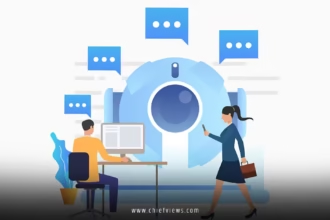

Harnessing AI to Revolutionize HR: The Top Priority
Let’s start with the big one. Gartner identifies harnessing AI to revolutionize HR as a primary focus for CHROs in 2026. This means crafting a dedicated, HR-focused AI strategy rather than just tagging along with the enterprise-wide one.
Why is this so powerful? Evolving your HR operating model could deliver up to 29% of AI productivity gains. We’re talking about automating routine tasks like resume screening, onboarding, and even initial performance feedback, freeing your team for higher-value work.
But here’s the conversational twist: Have you ever wondered why so many AI initiatives fizzle? It’s often because HR wasn’t in the driver’s seat from day one. In 2026, proactive CHROs are building AI centers of excellence within HR, prioritizing high-impact use cases, and measuring success with clear metrics. It’s like giving your HR department superpowers—without losing the human touch.
For more on building responsible AI in HR, check out this guide from Gartner on AI in HR.

Shaping Work in the Human-Machine Era
Now, onto the blended workforce. CHRO priorities for AI and human talent in 2026 demand a “now-next” talent strategy: Deliver results today while preparing for tomorrow.
AI will handle predictable, data-heavy tasks, leaving humans to fill gaps, innovate, and explore. CHROs must plan for multiple scenarios—AI agents as co-workers, humans pushing boundaries with AI assistance, or even AI stepping in where talent shortages bite.
This means redesigning jobs, upskilling aggressively, and shifting to skills-first hiring. Skills gaps are widening, but organizations embracing this blended model see massive gains in agility and innovation.
Visualize your workforce like a high-performance sports team: AI is the analytics coach spotting patterns, while humans are the players executing with flair and intuition.
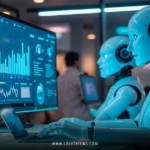
Here are some inspiring examples of blended human-AI teams in action:
These visuals show how collaborative human-AI environments boost creativity and efficiency—exactly what forward-thinking CHROs are building in 2026.
Mobilizing Leaders for Growth Amid Uncertainty
Uncertainty isn’t going anywhere in 2026. CEOs push for growth, but volatility makes it feel like steering a ship in a storm. This is where CHRO priorities for AI and human talent in 2026 include empowering leaders to thrive.
CHROs are training managers to lead change like pros—focusing on coaching, trust-building, and intuition over admin work. It’s about helping leaders navigate “ungovernable change” while keeping teams motivated.
Rhetorical question: If your managers are bogged down, how can they inspire? The answer lies in AI offloading tasks so leaders can focus on people.
Addressing Culture Atrophy to Drive Performance
Finally, don’t overlook culture. In the rush to adopt AI, many organizations experience “culture atrophy”—disengagement from constant change and efficiency pressures.
Successful CHROs embed culture into daily work, fostering human connections and recognition. Organizations that do this see up to 34% higher performance. It’s the glue that holds everything together when AI handles the heavy lifting.
Conclusion
Wrapping it up: CHRO priorities for AI and human talent in 2026 boil down to four interconnected pillars—revolutionizing HR with AI, shaping a human-machine workforce, mobilizing leaders through uncertainty, and combating culture atrophy. By focusing here, CHROs can turn disruption into opportunity, driving growth while keeping humans at the center.
The future isn’t about AI replacing people—it’s about amplifying them. Take the leap, invest in these priorities, and watch your organization soar. You’ve got this.
FAQs on CHRO Priorities for AI and Human Talent in 2026
What are the top CHRO priorities for AI and human talent in 2026?
According to Gartner, they include harnessing AI to revolutionize HR, shaping work in the human-machine era, mobilizing leaders for growth, and addressing culture issues to power performance.
How can CHROs balance AI adoption with human talent development in 2026?
By creating a “now-next” talent strategy that delivers immediate results while upskilling employees for AI collaboration, ensuring technology augments rather than replaces human strengths.
Why is an HR-focused AI strategy essential for CHRO priorities in 2026?
It evolves the HR operating model for maximum productivity gains (up to 29%) and positions HR as a strategic leader in the AI transformation.
What role does culture play in CHRO priorities for AI and human talent in 2026?
Combating “culture atrophy” through embedded practices and human connections can boost employee performance significantly amid rapid change.
How should CHROs prepare leaders for the uncertainties of 2026?
Focus on change training, coaching skills, and AI-enabled tools to free managers for high-impact leadership.