




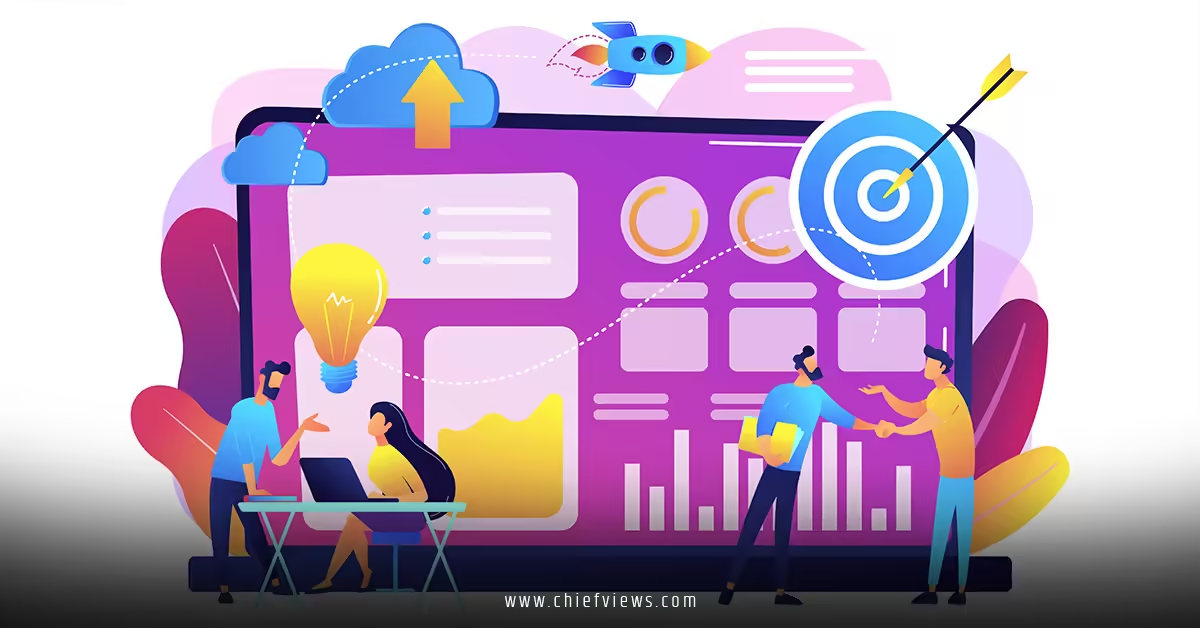
CMO digital marketing transformation strategies aren’t just buzzwords thrown around in boardroom meetings—they’re the difference between companies that thrive in 2026 and those still playing catch-up from 2019. The chief marketing officer role has fundamentally shifted from creative campaigns to data-driven orchestration of customer experiences across every digital touchpoint.
Here’s what smart CMOs are doing right now to transform their marketing operations:
- Building unified customer data platforms that break down departmental silos
- Implementing AI-powered personalization at scale without losing the human touch
- Creating omnichannel experiences that actually feel seamless (not just claim to be)
- Establishing real-time attribution models that prove marketing ROI beyond vanity metrics
- Developing agile content systems that can pivot faster than market trends
The kicker? Most CMOs are still treating digital transformation like a technology problem when it’s actually a people and process challenge wrapped in a tech solution.
The New CMO Playbook: Why Traditional Marketing Leadership Fails
Traditional marketing leadership worked when customers followed predictable journeys. Browse magazine ad. Visit store. Buy product. Done.
That world is dead.
Today’s customers research on TikTok, compare prices on their phones while standing in your competitor’s store, read reviews on platforms you’ve never heard of, and expect personalized experiences that somehow feel authentic rather than creepy.
The CMOs who get this aren’t just buying more marketing tools. They’re fundamentally rewiring how their teams think, work, and measure success.



Core Components of Effective CMO Digital Marketing Transformation Strategies
Data Infrastructure That Actually Works
Most marketing teams are drowning in data but starving for insights. The difference between struggling CMOs and successful ones? They’ve built what I call “decision-ready data systems.”
This means:
- Customer data platforms that update in real-time, not overnight batch processes
- Attribution modeling that tracks the actual customer journey, not just last-click nonsense
- Predictive analytics that help you get ahead of trends instead of reacting to them
Smart CMOs are also establishing data governance protocols early. Because nothing kills a transformation faster than teams fighting over whose conversion numbers are “correct.”
Technology Stack Consolidation
Here’s the hard truth: your marketing team probably uses 47 different tools, and 32 of them do essentially the same thing.
Successful digital transformation means ruthlessly auditing your martech stack. According to the Marketing Technology Landscape report, the average enterprise uses over 120 marketing tools. But the highest-performing teams? They use fewer tools more effectively.
The goal isn’t having the most sophisticated setup. It’s having the most integrated one.
Organizational Restructuring for Speed
Traditional marketing hierarchies move like cruise ships. Digital markets move like speedboats.
Forward-thinking CMOs are flattening their organizations and creating cross-functional pods that can execute campaigns faster than competitors can plan them. This usually means:
- Breaking down walls between paid, owned, and earned media teams
- Embedding analysts directly into creative teams
- Creating rapid-response units for trending topics and real-time opportunities
Skills Development That Matters
Your team needs new capabilities, but not the ones everyone talks about. Sure, everyone needs to understand basic analytics. But the real competitive advantage comes from developing:
Strategic thinking in real-time environments. Teaching marketers to make good decisions with incomplete information, because perfect data analysis takes too long.
Cross-channel orchestration. Understanding how a LinkedIn ad influences email open rates influences in-store visits. Most marketers still think in channel silos.
Customer empathy at scale. Using technology to deliver personalized experiences that feel genuinely helpful, not algorithmic.
Step-by-Step CMO Digital Marketing Transformation Action Plan
Ready to stop talking about transformation and actually do it? Here’s your roadmap:
Phase 1: Assessment and Foundation (Months 1-3)
- Audit your current state ruthlessly. Map every customer touchpoint, every data source, every team handoff. Document what’s actually happening, not what’s supposed to happen.
- Identify your biggest bottlenecks. Usually it’s one of three things: data silos, approval processes, or skill gaps. Fix the biggest constraint first.
- Establish baseline metrics. Pick 5-7 KPIs that directly tie to business outcomes. Revenue attribution, customer lifetime value, cost per acquisition across channels.
- Get executive alignment. Transformation requires investment and patience. Make sure leadership understands this is a 12-18 month commitment, not a quarterly sprint.
Phase 2: Infrastructure and Integration (Months 4-8)
- Implement your customer data platform. This is your foundation. Everything else builds on unified customer profiles.
- Consolidate your martech stack. Cancel redundant tools. Integrate the keepers. Train teams on the new workflow.
- Establish data governance. Create clear ownership of data sources, definitions, and quality standards. Boring but essential.
- Build cross-functional teams. Start with one pilot project that requires collaboration between previously siloed departments.
Phase 3: Optimization and Scale (Months 9-18)
- Launch advanced personalization. Now that you have unified data and integrated tools, you can deliver truly customized experiences.
- Implement predictive analytics. Use historical data to forecast customer behavior and optimize campaigns proactively.
- Scale successful processes. Whatever worked in your pilot projects, systematize and roll out across all campaigns.
- Establish continuous improvement cycles. Monthly reviews, quarterly strategy pivots, annual transformation assessments.
Comparison: Traditional vs. Transformed Marketing Organizations
| Aspect | Traditional Marketing | Transformed Marketing |
|---|---|---|
| Decision Making | Campaign-based, quarterly planning | Real-time optimization, agile sprints |
| Data Usage | Reporting after campaigns | Predictive insights during planning |
| Team Structure | Channel-specific silos | Cross-functional collaboration |
| Customer View | Demographic segments | Individual behavior patterns |
| Success Metrics | Impressions, clicks, opens | Revenue attribution, lifetime value |
| Technology Approach | Best-of-breed point solutions | Integrated platform ecosystem |
Common Mistakes in CMO Digital Marketing Transformation Strategies
The “Shiny Object” Trap
New marketing technology launches every week. Successful CMOs resist the urge to chase every innovation. They focus on mastering their current stack before adding complexity.
The fix: Establish a technology evaluation process. New tools must solve a documented business problem and integrate with existing systems.
Underestimating Change Management
Most transformation failures happen because teams resist new processes, not because the technology doesn’t work.
The fix: Involve frontline marketers in planning. Create champions who can advocate for changes with their peers. Celebrate early wins publicly.
Focusing on Tools Instead of Outcomes
It’s easy to get excited about implementing a new customer data platform. It’s harder to define what success looks like in concrete business terms.
The fix: Start with business objectives, then work backward to required capabilities, then select tools.
Neglecting Data Quality
Garbage in, garbage out. Advanced analytics and AI personalization are only as good as the data feeding them.
The fix: Audit data quality before building sophisticated systems on top of flawed foundations. Clean, standardize, and validate data sources.
Moving Too Fast on Customer-Facing Changes
Internal process improvements can happen quickly. Customer experience changes need more careful consideration and testing.
The fix: Run A/B tests on customer-facing implementations. Gradual rollouts beat big-bang launches for experience changes.
The Role of AI and Machine Learning in Modern Marketing Transformation
Artificial intelligence isn’t replacing marketing creativity—it’s amplifying it. Smart CMOs are using AI to handle routine optimization so human marketers can focus on strategy and innovation.
The most impactful AI applications for marketing transformation include:
Predictive customer scoring. Identifying which leads are most likely to convert, which customers are at risk of churning, and which segments offer the highest growth potential.
Dynamic content optimization. Automatically testing and optimizing email subject lines, ad copy, and website experiences based on individual user behavior patterns.
Attribution modeling. Understanding the true impact of each marketing touchpoint on customer decisions, beyond simple last-click attribution.
The key is starting with specific use cases that solve documented problems, rather than implementing AI for its own sake.
Measuring Success: KPIs That Actually Matter
Vanity metrics feel good but don’t drive business growth. Transformed marketing organizations focus on metrics that directly correlate with revenue and customer value.
Primary metrics:
- Customer acquisition cost by channel (fully loaded, including overhead)
- Customer lifetime value by acquisition source
- Marketing qualified lead to customer conversion rates
- Revenue attribution across the entire customer journey
- Marketing’s contribution to pipeline velocity
Secondary metrics:
- Campaign optimization speed (time from insight to implementation)
- Data accuracy and completeness scores
- Cross-channel campaign coordination effectiveness
- Team productivity improvements from automation
The Harvard Business Review research on marketing measurement emphasizes that the highest-performing marketing organizations track fewer metrics but track them more accurately and act on them more quickly.
Building Organizational Buy-In for Transformation
Transformation initiatives fail when they’re perceived as top-down mandates rather than collaborative improvements. Successful CMOs build consensus through demonstration, not declaration.
Start with pilot projects that solve real pain points for frontline marketers. When the sales team sees that marketing qualified leads are suddenly higher quality, they become advocates for further changes. When content creators can publish faster because of new workflow automation, they champion the transformation.
The most effective approach combines quick wins with long-term vision. Show immediate improvements while building toward comprehensive change.
Future-Proofing Your Marketing Organization
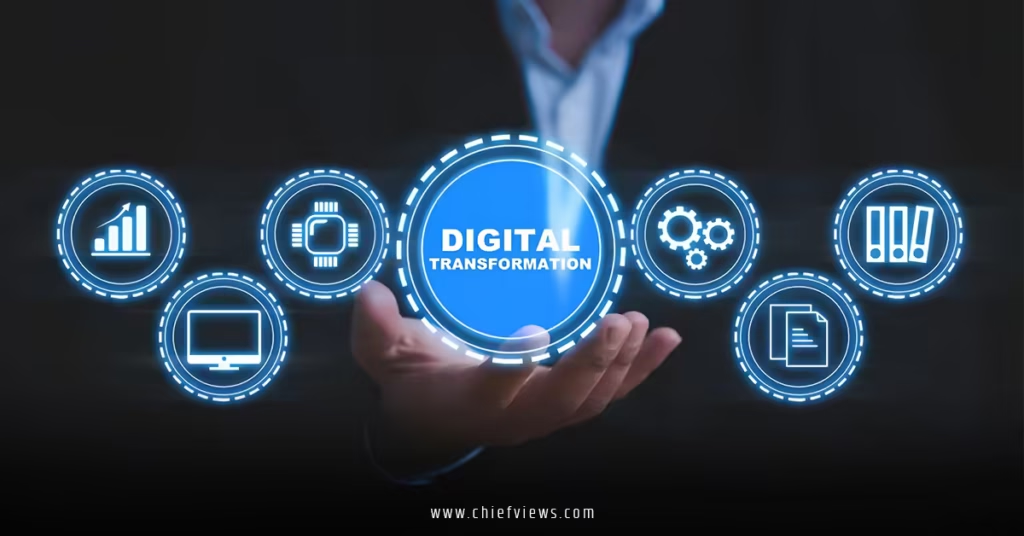
Digital transformation isn’t a destination—it’s an operating philosophy. The marketing landscape will continue evolving, with new channels, technologies, and customer behaviors emerging constantly.
Future-ready marketing organizations build adaptability into their systems and processes. This means:
- Flexible technology architectures that can integrate new tools without complete overhauls
- Cross-trained teams that can pivot between channels and tactics as needed
- Decision-making frameworks that prioritize speed and experimentation over perfectionism
- Continuous learning cultures that see change as opportunity rather than threat
The CMOs who thrive in 2026 and beyond won’t just implement digital transformation—they’ll create organizations that can transform continuously.
Key Takeaways
- Start with business outcomes, not technology features. Define what success looks like before selecting tools to achieve it.
- Focus on integration over accumulation. Fewer tools working together beat more tools working separately.
- Invest heavily in change management. Technology changes are easy; people and process changes require dedicated effort.
- Build data foundations before advanced analytics. Clean, unified customer data enables everything else.
- Create cross-functional collaboration from day one. Silos kill transformation faster than any technology limitation.
- Measure what matters to the business, not just what’s easy to track. Revenue attribution beats vanity metrics every time.
- Plan for continuous evolution, not one-time implementation. Digital transformation is an ongoing capability, not a project.
- Balance automation with human creativity. Use technology to amplify marketing judgment, not replace it.
Conclusion
CMO digital marketing transformation strategies work when they solve real business problems rather than chasing technological trends. The most successful transformations combine smart technology choices with organizational changes that help teams work faster, smarter, and more collaboratively.
Your next step? Pick one specific bottleneck in your current marketing operations and design a solution that addresses both the immediate problem and builds toward broader transformation. Start small, measure carefully, and scale what works.
The companies winning in 2026 aren’t necessarily the ones with the most sophisticated marketing technology—they’re the ones where technology, people, and processes work together seamlessly to create exceptional customer experiences.
Transform thoughtfully, and your marketing organization becomes a competitive advantage that’s hard to replicate.
Frequently Asked Questions
Q: How long does a complete CMO digital marketing transformation typically take?
A: Most comprehensive transformations require 12-18 months for full implementation, but you should see measurable improvements within 90 days of starting. The key is balancing quick wins with sustainable long-term changes.
Q: What’s the biggest budget consideration for marketing transformation initiatives?
A: Technology costs are obvious but often overestimated. The bigger investment is usually training, change management, and temporary productivity decreases while teams adapt to new processes. Plan for 60% technology, 40% people and process costs.
Q: How do you measure ROI on digital marketing transformation projects?
A: Focus on business outcome improvements rather than technology deployment metrics. Track improvements in customer acquisition cost, conversion rates, campaign velocity, and marketing’s contribution to pipeline. Most successful transformations show 20-30% improvement in marketing efficiency within the first year.
Q: What’s the difference between marketing automation and true digital transformation?
A: Marketing automation optimizes existing processes. Digital transformation fundamentally changes how your organization thinks about and executes marketing. Automation is a tool; transformation is a comprehensive approach to modern marketing operations.
Q: How do CMO digital marketing transformation strategies differ for B2B versus B2C companies?
A: B2B transformations typically focus more on lead nurturing, sales alignment, and account-based marketing capabilities. B2C transformations emphasize real-time personalization, omnichannel experiences, and customer lifecycle optimization. Both require unified data platforms and cross-functional collaboration, but the specific use cases vary significantly.