



CMO strategies for customer acquisition cost reduction are no longer optional—they’re essential for survival in today’s hyper-competitive landscape. As marketing budgets tighten and customer expectations soar, chief marketing officers face mounting pressure to acquire new customers without burning through cash. The good news? Smart, data-driven moves can slash CAC dramatically while actually improving the quality of leads you bring in. In this guide, we’ll dive deep into proven, actionable CMO strategies for customer acquisition cost reduction that you can start implementing right away.
Why CMOs Must Prioritize Customer Acquisition Cost Reduction
Let’s start with the reality check: customer acquisition cost has been climbing steadily for years. Paid advertising platforms keep raising bids, organic reach keeps shrinking, and consumers have become expert at tuning out generic messaging. When CAC outpaces customer lifetime value (LTV), profitability erodes fast.
Yet many companies still treat acquisition like an unlimited tap. As a CMO, your job is to turn that tap into a precision instrument. Effective CMO strategies for customer acquisition cost reduction not only protect margins—they free up budget to invest in innovation, brand building, and customer experience. Think of it like upgrading from a gas-guzzling truck to an electric sports car: same distance covered, far less fuel burned.
Understanding Customer Acquisition Cost: The Foundation of Smart CMO Strategies
Before implementing any CMO strategies for customer acquisition cost reduction, you need crystal clarity on what CAC actually measures.
CAC = (Total marketing spend + sales spend attributable to acquisition) ÷ Number of new customers acquired


This includes ad spend, content production, tool subscriptions, agency fees, and the portion of salaries dedicated to acquisition efforts. Many CMOs make the mistake of only counting paid media—leaving huge hidden costs untracked.
Once you have an accurate baseline CAC, segment it by channel, campaign, audience, and product line. You’ll quickly spot the outliers draining your budget. This segmentation is the bedrock of every successful CMO strategy for customer acquisition cost reduction.
Top CMO Strategies for Customer Acquisition Cost Reduction
Here are the most powerful, field-tested approaches that forward-thinking CMOs are using today.
1. Shift Budget to High-Intent, Bottom-of-Funnel Channels
One of the fastest CMO strategies for customer acquisition cost reduction is reallocating spend toward channels where buyers are actively searching for solutions.
Search engine marketing (Google Ads, Microsoft Advertising), comparison shopping engines, and review platforms consistently deliver lower CAC than top-of-funnel social awareness campaigns. Why? Intent.
For example, someone searching “best CRM for small business 2026” is far closer to buying than someone scrolling Instagram. According to HubSpot’s 2025 State of Marketing Report, brands that shifted 30%+ of budget to high-intent channels saw average CAC drops of 28%.
2. Double Down on Organic Content and SEO
Paid traffic costs rise relentlessly. Organic traffic? It compounds.
A robust content marketing and SEO program is one of the most sustainable CMO strategies for customer acquisition cost reduction. Create in-depth guides, comparison articles, tools, calculators, and templates that target commercial and transactional intent keywords.
The upfront investment is significant, but the marginal cost of each additional organic visitor approaches zero. Companies with mature content programs often achieve CAC ratios 3-5x lower than paid-only peers. Focus on topic clusters, update old content regularly, and build internal linking authority.
3. Master Audience Targeting and Lookalike Modeling
Spray-and-pray advertising is dead. Precision targeting is table stakes.
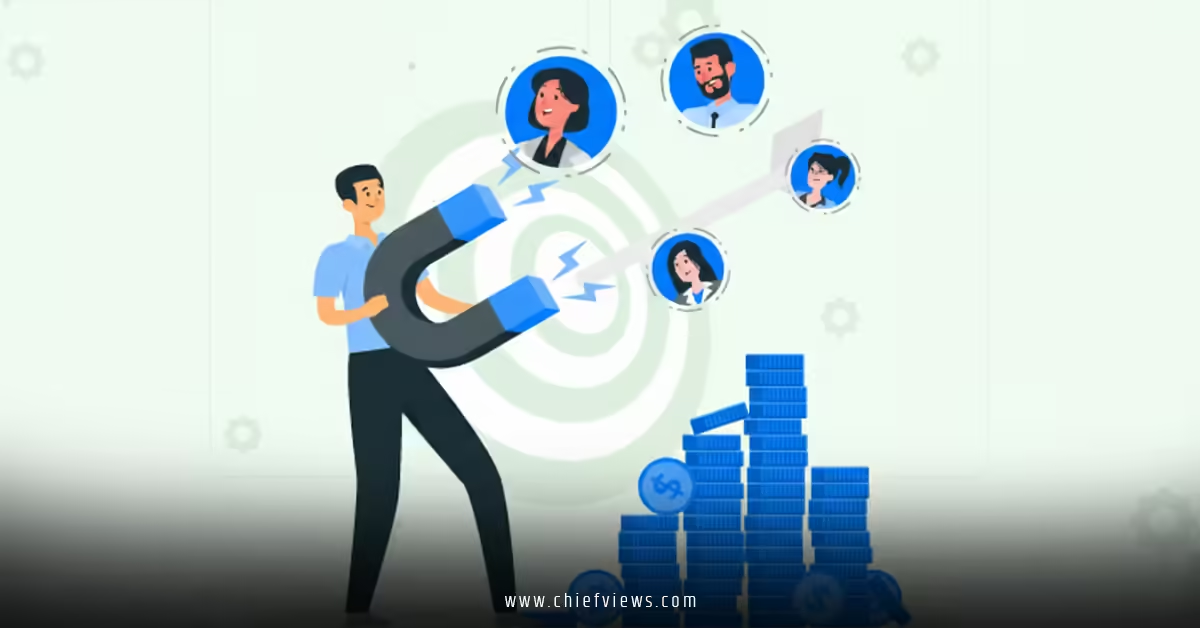
Modern CMO strategies for customer acquisition cost reduction rely heavily on first-party data enrichment, lookalike audiences, and predictive modeling. Upload your highest-LTV customer lists to platforms like Meta, LinkedIn, and Google. Let their algorithms find “digital twins” of your best customers.
Combine this with contextual targeting (placing ads on relevant sites) and retargeting sequences that nurture warm leads. When done right, lookalike audiences can reduce CAC by 40-60% compared to broad demographic targeting.
4. Build Referral and Advocacy Programs That Scale
The cheapest customer is one brought in by an existing happy customer.
Referral programs, when designed thoughtfully, deliver some of the lowest CAC in existence. Dropbox famously grew from 100,000 to 4 million users in 15 months with a simple double-sided referral incentive.
Modern twists include:
- Tiered rewards based on referrer tenure
- Gamification and leaderboards
- Integrating referrals into post-purchase flows
- Partnering with complementary brands for co-referrals
According to Harvard Business Review, referred customers often have 16% higher LTV and cost dramatically less to acquire.
5. Embrace Account-Based Marketing (ABM) for B2B
For B2B companies selling high-ticket solutions, traditional volume-based acquisition is inefficient. ABM flips the script: identify target accounts, then surround them with personalized experiences.
Coordinated efforts across sales, marketing, and customer success create hyper-relevant content, direct outreach, events, and gifting. While total spend may be similar, CAC per valuable customer plummets because conversion rates soar.
Leading ABM practitioners report CAC reductions of 30-50% on their ideal customer profile accounts.
6. Optimize Creative and Messaging Through Rigorous Testing
Generic creative kills performance. Winner creative multiplies it.
The most overlooked of CMO strategies for customer acquisition cost reduction is systematic creative testing. Run multivariate tests on headlines, visuals, offers, and value propositions. Kill losers fast. Scale winners aggressively.
Use dynamic creative optimization (DCO) tools that automatically assemble the best-performing combinations for each audience segment. Brands that test weekly often see 20-40% CAC improvements within quarters.
7. Leverage Partnerships and Co-Marketing
Why pay full freight when you can share it?
Strategic partnerships—affiliate programs, co-marketing campaigns, integrations, and bundle offers—spread acquisition costs across multiple parties. A well-structured affiliate program with performance-based payouts aligns incentives perfectly.
Look for partners serving the same audience but non-competing products. Joint webinars, co-branded content, and shared lead lists can cut effective CAC in half.
8. Implement Marketing Automation and Lead Scoring
Manual processes waste time and miss opportunities.
Marketing automation platforms allow sophisticated nurture streams based on behavior triggers. Lead scoring ensures sales only engages the hottest prospects, improving close rates and reducing wasted spend on unqualified leads.
When combined with progressive profiling (gradually collecting more data), automation dramatically improves conversion rates throughout the funnel—directly lowering CAC.
9. Focus on Customer Retention to Indirectly Reduce CAC
Here’s a counterintuitive truth: the fastest way to lower CAC is often to improve retention.
When customers stay longer and spend more, LTV rises. This allows you to profitably spend more on acquisition while maintaining healthy LTV:CAC ratios. A 5% improvement in retention can boost profits 25-95%, per Bain & Company research.
Invest in onboarding, customer marketing, community building, and proactive success management. Happy customers also refer others—creating a virtuous cycle.
10. Use Data Analytics to Continuously Optimize Spend
Finally, no list of CMO strategies for customer acquisition cost reduction would be complete without emphasizing measurement.
Implement multi-touch attribution modeling (not last-click!) to understand true channel contribution. Use incrementality testing to measure the actual lift from each tactic. Build dashboards tracking CAC by cohort, channel, campaign, and creative.
Make data-driven budget allocation a weekly ritual. Cut underperformers ruthlessly. Double down on winners. This alone can drive 15-30% CAC reductions year over year.
Implementing CMO Strategies for Customer Acquisition Cost Reduction: A Step-by-Step Framework
Ready to put these ideas into action? Follow this practical framework:
- Audit Current State
Calculate accurate CAC across all segments. Map your full funnel. - Set Targets
Define aggressive but realistic CAC reduction goals (15-30% YoY is common). - Prioritize Quick Wins
Start with channel reallocation, creative testing, and retargeting optimization. - Build Foundations
Invest in SEO/content, first-party data, and automation infrastructure. - Scale Advanced Tactics
Launch referral programs, ABM, partnerships as maturity increases. - Measure Relentlessly
Track progress weekly. Adjust rapidly. - Foster Cross-Functional Alignment
CAC reduction requires sales, product, and finance collaboration.
Common Pitfalls to Avoid in CMO Strategies for Customer Acquisition Cost Reduction
Even smart CMOs fall into traps:
- Chasing vanity metrics (impressions, likes) instead of revenue impact
- Cutting budget indiscriminately instead of optimizing allocation
- Ignoring brand building in pursuit of short-term CAC wins
- Failing to account for rising LTV when evaluating higher-CAC channels
- Neglecting creative fatigue and audience saturation
Balance tactical efficiency with strategic brand investment. The goal is sustainable growth, not just lower numbers on a spreadsheet.
The Future of CMO Strategies for Customer Acquisition Cost Reduction
Looking ahead, privacy changes, AI advancements, and economic uncertainty will reshape acquisition.
Zero-party data collection, server-side tracking, AI-powered creative generation, and contextual targeting will become critical. CMOs who build resilient, diversified acquisition systems now will dominate tomorrow.
Conclusion: Take Control of Your Acquisition Destiny
CMO strategies for customer acquisition cost reduction aren’t about doing less—they’re about doing better. By focusing on intent, leveraging owned channels, personalizing at scale, and measuring obsessively, you can acquire more customers at lower cost while building a stronger, more resilient brand.
Start small, measure everything, and iterate relentlessly. The companies winning today aren’t the ones spending the most—they’re the ones spending the smartest. Your move.
FAQs About CMO Strategies for Customer Acquisition Cost Reduction
1. What is the fastest CMO strategy for customer acquisition cost reduction?
The quickest wins usually come from reallocating budget to high-intent channels (search, retargeting) and aggressive creative testing. Many CMOs see 20-30% CAC drops within 60-90 days from these moves alone.
2. How do privacy changes affect CMO strategies for customer acquisition cost reduction?
Cookie deprecation and privacy regulations make third-party targeting less effective. Successful CMOs shift toward first-party data, contextual advertising, and owned audience growth (email lists, communities) to maintain low CAC.
3. Should CMOs ever accept higher CAC temporarily?
Yes—when targeting higher-LTV segments or entering new markets. The key is ensuring projected LTV justifies the increased spend. Smart CMO strategies for customer acquisition cost reduction always consider the full LTV:CAC picture.
4. How can startups implement CMO strategies for customer acquisition cost reduction with limited budget?
Focus on organic growth tactics: content marketing, SEO, referral programs, and community building. These have high upfront time investment but near-zero marginal costs, making them ideal for bootstrapped companies.
5. What role does AI play in modern CMO strategies for customer acquisition cost reduction?
AI excels at predictive targeting, creative variation testing, bid optimization, and personalization at scale. Leading CMOs use AI tools to squeeze 15-40% more efficiency from existing budgets.