





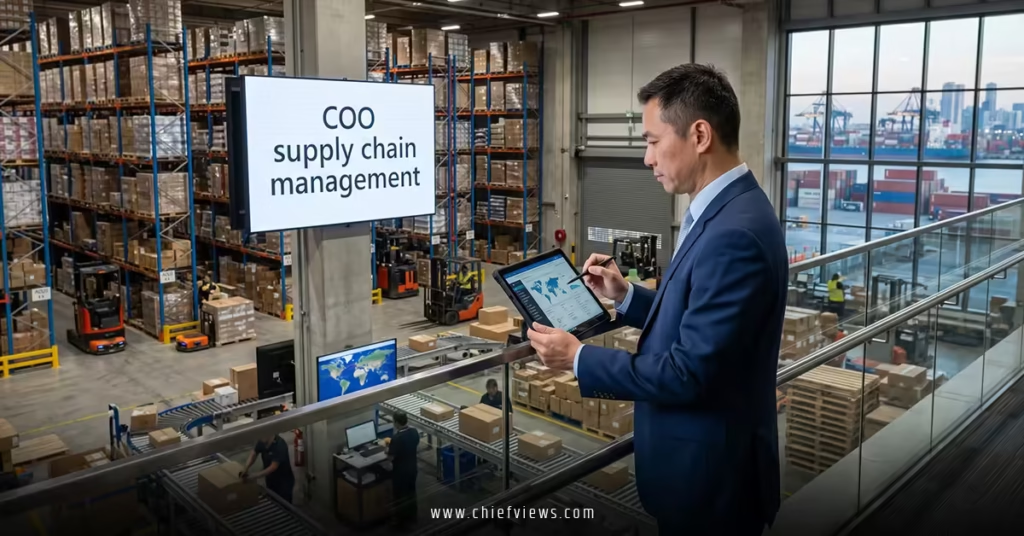
COO supply chain management best practices have become the backbone of competitive advantage in today’s interconnected economy. As a Chief Operating Officer, your supply chain isn’t just a cost center—it’s your secret weapon for customer satisfaction, cost control, and market agility.
Here’s what effective COO supply chain management delivers:
• End-to-end visibility across all suppliers, logistics, and inventory touchpoints • Risk mitigation through diversified supplier networks and scenario planning • Cost optimization via strategic sourcing and lean inventory management • Customer satisfaction through reliable delivery and quality control • Scalability that grows with your business without breaking operations
The difference between supply chain leaders and laggards? Leaders treat their supply chain as a strategic asset, not an operational afterthought.
The COO’s Supply Chain Leadership Framework
Building Your Strategic Foundation
Most COOs inherit supply chains rather than design them. Here’s the thing: you can’t optimize what you don’t understand. Start with a comprehensive supply chain audit that maps every vendor, process, and dependency.
Your audit should answer three critical questions:
- Where are our single points of failure?
- Which suppliers represent 80% of our risk or value?
- What visibility gaps exist in our current operations?
This isn’t about perfectionism. It’s about identifying the levers that actually move the needle on performance and profitability.


Technology Integration That Actually Works
Supply chain technology isn’t about having the shiniest tools—it’s about connecting data flows that enable better decisions. The most effective COOs focus on three technology pillars:
Real-time visibility platforms give you the dashboard view of inventory levels, supplier performance, and logistics bottlenecks. Think air traffic control for your supply chain.
Predictive analytics engines help you spot demand patterns, supplier risks, and capacity constraints before they become problems. The best systems learn from your historical data and external market signals.
Collaboration platforms create seamless communication channels with suppliers, logistics partners, and internal teams. When everyone’s working from the same playbook, friction disappears.
Core COO Supply Chain Management Best Practices
1. Supplier Relationship Management Excellence
Strong supplier relationships aren’t built on contracts alone. They’re built on mutual value creation and transparent communication.
Implement a tiered supplier management approach:
• Strategic partners (5-10% of suppliers): Deep collaboration, shared forecasting, joint innovation projects • Preferred suppliers (20-30%): Regular performance reviews, volume commitments, development programs
• Transactional suppliers (60-70%): Competitive sourcing, standardized contracts, basic performance monitoring
The kicker is this: your strategic partners should feel like extensions of your team, not external vendors competing for scraps.
2. Demand Planning and Forecasting Mastery
Accurate demand forecasting is part science, part art, and part gut instinct from experience. The best COOs combine multiple forecasting methods:
Statistical models analyze historical patterns and seasonal trends. They’re great for stable products with predictable demand cycles.
Market intelligence incorporates external factors like economic indicators, competitor actions, and industry trends that pure historical data misses.
Collaborative forecasting brings together sales, marketing, and key customers to validate assumptions and spot emerging opportunities or threats.
No forecast is perfect, but the goal isn’t perfection—it’s making better decisions with imperfect information.
3. Inventory Optimization Strategies
Inventory is the graveyard of cash flow. Too little and you disappoint customers. Too much and you tie up working capital while risking obsolescence.
Modern inventory management follows these principles:
• ABC analysis focuses attention on high-value items that drive the most impact • Safety stock calculations balance service levels with carrying costs using statistical models • Just-in-time principles reduce waste while maintaining operational flexibility • Vendor-managed inventory shifts inventory responsibility to suppliers for key components
The sweet spot? Enough inventory to hit service level targets without turning your warehouse into a museum of slow-moving stock.
Step-by-Step Implementation Guide
Phase 1: Assessment and Planning (Weeks 1-4)
- Conduct supply chain mapping exercise
- Document all suppliers, products, and processes
- Identify critical path dependencies
- Assess current performance metrics
- Establish baseline measurements
- Service level performance
- Inventory turnover rates
- Supplier performance scores
- Total cost of ownership by category
- Define improvement priorities
- Focus on highest-impact, lowest-risk improvements first
- Set specific, measurable goals for each initiative
Phase 2: Quick Wins Implementation (Weeks 5-12)
- Standardize supplier performance reviews
- Monthly scorecards for strategic suppliers
- Quarterly business reviews with key partners
- Clear escalation processes for performance issues
- Implement basic visibility tools
- Real-time inventory tracking systems
- Supplier delivery performance dashboards
- Exception-based reporting for critical issues
Phase 3: Advanced Optimization (Weeks 13-26)
- Deploy predictive analytics
- Demand forecasting improvements
- Supplier risk monitoring
- Inventory optimization algorithms
- Build strategic supplier partnerships
- Joint planning sessions with key suppliers
- Shared technology platforms
- Collaborative innovation projects
| Implementation Area | Timeline | Resource Requirements | Expected ROI |
|---|---|---|---|
| Supplier Scorecards | 2-4 weeks | 1 analyst, basic reporting tools | 5-10% supplier performance improvement |
| Inventory Optimization | 8-12 weeks | Analytics software, inventory team | 15-25% inventory reduction |
| Demand Planning | 12-16 weeks | Forecasting software, cross-functional team | 10-20% forecast accuracy improvement |
| Strategic Partnerships | 16-24 weeks | Senior management time, legal support | 20-30% cost reduction on strategic categories |
Technology and Digital Transformation
The Modern COO’s Tech Stack
Supply chain technology has evolved from basic ERP modules to sophisticated AI-powered platforms. The Council of Supply Chain Management Professionals reports that companies using advanced analytics see 15-20% improvements in forecast accuracy.
Cloud-based platforms provide the scalability and flexibility that on-premise systems can’t match. They’re particularly valuable for companies with multiple locations or rapid growth trajectories.
Internet of Things (IoT) sensors enable real-time monitoring of inventory levels, equipment performance, and environmental conditions throughout your supply chain.
Artificial intelligence powers everything from demand forecasting to route optimization, helping you make better decisions faster than humanly possible.
Integration Challenges and Solutions
The biggest technology mistake? Implementing point solutions that don’t talk to each other. Your supply chain tech stack should work like an orchestra, not a garage band.
Start with data integration. If your systems can’t share information seamlessly, you’ll spend more time reconciling data than optimizing operations.
Focus on user adoption. The fanciest software is worthless if your team won’t use it consistently. Invest in training and change management from day one.
Risk Management and Resilience Building
Creating Antifragile Supply Chains
Supply chains that merely survive disruption aren’t enough anymore. You need supply chains that get stronger under stress—what Nassim Taleb calls “antifragile” systems.
Build redundancy in critical areas:
- Multiple suppliers for key components
- Diversified geographic sourcing
- Flexible transportation options
- Alternative production facilities
Scenario planning helps you prepare for disruptions before they happen. The Federal Emergency Management Agency recommends developing response plans for at least three different risk scenarios.
Supplier Risk Assessment
Not all supplier risks are created equal. Financial instability might shut down production, while quality issues might damage your brand reputation.
Implement continuous risk monitoring that tracks: • Financial health indicators • Geographic concentration risks
• Regulatory compliance status • Cybersecurity vulnerabilities • Climate and natural disaster exposure
The best COOs don’t just monitor risks—they work with suppliers to mitigate them proactively.
Performance Measurement and KPIs
The COO’s Supply Chain Dashboard
What gets measured gets managed, but measuring everything manages nothing. Focus on KPIs that drive business outcomes:
Financial metrics:
- Total cost of ownership by supplier category
- Inventory turnover and carrying costs
- Cash-to-cash cycle time
Operational metrics:
- On-time delivery performance
- Quality defect rates
- Fill rate and service levels
Strategic metrics:
- Supplier innovation contributions
- Risk mitigation effectiveness
- Sustainability improvements
Track leading indicators, not just lagging ones. Supplier quality trends tell you more than defect reports after the fact.
Common Mistakes to Avoid
The “Lowest Price Wins” Trap
Chasing the lowest unit cost often leads to higher total costs. Hidden expenses like quality issues, delivery delays, and relationship management can dwarf initial savings.
Fix: Implement total cost of ownership (TCO) analysis that includes all direct and indirect costs over the supplier relationship lifecycle.
Over-Reliance on Single Suppliers
Putting all your eggs in one basket might save on administrative overhead, but it creates catastrophic risk exposure.
Fix: Maintain at least two qualified suppliers for critical components, even if it costs slightly more in the short term.
Ignoring Supplier Financial Health
Your suppliers’ financial problems become your operational problems faster than you’d expect.
Fix: Implement quarterly financial health checks for strategic suppliers using credit monitoring services and financial ratio analysis.
Technology Without Process
Implementing new technology on top of broken processes just digitizes the dysfunction.
Fix: Map and optimize your processes before selecting technology solutions. The technology should enable better processes, not paper over process gaps.
Lack of Cross-Functional Alignment
When procurement, operations, and sales work in silos, the supply chain becomes a bottleneck instead of a competitive advantage.
Fix: Create cross-functional supply chain governance with clear roles, responsibilities, and shared KPIs.
Building Strategic Supplier Partnerships
Beyond Transactional Relationships
The most effective COO supply chain management best practices treat key suppliers as strategic partners, not interchangeable vendors.
True partnerships require mutual investment and shared risk. This might include:
- Joint technology development projects
- Shared forecasting and planning processes
- Co-located teams for critical projects
- Shared savings programs that benefit both parties
The partnership test: If switching suppliers would take more than six months and significantly impact your operations, that’s a strategic partnership that deserves special attention and investment.
Supplier Development Programs
Growing your suppliers’ capabilities grows your own competitive advantages. The Institute for Supply Management research shows companies with formal supplier development programs achieve 23% better cost performance.
Effective development programs focus on:
- Capability building in quality, delivery, and cost management
- Process improvement methodologies and training
- Technology adoption and integration support
- Sustainability and compliance improvements
Sustainability and Future-Proofing
Environmental and Social Responsibility
Supply chain sustainability isn’t just about doing good—it’s about managing risk and meeting customer expectations. Companies with strong sustainability programs report 16% higher profit margins on average.
Key sustainability initiatives include: • Carbon footprint reduction across transportation and facilities • Ethical sourcing standards and supplier audits • Waste reduction and circular economy principles • Local sourcing to reduce transportation impacts and support communities
Preparing for Future Disruptions
Climate change, geopolitical tensions, and technological disruption will reshape global supply chains over the next decade. Forward-thinking COOs are already adapting:
Reshoring and nearshoring reduce transportation costs and lead times while improving supply chain control.
Circular economy principles create new revenue streams from waste products while reducing raw material dependencies.
Autonomous vehicles and drones will revolutionize last-mile delivery and warehouse operations within the next five years.
Key Takeaways
• Start with visibility: You can’t optimize what you can’t see across your entire supply chain network • Invest in relationships: Strategic supplier partnerships create competitive advantages that pure cost-cutting cannot match • Embrace technology strategically: Focus on tools that enable better decisions and seamless collaboration, not just automation • Build resilience proactively: Diversify suppliers, create redundancies, and plan for multiple risk scenarios before disruptions occur • Measure what matters: Track KPIs that drive business outcomes, not just operational efficiency metrics • Think long-term: Balance short-term cost pressures with long-term strategic positioning and sustainability goals • Foster cross-functional collaboration: Break down silos between procurement, operations, sales, and finance for optimal supply chain performance • Continuously improve: Implement regular reviews, feedback loops, and improvement initiatives to stay ahead of changing market conditions
Conclusion
Mastering COO supply chain management best practices isn’t about implementing every trendy methodology or technology. It’s about building robust, flexible operations that deliver consistent value to customers while adapting to an ever-changing business environment.
The most successful COOs view their supply chains as strategic assets that require continuous investment, attention, and improvement. They balance efficiency with resilience, cost control with relationship building, and operational excellence with innovation.
Your next step? Start with a comprehensive assessment of your current state, identify the highest-impact improvement opportunities, and begin building the supplier relationships and technology capabilities that will drive your competitive advantage for years to come.
Remember: great supply chains aren’t built overnight, but every day you delay improvement is a day your competitors get further ahead.
Frequently Asked Questions
Q: What are the most critical COO supply chain management best practices for small to medium businesses?
A: For SMBs, focus on supplier diversification, basic visibility tools, and strong relationships with 3-5 key suppliers. Start with simple inventory management systems and gradually add predictive analytics as you grow.
Q: How do I balance cost reduction with supply chain resilience when implementing COO supply chain management best practices?
A: Use total cost of ownership analysis that includes risk factors like potential disruption costs. Often, paying 5-10% more for diversified suppliers saves 30-50% in disruption recovery costs.
Q: What technology investments should COOs prioritize first in their supply chain transformation?
A: Start with real-time visibility platforms that connect your existing systems. Focus on data integration before adding new capabilities like AI or advanced analytics.
Q: How long does it typically take to see ROI from improved COO supply chain management best practices?
A: Quick wins like supplier scorecards show results in 2-3 months. Comprehensive improvements typically deliver measurable ROI within 6-12 months, with full optimization taking 18-24 months.
Q: What’s the best way to get buy-in from other executives for supply chain investments?
A: Connect supply chain improvements to business outcomes they care about: customer satisfaction scores, cash flow improvements, and revenue protection. Use specific examples and pilot programs to demonstrate value before requesting larger investments.