






Customer journey mapping framework is one of those phrases that sounds like workshop theatre… until you use it properly and suddenly your funnel, retention, and revenue numbers all start making more sense.
Think of it as the blueprint for how real customers move from “Who are you?” to “Where do I sign… again?” When done well, it becomes the bridge between brand, product, and customer experience—and the backbone of a strong CMO and CCO partnership for growth 2026.
Quick summary: What a customer journey mapping framework actually does
If you’re skimming, here’s the headline version:
- What it is: A structured way to visualize and document every major step, touchpoint, and emotion in a customer’s experience with your brand.
- Why it matters: It exposes friction, mismatched expectations, and wasted effort that traditional funnel views can’t see.
- Who needs it: Growth leaders, marketing teams, customer success, product, and anyone trying to improve acquisition, activation, or retention.
- Core output: A shared map of stages, goals, pain points, and opportunities that teams can execute against—not just admire.
- Big upside: Better alignment, smarter campaigns, higher NPS/CSAT, and more efficient paths to revenue.
What is a customer journey mapping framework?
A customer journey mapping framework is a repeatable structure for capturing:
- The stages a customer moves through
- The touchpoints they encounter (ads, website, sales calls, support, product UI)
- Their goals, questions, and emotions at each step
- The internal owners and systems behind each experience
- Opportunities to improve or innovate
Instead of a vague “funnel,” you’re creating a specific, visual story of how your customers actually buy and stay.



Most effective frameworks break the journey into clear stages, then layer detail on top. For example:
- Awareness
- Consideration
- Purchase
- Onboarding
- Adoption/Value
- Renewal/Expansion
- Advocacy
Within each, you capture what the customer is doing, thinking, and feeling, plus what your company is saying and delivering.
Why customer journey mapping framework matters in 2026
Here’s the thing: in 2026, growth lives in the gaps.
Ad platforms are more regulated, cookies are weaker, and customers are savvier. They expect consistent, context‑aware experiences across channels. If your messaging, product, and support don’t line up, they notice—and they leave.
A strong customer journey mapping framework helps you:
- Align teams around one reality
No more marketing saying “We bring the leads,” while success says “They’re not a fit.” Everyone looks at the same journey, same friction points. - Prioritize high‑impact fixes
Instead of endless wishlists, you focus on the moments that move revenue: first value, renewal, expansion, churn risk. - Turn customer insight into growth strategy
Voice of customer, usage analytics, and support tickets stop being separate reports and become a single narrative. - Support AI‑driven and automation initiatives
Clear journey stages and events are essential for smart personalization and lifecycle automation.
Major CX studies from firms like Forrester and Gartner consistently show that companies with disciplined customer experience design outperform peers on revenue growth and loyalty. Journey mapping is the foundational tool behind that discipline.
Core components of a customer journey mapping framework
Let’s break down what a complete framework usually includes.
1. Defined customer segments or personas
You can’t map “everyone.” You pick 1–3 priority segments:
- Primary decision maker
- Key user
- Influencer or champion
Each will have slightly different goals and journeys. Start with the segment that drives the most revenue or strategic importance.
2. Journey stages
Use language that makes sense for your business, but keep it consistent. A common backbone:
- Awareness
- Consideration
- Decision/Purchase
- Onboarding
- Adoption/Value
- Renewal/Expansion
- Advocacy
The key is that each stage has a clear entry and exit condition (e.g., “Signed contract,” “Completed onboarding checklist,” “Submitted first referral”).
3. Customer goals and emotions per stage
Ask: What is the customer trying to achieve here? How do they feel?
Examples:
- Awareness: “I’m confused by options, I just want a shortlist.”
- Onboarding: “Did I make the right choice? Don’t waste my time.”
- Renewal: “Is this still worth the cost vs alternatives?”
This is where qualitative inputs like customer interviews and NPS verbatims, which many teams collect via platforms referenced in CX benchmarks, really shine.
4. Touchpoints and channels
List everything the customer actually interacts with:
- Ads, social posts, content
- Website, landing pages, chat
- Sales calls, demos, proposals
- Emails, in‑app messages, notifications
- Support tickets, knowledge base, community
This exposes fragmented experiences—like a polished sales deck followed by a confusing onboarding email.
5. Internal owners and systems
For each touchpoint, name:
- The team (marketing, sales, CS, product, support)
- The tool (CRM, marketing automation, helpdesk, app)
This is where you spot hand‑offs that drop context or rely on manual steps that eventually fail.
6. Pain points and opportunities
Finally, the payoff: where is the journey breaking, and where could you create delight?
Examples:
- Confusing pricing explanation → high cart abandonment
- Slow onboarding → customers never reach first value
- No proactive value reminders → renewals feel unjustified
These become inputs into your roadmap and growth experiments.
How customer journey mapping powers CMO and CCO partnership for growth 2026
Here’s the kicker: a customer journey mapping framework is often the missing link in a strong CMO and CCO partnership for growth 2026.
Why? Because it gives both leaders:
- A shared visual model of the entire customer lifecycle
- Clear points where marketing and customer teams must collaborate
- A neutral framework to discuss problems without finger‑pointing
Instead of “marketing vs customer success,” you’re co‑owning:
- Onboarding experiences that reflect pre‑sale promises
- Lifecycle campaigns triggered by real customer behavior
- Advocacy and referral programs rooted in genuine success stories
If you’re trying to align your CMO and CCO, start with the journey map. It’s the fastest way to see where your strategy and your customer’s reality diverge.
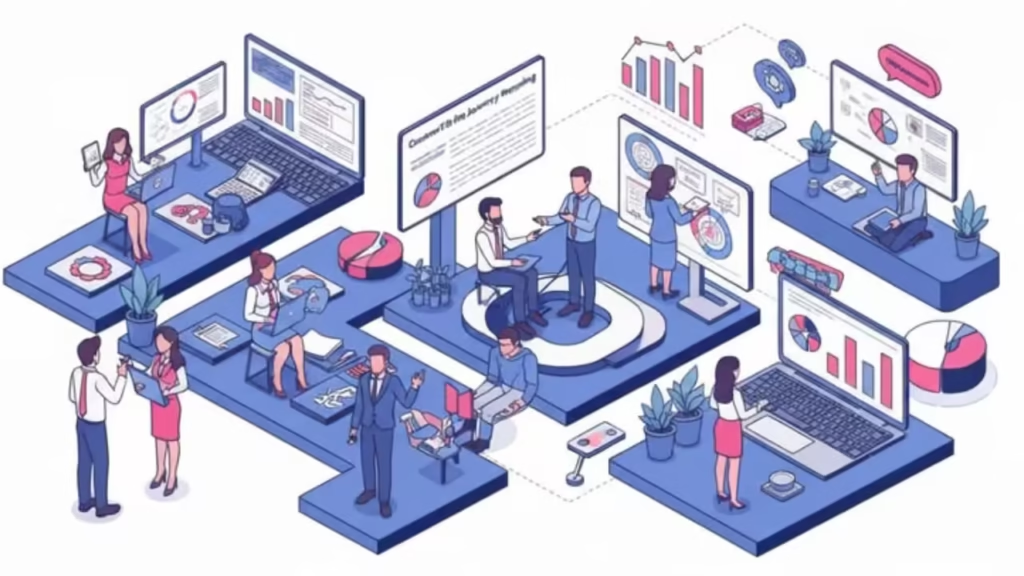
Step‑by‑step: How to build a customer journey mapping framework (for beginners and intermediates)
No fluff. Here’s a practical process you can run in a week or two.
Step 1: Pick one core segment and one primary journey
Don’t try to boil the ocean.
- Choose your highest‑value or highest‑volume segment.
- Choose the primary journey (e.g., new logo acquisition → onboarding → renewal).
You can always expand later.
Step 2: Gather raw input from data and humans
You need both numbers and narratives:
- Quantitative:
- Analytics (site, product, app)
- CRM stages and conversion rates
- Support volume by stage
- Qualitative:
- Customer interviews
- Sales and CS anecdotes
- NPS or CSAT comments
In my experience, teams often over‑index on dashboards and under‑index on conversations. The insights that change your map usually come from what customers say out loud.
Step 3: Draft your high‑level stages
On a whiteboard or digital board, lay out the main stages across the top:
- Awareness → Consideration → Decision → Onboarding → Adoption → Renewal → Advocacy
For each stage, add:
- Entry condition (what starts it)
- Exit condition (what completes it)
Keep it simple enough that everyone in the business can repeat it.
Step 4: Fill in customer goals, questions, and emotions
For each stage, answer:
- “What is the customer trying to get done?”
- “What are they worried about?”
- “What would success feel like here?”
Use real quotes where you can. This is where your map starts reflecting reality, not wishful thinking.
Step 5: Layer on touchpoints, channels, and owners
Now, under each stage, add:
- Every major touchpoint
- The channel it happens in
- The team that owns it
- The primary system behind it
This is the messy part—and it’s where you’ll see disconnects between teams and tools.
Step 6: Highlight friction and missed opportunities
Use colors or icons to mark:
- Pain points (friction, confusion, delay, broken promises)
- “Wow” moments (where customers love the experience)
- Opportunities (gaps you could fill with new touchpoints or improvements)
Ask sharp questions like:
- “Where are we forcing the customer to repeat themselves?”
- “Where does the customer wait on us, without any communication?”
- “Where are we asking for trust without having earned it?”
These answers become your improvement backlog.
Step 7: Prioritize 3–5 high‑impact fixes
Turn your insights into action:
- Tie each idea to a business metric (conversion, activation, NRR, churn).
- Estimate impact and effort.
- Pick 3–5 to execute in the next quarter.
A journey map without a prioritization step is just wall art.
Common mistakes with customer journey mapping (and how to fix them)
Everyone loves workshops. Not everyone loves hard decisions. Here’s where teams usually stumble.
Mistake 1: Making the map too pretty and not actionable
Gorgeous diagram, zero follow‑through.
Fix: Treat design as secondary. Focus on decisions: what will you start, stop, or change based on this map in the next 90 days?
Mistake 2: Mapping the internal process, not the customer experience
You end up documenting internal steps (“sales qualifies lead in CRM”) instead of what the customer experiences.
Fix: Force the team to express each stage in customer language. If your wording sounds like internal ops, rewrite it.
Mistake 3: Mapping every persona at once
Three personas, four use cases, 27 stages. Chaos.
Fix: Start with one core persona and journey. Get good at updating that map before multiplying complexity.
Mistake 4: Treating it as a one‑off project
You run a workshop once a year, then forget it.
Fix: Make journey map review part of your quarterly planning and your recurring growth or CX council meetings. Update the map when your product, messaging, or go‑to‑market changes.
Mistake 5: Ignoring hard data
The map looks optimistic because nobody brought the ugly numbers.
Fix: Require at least basic metrics at each stage: conversion, time spent, drop‑off rate, ticket volume. If you can’t measure it at all, that’s a problem worth solving on its own.
Simple customer journey mapping framework template
Use this as a starting point and adapt the stages to your business.
For each stage, capture:
- Stage name
- Customer goal
- Key questions
- Emotions/concerns
- Touchpoints and channels
- Internal owners
- Systems involved
- Metrics
- Pain points
- Opportunities
You can structure it as a spreadsheet or a visual canvas. For more complex environments, teams often evolve toward a dedicated journey‑orchestration tool integrated with their CRM and analytics.
How to keep your customer journey mapping framework alive
A static map gets stale fast. The best teams treat their framework like a living product.
- Assign an owner
Usually CX, product marketing, or a dedicated experience lead owns the canonical map. - Align with planning cycles
Update the map before major roadmap and campaign planning to ensure your work reflects current customer reality. - Connect to experimentation
Use the map to source experiment ideas and then feed learnings back into it. - Share widely
Onboard new hires with the journey map. Use it in exec reviews. Bring it into vendor discussions. The more it’s used, the more accurate it becomes.
Key takeaways
- A customer journey mapping framework is the practical backbone for understanding and improving how customers move from first contact to long‑term loyalty.
- It aligns teams around one shared view of the customer—far beyond a simplistic funnel or isolated dashboards.
- The framework works best when it combines quantitative data with qualitative insight from interviews, support, sales, and success.
- A strong map directly supports a high‑performing CMO and CCO partnership for growth 2026 by exposing joint responsibilities and shared opportunities.
- The most important part isn’t the visual—it’s the disciplined prioritization of 3–5 improvements each quarter.
- Avoid common traps like over‑designed maps, process‑centric views, and one‑off workshops that never turn into action.
- Treat the journey map as a living asset, updated as your product, market, and customer expectations evolve.
FAQs about customer journey mapping framework
1. How detailed should a customer journey mapping framework be?
Start with a high‑level map across 6–7 stages, then add detail where it impacts real metrics like activation, NRR, or churn. If the framework is so detailed that no one uses it, you’ve gone too far. It should be clear enough for executives to grasp quickly and specific enough for teams to act on.
2. How often should we update our customer journey mapping framework?
Review it at least quarterly, or whenever you make major changes to pricing, product, or go‑to‑market. Fast‑moving teams revisit parts of the map monthly as new data and customer feedback emerge, especially around onboarding and renewal stages.
3. Who should be involved in building the customer journey mapping framework?
At a minimum: marketing, sales, customer success, support, and product. For organizations focusing on a strong CMO and CCO partnership for growth 2026, both leaders and their direct reports should participate so the framework reflects cross‑functional reality, not just a single team’s view.