




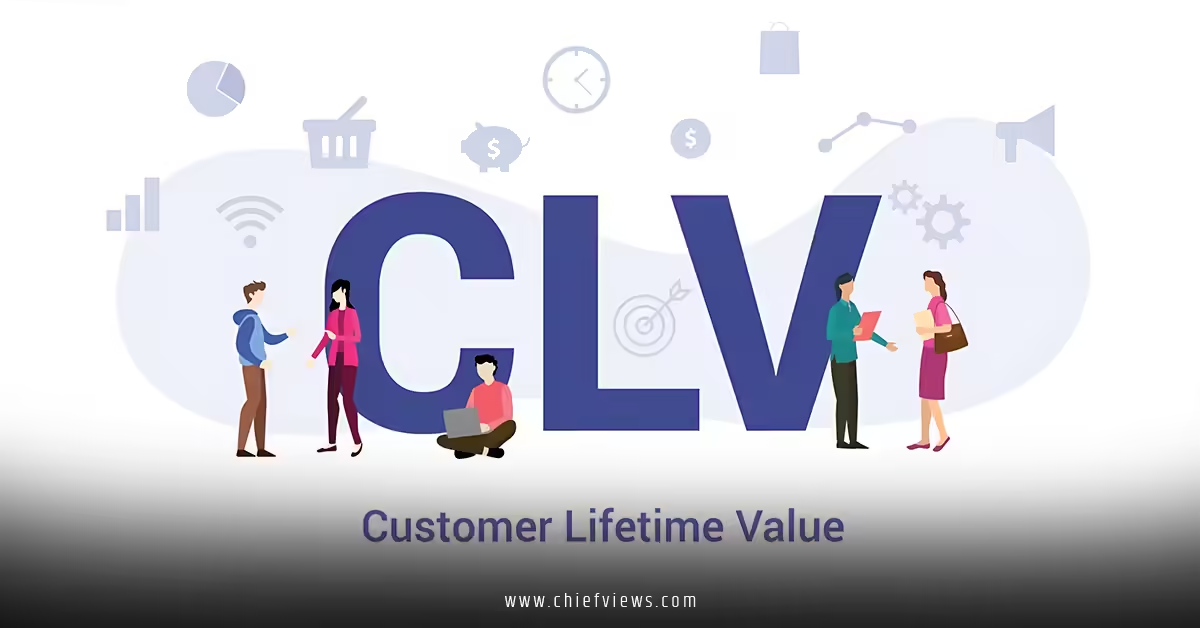
Customer lifetime value optimization is one of the smartest moves any business leader can make in 2026. While everyone obsesses over acquiring new customers, the real money lies in keeping the ones you already have—and getting them to spend more over time. When you master customer lifetime value optimization, you unlock higher profitability, better cash flow, and a competitive edge that’s hard to copy. In this comprehensive guide, we’ll explore proven strategies, real-world examples, and actionable steps to elevate your CLV game.
Why Customer Lifetime Value Optimization Matters More Than Ever
Let’s cut to the chase: acquiring customers is expensive. Customer acquisition costs continue to rise across channels, making it tougher to achieve profitable growth through new sign-ups alone. This is where customer lifetime value optimization shines.
A higher CLV means each customer contributes more revenue over their relationship with your brand. This directly improves your LTV:CAC ratio—a key metric investors and boards scrutinize. For instance, if your CAC is $200 but optimized CLV jumps from $600 to $1,200, you’ve effectively doubled your return on marketing spend.
Research from Bain & Company shows that a 5% increase in retention can boost profits by 25-95%. That’s the power of customer lifetime value optimization: small improvements compound dramatically.
Moreover, loyal customers refer others, reducing reliance on paid acquisition. As we discussed in related CMO strategies for customer acquisition cost reduction, balancing CLV gains with lower CAC creates a virtuous growth cycle.
Understanding Customer Lifetime Value: The Core Formula
Before diving into customer lifetime value optimization tactics, let’s nail the basics.
The standard CLV formula is:
CLV = (Average Purchase Value × Purchase Frequency × Average Customer Lifespan) – Customer Acquisition Cost
More advanced versions factor in gross margin:
CLV = Average Margin per Customer × (Retention Rate ÷ (1 + Discount Rate – Retention Rate))
Segment your customers—by cohort, product usage, or demographics—to uncover hidden opportunities. A SaaS company might find enterprise clients have 5x higher CLV than SMBs, guiding resource allocation.
Accurate CLV calculation is the foundation of effective customer lifetime value optimization. Use tools like Google Analytics, Amplitude, or Mixpanel to track cohorts over time.
Proven Strategies for Customer Lifetime Value Optimization
Here are the most impactful approaches to boost CLV, drawn from years of marketing successes.
1. Prioritize Customer Retention Over Acquisition
Retention is the biggest lever in customer lifetime value optimization.
Implement proactive churn prevention: send personalized re-engagement campaigns, offer win-back incentives, and monitor usage patterns for at-risk customers. Netflix excels here by recommending content that keeps subscribers hooked month after month.
Create exceptional onboarding experiences. A smooth first 30 days dramatically increases long-term retention. According to Harvard Business Review, reducing churn by just 5% can double CLV in many industries.
2. Master Upselling and Cross-Selling
Why stop at one sale? Smart upselling and cross-selling are cornerstone tactics in customer lifetime value optimization.
Use behavioral data to recommend relevant add-ons. Amazon’s “Frequently bought together” feature reportedly drives 35% of revenue. In B2B, account expansion through tier upgrades or module add-ons can increase CLV by 2-4x.
Time offers strategically: trigger upsell prompts after milestones (e.g., when a user hits usage thresholds). Personalize based on past purchases—generic recommendations fall flat.
3. Build Loyalty Programs That Actually Work
Done right, loyalty programs supercharge customer lifetime value optimization.
Move beyond basic points systems. Starbucks Rewards uses gamification, personalized offers, and tiered status to drive 40%+ of transactions from members. Key elements:
- Immediate value (free item on sign-up)
- Emotional connection (birthday rewards, exclusive access)
- Progress visibility (status bars, challenges)
- Multi-channel redemption
For ecommerce, consider subscription models or VIP perks. Sephora’s Beauty Insider program turns casual buyers into brand advocates.
4. Personalization at Scale
Generic experiences kill loyalty. Hyper-personalization is essential for customer lifetime value optimization.
Leverage zero-party data (preferences shared directly) and behavioral signals to tailor everything: emails, product recommendations, pricing, even website content.
AI tools like Dynamic Yield or Optimizely make this scalable. Brands using advanced personalization see 20-30% CLV lifts, per McKinsey research.
Segment messaging by lifecycle stage: welcome series for new customers, reactivation for dormant ones, appreciation campaigns for VIPs.
5. Deliver World-Class Customer Experience
Exceptional service isn’t a nice-to-have—it’s a CLV multiplier.
Invest in omnichannel support, proactive outreach, and feedback loops. Zappos built a billion-dollar brand on legendary customer service, turning buyers into lifelong fans.
Use Net Promoter Score (NPS) surveys to identify detractors early. Close the loop by addressing issues personally. Positive experiences drive repeat purchases and referrals—both critical to customer lifetime value optimization.
6. Community Building and User-Generated Content
Turn customers into advocates.
Build branded communities (Slack groups, forums, social media hubs) where users connect and share. Harley-Davidson’s H.O.G. chapters create emotional bonds that last decades.
Encourage user-generated content: reviews, testimonials, social posts. Feature top contributors. This social proof attracts new customers while deepening loyalty among existing ones.
7. Pricing and Packaging Optimization
Smart pricing directly impacts CLV.
Test annual vs. monthly billing (annual often boosts retention). Introduce tiered plans that encourage upgrades over time. Bundle high-margin items to increase average order value.
Dynamic pricing based on customer segment or behavior can further optimize revenue without alienating users.
8. Post-Purchase Nurturing and Education
The sale isn’t the end—it’s the beginning.
Send educational content, tips, and success stories to help customers derive more value. This reduces churn and opens upsell opportunities.
For SaaS, proactive customer success managers drive expansions. In ecommerce, post-purchase emails with usage ideas or complementary products work wonders.
9. Referral Programs That Scale
Happy customers bring more like them—at near-zero cost.
Design double-sided referral programs with compelling incentives. Dropbox’s early referral scheme exploded growth by giving storage to both referrer and referee.
Track referral CLV separately—you’ll often find it’s 2-3x higher than average.
10. Data-Driven Cohort Analysis and Predictive Modeling
The most sophisticated customer lifetime value optimization relies on predictive analytics.
Use machine learning to forecast CLV at acquisition. Identify high-potential segments early. Tools like Lifetime Value Prediction in Google Analytics 360 or custom models in Python/R help here.
Monitor cohort performance monthly. Spot trends: Are recent cohorts churning faster? Why? Adjust strategies accordingly.
Implementing Customer Lifetime Value Optimization: A Practical Framework
Ready to get started? Follow this step-by-step approach:
- Calculate Current CLV
Segment by channel, product, and demographics for baseline insights. - Map the Customer Journey
Identify drop-off points and delight opportunities. - Prioritize High-Impact Levers
Start with retention and personalization—biggest bang for buck. - Test and Iterate
Run A/B tests on emails, offers, pricing. Measure CLV impact. - Align Teams
Customer lifetime value optimization requires marketing, sales, product, and support collaboration. - Invest in Tools
CRM (HubSpot, Salesforce), analytics (Amplitude), personalization (Braze), and loyalty platforms (Yotpo). - Track Progress Quarterly
Aim for 15-30% CLV improvement annually.
Common Mistakes in Customer Lifetime Value Optimization
Avoid these pitfalls:
- Focusing only on acquisition while neglecting retention
- Using average CLV instead of segmented cohorts
- Implementing loyalty programs without clear ROI tracking
- Over-discounting, which trains customers to wait for deals
- Ignoring qualitative feedback in favor of pure metrics
Balance short-term revenue tactics with long-term relationship building.
The Future of Customer Lifetime Value Optimization
In 2026 and beyond, AI will revolutionize CLV strategies. Predictive churn models, automated personalization, and real-time offer optimization will become standard.
Privacy regulations will push brands toward zero-party data and trust-based relationships. Subscription fatigue will reward companies that genuinely add ongoing value.
Those who prioritize customer lifetime value optimization now will build moats competitors can’t breach.
Conclusion: Make Customer Lifetime Value Optimization Your North Star
Customer lifetime value optimization isn’t a one-time project—it’s a mindset shift. By focusing on delighting existing customers, personalizing experiences, and systematically increasing their value over time, you create sustainable, profitable growth.
Pair these strategies with smart [CMO strategies for customer acquisition cost reduction], and you’ll achieve the holy grail: acquiring better customers while keeping them longer and making them spend more.
Start measuring your CLV today. Small improvements now compound into massive advantages tomorrow. Your customers—and your bottom line—will thank you.
FAQs About Customer Lifetime Value Optimization
1. What is the fastest way to improve customer lifetime value optimization?
Focus on retention first. Implementing personalized re-engagement campaigns and improving onboarding can deliver 10-20% CLV lifts within months.
2. How does customer lifetime value optimization relate to customer acquisition cost?
Higher CLV allows you to profitably spend more on acquisition. Optimizing both creates balanced, sustainable growth—see related [CMO strategies for customer acquisition cost reduction].
3. Which industries benefit most from customer lifetime value optimization?
Subscription businesses (SaaS, media), ecommerce, and financial services see the biggest gains due to recurring revenue models.
4. What tools are essential for customer lifetime value optimization?
CRM platforms (Salesforce, HubSpot), analytics tools (Amplitude, Mixpanel), personalization engines (Dynamic Yield), and loyalty software (Smile.io, Yotpo).
5. Can small businesses achieve customer lifetime value optimization?
Absolutely. Start with email personalization, simple loyalty rewards, and excellent service. Tools like Klaviyo or Mailchimp make it accessible on tight budgets.