





CXO strategies for exceptional customer journeys 2026 are not about chasing shiny tools or adding more dashboards. They’re about building a joined‑up, data-informed, emotionally intelligent experience that feels effortless to your customers and controlled by your leadership team.
Here’s the quick version for busy execs:
- Treat customer journey design as a board-level discipline, not a marketing side project.
- Build a single, trusted view of the customer that sales, service, product, and finance actually use.
- Design journeys around customer outcomes, not internal processes or channels.
- Use AI to predict intent and reduce friction, but keep humans in the loop for complex, emotional moments.
- Align incentives, KPIs, and governance so every CXO is accountable for the same journey-level outcomes.
What “CXO strategies for exceptional customer journeys 2026” really means
CXO strategies for exceptional customer journeys 2026 is shorthand for how senior leaders (CEO, CMO, CCO, CIO, CDO, CFO, etc.) work together to design, govern, and continuously improve the end‑to‑end experiences customers have with a brand.
It’s not just “customer experience” as a department.
In my experience, when you get this right, three things happen quickly:
- Revenue per customer goes up because you’re removing friction and confusion.
- Cost-to-serve drops because you stop forcing customers into high-cost channels for simple tasks.
- Brand trust improves because the experience is consistent, predictable, and respectful of people’s time and data.
Why now? Because in 2026:


- Customers compare you to the best experience they had last week, not to your direct competitors.
- Generative AI, real‑time analytics, and privacy regulations changed what’s possible—and what’s allowed.
- Search and AI overviews surface direct answers, so your experience must deliver value fast or you lose the click and the customer.
The new CXO playbook: core principles for 2026
1. Start with customer outcomes, not channels or tools
Every CXO strategy should start with one sharp question:
“What problem is the customer trying to solve, and how do we make that feel effortless?”
In practice, that means:
- Map the journey around customer jobs-to-be-done (e.g., “get covered,” “file a claim,” “upgrade my plan”) instead of internal steps.
- Define success in customer terms: speed, clarity, confidence, and emotional assurance, not just completion.
- Then align your tech, content, and people around those jobs.
When leaders start with channels (“we need an app,” “we should add chatbots”), journeys become fragmented. When they start with outcomes, channels become flexible tools, not constraints.
2. Treat unified customer data as infrastructure, not a “nice to have”
You can’t create exceptional customer journeys if your data is scattered across CRM, billing, support, and product analytics.
By 2026, high-performing CXO teams:
- Use a customer data platform (CDP) or similar architecture to build a single, consent-aware customer profile.
- Combine behavioral data (clicks, calls, visits, product usage) with operational data (orders, tickets, invoices) and sentiment data (NPS, CSAT, social signals).
- Establish strict data governance and privacy controls aligned with guidance from organizations like the Federal Trade Commission in the U.S.
The point is simple: better journeys need better context. No context, no personalization—just noise.
3. Use AI as a co-pilot, not an autopilot
Every CXO deck now has “AI” all over it. But here’s the thing: AI can optimize a broken journey into a slightly more efficient mess.
Smart CXO strategies for exceptional customer journeys 2026:
- Use predictive models to flag churn risk, identify intent, and suggest next best actions.
- Deploy generative AI for content personalization, self‑service support, and assistant-like experiences.
- Keep humans as escalation points for high-stakes interactions (healthcare, finance, legal issues, complaints).
- Monitor AI outcomes against fairness, accuracy, and regulatory guidelines (for example, suggestions from bodies like NIST on AI risk management in the U.S.).
AI amplifies design. If the design is thoughtful, AI makes it feel magical. If the design is sloppy, AI just speeds up the damage.
CXO strategies for exceptional customer journeys 2026: leadership roles and responsibilities
Different CXOs see different parts of the elephant. The winning move is to align roles around a shared, journey-first view.
Here’s a simple way to structure it:
CEO: Owns the promise
- Sets customer-centric growth as a core strategic pillar.
- Makes journey performance (not just P&L) part of board reporting.
- Breaks deadlocks when functions fight over ownership or budget.
CCO / CXO (Chief Customer Officer / Chief Experience Officer)
- Leads the end‑to‑end journey blueprint and governance.
- Owns cross‑functional journey KPIs: satisfaction, effort, churn, LTV.
- Facilitates regular “journey reviews” with peers to prioritize fixes and experiments.
CMO: Orchestrates expectation vs. reality
- Ensures acquisition messages match actual experience.
- Uses customer insights and market research (e.g., from firms like McKinsey or Forrester) to inform journey design.
- Owns personalization strategy and experience-level content.
CIO / CDO: Owns the enablement layer
- Delivers the data platform, integration, and security needed for a unified journey.
- Ensures compliance with regulations and best practices (such as those from the U.S. Cybersecurity and Infrastructure Security Agency) when using data and AI.
- Partners with CCO/CMO to turn journey requirements into tech roadmaps.
CFO: Keeps it disciplined
- Ties journey investments to clear financial outcomes: retention, cross‑sell, cost‑to‑serve.
- Helps quantify the cost of bad experiences: rework, complaints, lost revenue.
- Supports test-and-learn funding, not just big-bang implementations.
Answer-ready table: CXO strategy components vs. impact
| Strategy Component | Primary Owner | Customer Impact | Business Impact | Time to See Results |
|---|---|---|---|---|
| Unified customer data platform | CIO / CDO | Consistent, personalized experiences across channels | Higher conversion, better retention, lower duplication | Medium (6–12 months) |
| End-to-end journey mapping and ownership | CCO / CXO | Clear paths, fewer dead ends, less effort | Reduced churn, improved NPS/CSAT | Short–Medium (3–9 months) |
| AI-powered personalization and support | CMO + CIO | Faster answers, relevant offers, 24/7 support | Higher average order value, lower support cost | Short (2–6 months) |
| Cross-functional journey KPIs and governance | CEO + CFO | More consistent experience across departments | Aligned investments, less internal friction | Medium (6–12 months) |
| Voice-of-customer and continuous feedback loops | CCO / CXO | Customers feel heard and respected | Faster issue resolution, more product-market fit | Short (1–3 months) |
Step-by-step action plan for beginners
If you’re just getting serious about CXO strategies for exceptional customer journeys 2026, don’t try to boil the ocean. Start with one anchor journey and go deep.
Step 1: Pick one high-value journey
Examples:
- “First-time customer purchase”
- “Onboarding after sign‑up”
- “Account renewal or upgrade”
Choose the journey where a small improvement will have a big revenue or retention impact.
Step 2: Map the journey from the customer’s point of view
Gather people from marketing, sales, service, product, and operations.
Document:
- Trigger: What starts the journey?
- Steps: What the customer actually does, sees, and feels (including search, reviews, competitors).
- Pain points: Confusion, delays, channel jumps, repeated information.
- Moments that matter: Points where the customer decides to stay, buy more, or leave.
Use plain language. No internal jargon.
Step 3: Quantify the current performance
Use whatever you have:
- Analytics: drop‑off points, time to complete, contact rates.
- VOC: surveys, reviews, social comments, support transcripts.
- Financial data: churn, refunds, discount usage.
Complement your internal data with external benchmarks where available, such as customer experience studies from recognized organizations like Forrester Research or insights from the U.S. Bureau of Labor Statistics on consumer behavior trends.
You’re looking for patterns, not perfection.
Step 4: Define a target experience
This is the “north star” version.
Answer:
- How fast should this journey be?
- How should it feel emotionally (reassuring, empowering, simple)?
- What will “success” look like in metrics (conversion, NPS, repeat rate)?
Write it as a short narrative: “A customer in this journey should be able to… in under X minutes, with Y level of effort.”
Step 5: Prioritize 3–5 fixes or enhancements
Focus on:
- Removing friction (extra forms, unnecessary approvals, duplicate steps).
- Clarifying communication (plain language, fewer options, clearer next steps).
- Adding smart assistance (AI chat for FAQs, proactive alerts, guided workflows).
Ask: “If we could only change one thing this quarter, what would move the needle most?”
Step 6: Build, test, learn in short cycles
Run experiments:
- A/B test new flows or messages.
- Pilot AI assistants on one segment or channel before scaling.
- Shadow support calls or watch session replays to see real behavior.
Document learnings. Feed them back into your next iteration.
Step 7: Scale the playbook across other journeys
Once you’ve proven value on one journey:
- Reuse patterns: templates, components, data models.
- Standardize roles and rituals: monthly journey review, shared dashboards, escalation paths.
- Extend to other core journeys (support, upgrades, renewals, referrals).
That’s how a “project” becomes an ongoing CXO strategy.
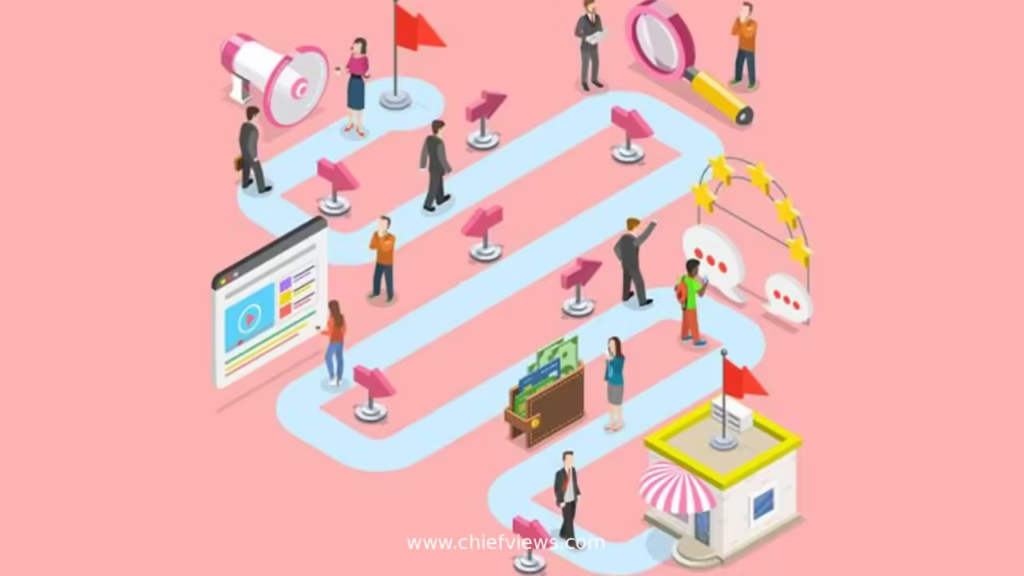
CXO strategies for exceptional customer journeys 2026 across the lifecycle
Let’s talk practical execution, stage by stage.
1. Discovery and research
- Ensure your search presence gives fast, accurate, helpful answers—whether through traditional search or AI overviews.
- Align content, SEO, and CX so that top pages solve real problems, not just rank.
- Provide clear comparisons, transparent pricing signals, and independent validation where possible (think referencing recognized sources like government health or finance sites when relevant to your industry).
2. Evaluation and decision
- Simplify product tiers and pricing explanations.
- Use configurators, calculators, and guided selling tools to match customers to the right option.
- Offer human support at key decision moments (live chat, callback, video consult).
3. Onboarding
This is where many journeys die quietly.
Strong CXO strategies for exceptional customer journeys 2026 treat onboarding as:
- A conversion phase, not a checklist.
- A chance to deliver an early “aha” moment and confirm value.
- A structured sequence of nudges, education, and quick wins.
Use layered communication: emails, in‑app prompts, SMS reminders—coordinated, not chaotic.
4. Usage and engagement
- Monitor product usage or service engagement to identify at‑risk customers early.
- Personalize tips, training, and recommendations based on behavior.
- Encourage feedback loops: micro‑surveys, user councils, beta programs.
The best journeys feel like the product or service is learning with the customer, not nagging them.
5. Support and issue resolution
Support is where trust either deepens or breaks.
As a CXO, you’ll want:
- Tiered support: instant answers for simple issues, expert help for complex ones.
- Clear escalation paths and time expectations.
- Root-cause analysis: fix the underlying issue, not just the symptom.
Look at high-trust industries for inspiration—healthcare guidance from organizations like the U.S. Department of Health and Human Services or financial disclosures standards from regulators—to see how they handle clarity and consent at stressful moments.
6. Renewal, advocacy, and growth
- Make renewal frictionless: clear reminders, easy options, no hidden tricks.
- Identify promoters and invite them into referral programs, communities, or advisory boards.
- Use journey insights to inform product roadmap and pricing decisions.
Retention and expansion are where your investment in customer journeys pays off in a big way.
Common mistakes & how to fix them
Even smart teams trip over the same issues. Here’s what usually happens—and what I’d do instead.
Mistake 1: Treating CX as a department, not a shared mandate
Problem: CXO or CX team is “responsible for customer experience” while everyone else keeps doing their thing.
Fix:
- Make journey KPIs part of every CXO’s scorecard.
- Set up a cross‑functional journey council that has decision rights, not just meeting invites.
- Tie bonuses or incentives to shared journey outcomes (e.g., reduced churn in onboarding).
Mistake 2: Over-collecting data, under-using insights
Problem: Huge data lakes, dozens of dashboards, no real decisions.
Fix:
- Decide on 5–7 core metrics per journey (e.g., completion rate, time to resolution, CSAT, cost-to-serve, churn).
- Kill vanity dashboards that don’t drive action.
- Assign clear owners for each metric and set improvement targets.
Mistake 3: Over-automating emotional moments
Problem: Bots everywhere, humans nowhere, especially when stakes are high.
Fix:
- Identify “high-emotion” touchpoints: complaints, financial hardship, health issues, service outages.
- Design hybrid experiences: AI for speed and triage, humans for empathy and negotiation.
- Train frontline staff in both soft skills and system navigation.
Mistake 4: Inconsistent experience across channels
Problem: Different answers from website, app, call center, and in‑store teams.
Fix:
- Maintain a single, authoritative knowledge base for policies, pricing, and FAQs.
- Sync changes across channels automatically.
- Run “mystery shopper” checks across channels monthly and compare results.
Mistake 5: Designing journeys once and treating them as “done”
Problem: Journey maps become wall art from two years ago.
Fix:
- Treat journey maps as living assets with version control.
- Review critical journeys quarterly with real customer data and new insights.
- Add continuous discovery practices: regular interviews, usability tests, and feedback reviews.
Advanced tips: leveling up CXO strategies for exceptional customer journeys 2026
For intermediate teams already shipping decent experiences, here’s how to push into top-tier territory.
1. Build journey “command centers”
Not more meetings—better ones.
- Shared dashboards showing journey health in real time.
- Alerts when metrics cross thresholds (e.g., spike in support tickets for one flow).
- Clear playbooks: who jumps in, what to investigate, how to respond.
2. Use “experience debt” as a concept like technical debt
You already track technical debt. Do the same for experience.
- Document shortcuts, mismatched flows, or compromises made during launches.
- Estimate impact on customers and revenue.
- Budget “experience sprints” to pay it down before it snowballs.
3. Make ethics and accessibility part of the strategy
Exceptional journeys are inclusive and respectful.
- Follow accessibility guidelines such as the Web Content Accessibility Guidelines (WCAG) for digital experiences.
- Be transparent about data use and consent.
- Stress-test AI-powered experiences for bias, misinterpretation, and overconfidence.
This isn’t just risk management; it’s a differentiator.
Key takeaways
- CXO strategies for exceptional customer journeys 2026 must be owned at the top and shared across the C‑suite, not parked in one “CX department.”
- Start with customer outcomes and one high‑value journey, then expand using a repeatable playbook.
- Build a unified, privacy-conscious customer data foundation so every interaction is contextual and relevant.
- Use AI as an amplifier for thoughtful design, not a shortcut to avoid real journey work.
- Align incentives, metrics, and governance to journey performance, not just functional KPIs.
- Review and refine journeys continuously; treat them as living systems, not one‑off projects.
- Invest in ethics, accessibility, and clear communication to build lasting trust.
- The payoff is simple: higher growth, lower costs, and a brand experience customers actually remember for the right reasons.
FAQs on CXO strategies for exceptional customer journeys 2026
1. What’s the first move if our organization has no formal CXO strategies for exceptional customer journeys 2026 yet?
Start by choosing one core journey (like onboarding or renewal) and mapping it end‑to‑end with a cross‑functional group. From there, define a target experience, pick a few high-impact fixes, and set shared KPIs—this becomes your initial CXO strategy blueprint.
2. How do CXO strategies for exceptional customer journeys 2026 relate to digital transformation efforts?
Digital transformation often focuses on tech stacks and processes, while CXO strategies for exceptional customer journeys 2026 focus on customer outcomes across those systems. The best results come when digital initiatives are prioritized and sequenced based on their impact on key journeys, not just system modernization.
3. How can smaller organizations apply CXO strategies for exceptional customer journeys 2026 without a full C-suite?
Even if you don’t have a formal CCO or CIO, you can assign journey ownership to existing leaders and create a lightweight governance group. The core idea is the same: shared metrics, clear roles, and a disciplined focus on improving a few critical journeys instead of scattering effort across everything at once.