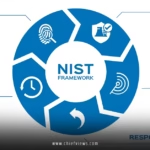






Cybersecurity frameworks for CTO implementation help technology leaders build structured, risk-based defenses without starting from scratch. As a CTO, you’re not just checking compliance boxes—you’re protecting the business from real threats while keeping innovation on track. These frameworks give you a repeatable way to assess gaps, prioritize fixes, and align security with business goals.
Cybersecurity frameworks for CTO implementation matter now more than ever. In 2026, threats move fast—AI-powered attacks, supply chain risks, and regulatory pressure don’t wait. A solid framework turns reactive firefighting into proactive resilience. It helps you speak the same language as the board, justify budgets, and scale security as your organization grows.
Here’s the quick overview:
- Risk-based foundation: Frameworks like NIST CSF 2.0 let you map your current state against desired outcomes and close gaps systematically.
- Governance at the core: The “Govern” function in modern frameworks ensures cybersecurity ties directly to enterprise risk and leadership accountability.
- Practical controls: Mix high-level guidance with actionable safeguards from CIS Controls or ISO 27001 to protect assets without slowing teams down.
- Flexibility for any size: Beginners start simple with prioritized controls; intermediates layer in threat modeling and continuous monitoring.
- Business alignment: Security becomes an enabler, not a blocker—supporting cloud, AI, and remote work without constant surprises.
Why CTOs Need Cybersecurity Frameworks in 2026
You’re the one balancing speed and safety. Without a framework, security feels like guesswork. One week it’s patching everything; the next, it’s a breach headline that could have been prevented.
Frameworks cut through the noise. They organize chaos into clear functions: understand your risks, protect what matters, spot trouble early, respond effectively, recover fast, and—crucially—govern the whole thing from the top.
In my experience, CTOs who adopt a framework early avoid the classic trap of bolting on tools after an incident. Instead, they build security into architecture from day one. The result? Fewer surprises, clearer metrics for the board, and teams that actually understand why controls exist.



Think of it like building a house. You wouldn’t skip the foundation because the paint looks nice. Frameworks are that foundation—everything else (tools, training, audits) stands on it.
Core Cybersecurity Frameworks Every CTO Should Know
Several established frameworks dominate discussions in 2026. None is perfect alone, but together they cover governance, operations, and compliance.
NIST Cybersecurity Framework (CSF) 2.0 stands out as the go-to for most U.S. organizations. Released with major updates in 2024, it now includes six core functions: Govern, Identify, Protect, Detect, Respond, and Recover. It’s voluntary, flexible, and works for companies of any size. The new Govern function puts leadership in the driver’s seat, forcing explicit decisions on risk tolerance and oversight.
ISO/IEC 27001 delivers the international gold standard for an Information Security Management System (ISMS). It emphasizes policies, risk assessment, controls, and continual improvement. Many global or customer-facing companies pursue certification here because it signals serious commitment.
CIS Critical Security Controls offer a prioritized, actionable list—think 18 key safeguards focused on the attacks that actually happen most often. Great for quick wins and technical teams.
COBIT bridges IT governance and business objectives. If you need to show how security supports enterprise goals (and audit trails), this one shines.
SOC 2 isn’t a full framework but a common reporting standard for service organizations handling customer data. Many SaaS CTOs implement controls that map to it.
Other mentions like MITRE ATT&CK help with threat modeling, but start with the big ones.
Cybersecurity Frameworks for CTO Implementation: A Practical Comparison
Choosing the right mix depends on your industry, size, customers, and regulatory needs. Here’s a straightforward comparison:
| Framework | Best For | Strengths | Weaknesses | Implementation Effort | Certification? |
|---|---|---|---|---|---|
| NIST CSF 2.0 | Most organizations, risk focus | Flexible, governance emphasis, easy to customize | Less prescriptive on specific controls | Medium | No |
| ISO 27001 | Global ops, customer trust | Comprehensive ISMS, auditable | Heavier documentation | High | Yes |
| CIS Controls | Quick operational improvements | Prioritized, practical safeguards | Narrower scope | Low-Medium | No |
| COBIT | IT governance alignment | Ties security to business outcomes | More high-level | Medium-High | No |
| SOC 2 | Service providers, data handling | Customer-facing assurance | Audit-focused, not full framework | Medium | Report-based |
This table helps you see trade-offs at a glance. Many CTOs start with NIST for the big picture, layer CIS for immediate controls, and add ISO or SOC 2 for certifications as needed.
Step-by-Step Action Plan for Implementing Cybersecurity Frameworks
Beginners and intermediates can follow this realistic roadmap. It assumes you’re a CTO leading or collaborating with a small security team or external help.
- Prioritize and Scope
Define what matters most—critical systems, data, processes. Ask: What would cripple the business if compromised? Align with business objectives. Short answer: Don’t boil the ocean. - Orient the Organization
Map your environment: assets, threats, regulations, supply chain risks. Review existing policies. This is where you build context. - Create a Current Profile
Assess where you stand against the framework’s outcomes. Be honest—use self-assessment tools or bring in a neutral third party. Gaps will appear quickly. - Conduct a Risk Assessment
Identify threats and vulnerabilities. Prioritize based on likelihood and impact. Factor in AI risks and third-party exposures common in 2026. - Define Your Target Profile
Decide the desired state. What outcomes do you need in each function? Make it achievable within budget and timeline. - Analyze and Prioritize Gaps
Compare current vs. target. Rank fixes by risk reduction and effort. Quick wins first—patch management, access controls, basic monitoring. - Implement the Action Plan
Assign owners, timelines, and metrics. Integrate into existing processes. Test, train, and iterate. Review quarterly.
Treat this as a cycle, not a one-time project. In practice, I usually see teams make solid progress in 6-12 months if leadership stays involved.
Common Mistakes in Cybersecurity Frameworks for CTO Implementation (and How to Fix Them)
Even experienced leaders trip up. Here’s what I’ve seen repeatedly:
- Treating it as a checklist instead of a living program — Fix: Build in regular reviews and tie metrics to business outcomes.
- Lack of executive buy-in — Security becomes an IT silo. Fix: Frame discussions around risk, cost of breaches, and competitive advantage. Involve the board early.
- Over-focusing on technology, ignoring people and processes — Humans remain the weakest link. Fix: Invest in training and clear policies alongside tools.
- Poor risk assessment or scoping — You either miss big risks or waste effort on low-impact areas. Fix: Use structured methods and validate with stakeholders.
- Implementing too much too fast — Leads to burnout and shadow IT. Fix: Phase it—start with Govern and Identify, then layer Protect and Detect.
- Neglecting supply chain and third-party risks — Common in 2026. Fix: Include them explicitly in profiles and contracts.
- Stopping at compliance — You meet the letter but not the spirit. Fix: Measure effectiveness through testing and simulations.
The kicker? Most of these stem from treating security as a project instead of ongoing risk management.
Key Takeaways
- Cybersecurity frameworks for CTO implementation provide structure without rigidity—use them to align security with business priorities.
- Start with NIST CSF 2.0 for its flexibility and governance focus; supplement with CIS Controls for fast operational gains and ISO 27001 for formal assurance.
- Governance is non-negotiable in 2026—leadership must own risk decisions.
- Implementation works best as an iterative cycle: assess, target, gap-fill, act, review.
- Avoid common pitfalls by keeping it practical, involving people, and measuring real outcomes.
- Security enables growth when done right—don’t let it become a drag on innovation.
- Combine frameworks thoughtfully rather than picking one in isolation.
- Regular testing and adaptation beat perfection on paper every time.
For deeper reading, explore the official NIST Cybersecurity Framework resources at nist.gov/cyberframework. Many organizations also reference the Center for Internet Security controls at cisecurity.org and the ISO 27001 standard overview at iso.org.
Cybersecurity frameworks for CTO implementation ultimately give you confidence. You know your posture, can explain it clearly, and can respond when things go sideways. That’s the difference between hoping for the best and managing risk like a pro.
Next step: Grab the NIST CSF 2.0 quick-start materials and run a lightweight current-state assessment with your team this quarter. Small moves compound.
FAQs
What are the main cybersecurity frameworks for CTO implementation?
Popular ones include NIST CSF 2.0 (flexible risk management), ISO 27001 (certifiable ISMS), CIS Critical Security Controls (prioritized safeguards), and COBIT (IT governance alignment). Many CTOs combine them based on needs.
How long does it take to implement cybersecurity frameworks as a CTO?
Expect 6-18 months for meaningful progress, depending on organization size and starting maturity. Focus on phased rollout—governance and core controls first—rather than full perfection upfront.
Is NIST CSF 2.0 suitable for small to mid-sized companies?
Yes. It’s designed for any organization, not just large enterprises or critical infrastructure. The framework’s flexibility and quick-start guides make it accessible for beginners.
Do I need certification when using cybersecurity frameworks for CTO implementation?
Not always. NIST and CIS are typically self-assessed. Pursue ISO 27001 or SOC 2 if customers demand it or if it strengthens market position.
How do cybersecurity frameworks help with AI and emerging threats in 2026?
They emphasize governance, risk assessment, and continuous monitoring—key for handling AI-specific risks like data leakage or model poisoning. Update profiles regularly to address new threat vectors.