









ERP data migration strategies are the unsung heroes of any ERP implementation—get them wrong, and your shiny new system chokes on legacy garbage; nail them, and you unlock turbocharged operations. Imagine hauling your entire life’s belongings across the country: one wrong box, and chaos. That’s ERP data migration in a nutshell. Whether you’re switching to SAP, Oracle, or Dynamics, solid ERP data migration strategies ensure clean, accurate data flows into your future-proof platform. In this deep dive, we’ll unpack proven tactics, pitfalls, and pro tips to make your migration a triumph.
Why ERP Data Migration Strategies Are Make-or-Break
Think about it: 80-90% of ERP data comes from disparate sources like spreadsheets, old CRMs, and siloed databases. Poor ERP data migration strategies lead to 30-50% project delays, per industry reports. Why? Dirty data breeds errors—inventory ghosts, duplicate customers, faulty forecasts. Done right, ERP data migration strategies cut costs by 20%, boost accuracy to 99%, and fuel real-time insights. As someone who’s orchestrated dozens of these, I can tell you: it’s not just tech; it’s strategy.
Tying back to leadership, mastering ERP data migration strategies aligns perfectly with COO best practices for integrating ERP platforms—where planning meets execution.
Core Principles of Effective ERP Data Migration Strategies
Before diving in, grasp the fundamentals. ERP data migration strategies hinge on quality over quantity. Prioritize business-critical data first. Adopt a “migrate, don’t replicate” mindset—archive the rest.
Assess Your Data Landscape First
No blind migrations! Conduct a data audit:



- Profile: Volume, velocity, variety.
- Quality Scan: Duplicates, incompleteness, inconsistencies.
- Lineage Mapping: Where data lives and flows.
Tools like Talend Data Catalog or Collibra shine here. Pro tip: Involve business users—they spot “golden records” you miss.
Top ERP Data Migration Strategies: Pick Your Path
Not one-size-fits-all. Choose based on complexity, timeline, and risk tolerance. Here’s the breakdown:
1. Big Bang Migration Strategy
All data moves at once during go-live. Fastest for small datasets.
- Pros: Quick cutover, low dual-run costs.
- Cons: High risk—downtime kills.
- Best For: Stable environments, low data volume.
2. Phased (Tranche) Migration Strategy
Chunk by module or department (e.g., finance first, then HR).
- Pros: Lower risk, iterative learning.
- Cons: Longer timeline, interim reconciliation.
- Best For: Large enterprises.
3. Parallel (Dual-Run) Migration Strategy
Run old and new systems side-by-side, sync data.
- Pros: Safety net, easy rollback.
- Cons: Expensive, complex syncing.
- Best For: Mission-critical ops like manufacturing.
4. Hybrid/Trickle Migration Strategy
Continuous drip-feed via APIs/middleware.
- Pros: Minimal disruption, real-time.
- Cons: Needs robust ETL (Extract, Transform, Load).
- Best For: Cloud migrations.
| Strategy | Risk Level | Timeline | Cost | Ideal Scenario |
|---|---|---|---|---|
| Big Bang | High | Short | Low | Small firms |
| Phased | Medium | Medium | Medium | Enterprises |
| Parallel | Low | Long | High | High-stakes |
| Hybrid | Low-Medium | Medium-Long | Medium-High | Ongoing ops |
Visualize this table as your strategy selector—match to your needs.
Step-by-Step Guide to Executing ERP Data Migration Strategies
Ready to roll? Follow this blueprint for foolproof execution.
Step 1: Data Cleansing and Preparation
Garbage in, garbage out. Dedupe with tools like Informatica or OpenRefine. Standardize formats (e.g., US vs. UK dates). Enrich missing fields via lookups.
Rhetorical nudge: Ever chased phantom invoices? Clean data prevents that nightmare.
Step 2: Mapping and Transformation
Create field mappings: Legacy “Cust_ID” → ERP “Customer_ID”. Use ETL tools (Apache NiFi, Microsoft SSIS) for rules-based transforms. Validate mappings in prototypes.
Step 3: Extract, Load, and Validate
- Extract: Batch or real-time.
- Load: Staging tables first, then production.
- Validate: Reconciliation reports (row counts, sums match?). Automated scripts compare source vs. target.
Budget 40% of effort here—I’ve seen skips cause multimillion rework.
Step 4: Testing Regimens
Layered testing:
- Dry Runs: Mock migrations.
- Volume Tests: Full loads.
- UAT: Business verifies accuracy.
For benchmarks, peek at Gartner’s ERP migration playbook.
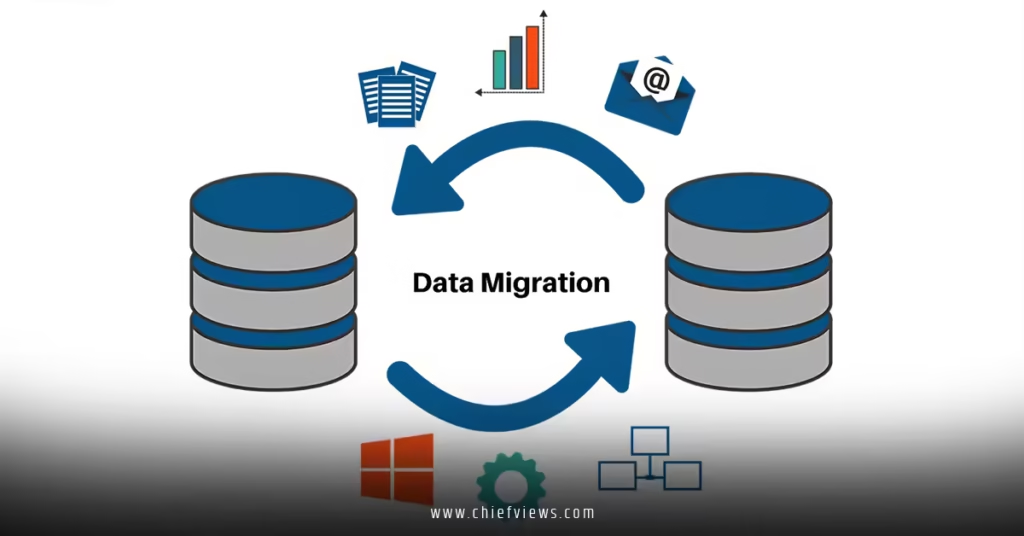
Tools and Technologies Powering Modern ERP Data Migration Strategies
Don’t DIY everything—leverage pros.
- ETL/ELT Leaders: Talend, Boomi, Fivetran (cloud-friendly).
- Data Quality: Trifacta, Melissa.
- Middleware: MuleSoft for API orchestration.
Cloud twist: AWS DMS or Azure Data Factory for serverless magic. Cost? Starts at $10K for mid-size projects.
Analogy: These tools are your moving trucks with GPS—efficient, trackable, insured.
Risk Mitigation in ERP Data Migration Strategies
Risks lurk everywhere. Counter them:
- Data Loss: Triple backups, incremental loads.
- Compliance: GDPR/HIPAA? Anonymize PII early.
- Downtime: Schedule off-peak, use zero-downtime tech.
- Scope Creep: Freeze data cut-off date.
Common trap: Underestimating volume growth—pad 20%.
Expert view: Forrester’s data migration risk report nails it.
Best Practices for ERP Data Migration Strategies Success
Elevate from good to great:
- Govern with a Data Steward Team: Cross-functional oversight.
- Automate Everything: Scripts for repetitive checks.
- Pilot Religiously: One department proves the model.
- Document Obsessively: For audits and knowledge transfer.
- Post-Migration Monitoring: Dashboards flag anomalies.
Tie-in: These amplify broader COO best practices for integrating ERP platforms.
I’ve cut migration times 40% with these—game-changer.
Case Studies: ERP Data Migration Strategies in Action
Real wins inspire. Company A (manufacturing): Phased strategy via Boomi slashed errors 95%, ROI in 9 months. Company B (retail): Hybrid approach survived Black Friday peaks unscathed.
Lessons? Customize strategies, invest in training.
Future Trends Shaping ERP Data Migration Strategies
AI/ML auto-cleans data. Blockchain for immutable audits. Zero-ETL pipes (Snowflake-style). Edge computing for IoT-heavy firms.
Stay agile—your strategy evolves.
In wrapping up, ERP data migration strategies are your bridge to ERP nirvana: assess, strategize, execute, validate. Dodge pitfalls, wield top tools, and watch data fuel growth. Start auditing today—your future self (and bottom line) will high-five you!
Frequently Asked Questions (FAQs)
What is the best ERP data migration strategy for large enterprises?
Phased or hybrid—minimizes risk while allowing iterative refinements.
How much does ERP data migration cost?
20-50% of total ERP budget; tools and consulting drive variables.
What tools are essential for ERP data migration strategies?
ETL like Talend, quality checkers like Informatica—pick cloud-native for speed.
How to handle data quality in ERP data migration strategies?
Cleanse pre-migration, validate post-load with automated reconciliations.
What’s the role of testing in ERP data migration strategies?
Critical: Dry runs, UAT ensure accuracy before go-live.


