

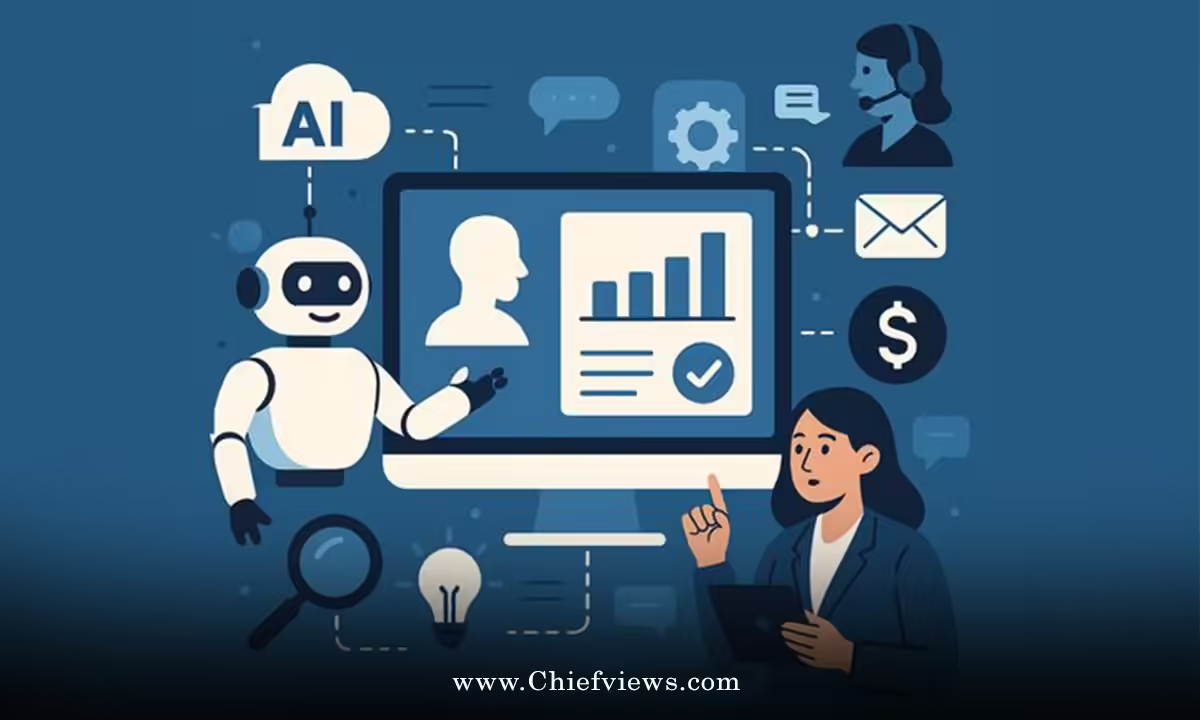
How AI is transforming CMO strategies for personalized customer experience in 2026 comes down to one brutal truth: customers now expect brands to know them better than they know themselves—at every touchpoint, in real time, without feeling stalked.
Gone are the days of broad segments and generic emails. In 2026, CMOs who win treat every interaction as a conversation with an individual. AI makes that possible at scale. It shifts marketing from guesswork to prediction, from broadcast to bespoke.
Early summary block
- AI lets CMOs deliver hyper-personalization using real-time data on behavior, context, and intent—moving beyond basic recommendations to dynamic journeys that adapt instantly.
- Strategies now focus on predictive analytics, generative content, and agentic AI that handles routine engagements while humans step in for empathy and complexity.
- The payoff? Higher engagement, better conversion, stronger loyalty—when done right. Get it wrong, and trust evaporates.
- Key shift for CMOs: Move from campaign manager to experience orchestrator, blending AI speed with human oversight.
- Privacy and ethics aren’t optional; they’re the foundation that keeps personalization from crossing into creepy territory.
This matters because 71% of consumers expect personalized interactions, and most get frustrated without them. Brands that deliver feel relevant. Those that don’t feel irrelevant—fast.
Why personalization now feels table stakes
Think of traditional marketing like throwing darts blindfolded. You hit the board sometimes, but rarely the bullseye. AI removes the blindfold. It analyzes signals—browsing patterns, past purchases, time of day, even external context—and adjusts what a customer sees on your site, in emails, or ads.
The kicker? This happens in milliseconds.


CMOs in 2026 aren’t just approving campaigns. They’re building systems where AI agents manage routine customer engagements, from notifications to reorders, while freeing teams for strategy. Gartner notes this shift from channel-based execution to fluid, autonomous journeys.
No kidding—customers notice. Personalized experiences drive real lifts in satisfaction and revenue. But here’s the catch: it only works if it feels helpful, not manipulative.
Core ways AI reshapes CMO playbooks
Predictive intent over reactive response
AI doesn’t wait for a click. It spots patterns and surfaces offers or content before the customer consciously wants them. A visitor lingers on a product page? The site might tweak pricing, swap imagery, or highlight reviews that match their profile—all dynamically.
This predictive layer turns static websites into living experiences.
Generative AI for content at impossible scale
Copy, images, even entire landing pages now get tailored on the fly. Gen AI crafts messages with the right tone for subgroups, speeding up creation dramatically while keeping relevance high. McKinsey highlighted cases where this approach boosted engagement by 10% in tests.
You still need human review for brand voice, sure. But the volume and speed? Game-changing for mid-sized teams.
Unified data as the new oil
Everything hinges on clean, consented first-party data. Siloed CRM? Dead end. CMOs now push for 360-degree profiles that feed AI models across channels. Real-time orchestration means a customer who abandons a cart gets a helpful nudge via email or app—not a generic blast.
Agentic AI and automation
By 2026, AI agents handle more routine interactions autonomously. They remember context across sessions (memory-rich systems), resolve simple issues, and escalate seamlessly to humans when empathy is needed. This scales personalization without burning out teams.
Emotion-aware and contextual layers
Advanced systems pick up on sentiment from language or behavior, adapting responses accordingly. It’s not sci-fi—it’s moving from “you bought X, here’s Y” to “you seem frustrated with shipping last time, let’s fix that upfront.”
Comparison: Traditional vs. AI-Driven Personalization Strategies
Here’s a quick side-by-side that cuts through the noise:
| Aspect | Traditional Approach | AI-Driven Approach in 2026 | Typical Impact |
|---|---|---|---|
| Segmentation | Static personas or demographics | Real-time dynamic micro-segments based on behavior + context | 2-3x higher relevance |
| Content Creation | Manual, batch-produced | Generative AI with human oversight | 50x faster production in some cases |
| Timing & Delivery | Scheduled campaigns | Predictive, real-time triggers | Higher conversion (up to 2x reported) |
| Scale | Limited by team size | Handles millions of unique experiences | Better ROI on marketing spend |
| Privacy Handling | Often afterthought | Built-in consent, transparent data use | Stronger trust and compliance |
| Measurement | Post-campaign reports | Continuous feedback loops and optimization | Faster iteration, lower waste |
This table isn’t theory. It’s what separates leaders from laggards right now.
How AI is transforming CMO strategies for personalized customer experience in 2026: Key shifts in execution
CMOs who succeed treat AI as a co-pilot, not a replacement. They audit data foundations first. Then layer in tools for real-time decisioning. Cross-functional alignment becomes non-negotiable—marketing, data, IT, and customer service all feed the same system.
What I’d do if stepping into a new role tomorrow? Start small with one high-impact journey (like onboarding or cart abandonment). Prove quick wins with clear metrics: engagement rate, conversion lift, customer satisfaction score. Only then scale.
Privacy isn’t a checkbox. It’s baked in. Use transparent explanations of why data helps (“This lets us skip steps you hated last time”). Consumers share more when value is obvious.
Action Plan: Getting Started as a Beginner or Intermediate Marketer
You don’t need a massive budget or PhD in data science. Follow these steps:
- Audit your data house. Map what you collect (website, CRM, email, support tickets). Identify gaps and consent issues. Clean and unify where possible.
- Pick one use case. Focus on something measurable—like personalized product recommendations or dynamic email content. Define success metrics upfront.
- Choose accessible tools. Start with platforms that integrate AI personalization without heavy custom builds. Test generative features for content.
- Build feedback loops. Track what works and feed results back into models. AI gets smarter with data.
- Involve humans early. Set guardrails for brand voice, ethics, and escalation paths. Review outputs regularly.
- Measure and iterate. Look at not just clicks but downstream value: repeat purchases, lifetime value, NPS.
- Scale responsibly. Once the pilot sings, expand to more channels while monitoring for bias or creepiness.
This phased approach keeps risk low and momentum high.
Common Mistakes (and How to Fix Them)
- Treating AI as a set-it-and-forget-it tool. Fix: Build continuous monitoring and human review. Models drift without oversight.
- Over-personalizing without consent. Fix: Prioritize transparency and opt-in value. Explain benefits clearly.
- Ignoring data quality. Garbage in, garbage out. Fix: Invest time in unification and cleaning before fancy features.
- Chasing tech over customer needs. Fix: Always tie initiatives back to real pain points or delight moments.
- Siloed teams. Fix: Create shared KPIs and regular cross-functional syncs.
I’ve seen too many pilots die because teams chased shiny objects instead of solving actual customer friction.
Key Takeaways
- AI shifts CMO focus from campaigns to orchestrated, predictive customer journeys.
- Hyper-personalization at scale drives engagement and loyalty when balanced with trust and privacy.
- Success requires strong data foundations, real-time capabilities, and human-AI collaboration.
- Start small, measure relentlessly, and iterate based on real results.
- Ethical use isn’t optional—it’s what separates sustainable wins from backlash.
- Agentic AI will handle routine tasks, letting teams focus on strategy and creativity.
- In 2026, personalization that feels helpful wins; anything else feels like noise.
Conclusion
How AI is transforming CMO strategies for personalized customer experience in 2026 isn’t about replacing people. It’s about amplifying what humans do best—understanding nuance, showing empathy—while machines handle the heavy lifting at scale.
Brands that get this right create experiences customers love and remember. They build loyalty that survives economic shifts. The ones that fumble it? They blend into the background.
Your next step is simple: Pick one customer journey that’s underperforming. Audit the data behind it. Layer in AI thoughtfully. Test, learn, refine.
The tools are here. The expectations are set. The only question left is how fast you’ll move.
External links
- Unlocking the next frontier of personalized marketing from McKinsey for insights on gen AI scaling content and promotions.
- Future of Marketing predictions from Gartner on agentic AI shifting to autonomous journeys.
- AI customer experience guide from Zendesk for practical examples of hyper-personalized support.
FAQ :
1. How is AI enabling hyper-personalization at scale for customer experiences?
AI analyzes vast amounts of real-time and historical customer data (behavior, preferences, purchase history, and context) to deliver dynamic, individualized experiences across channels. In 2026, this goes beyond basic segmentation to memory-rich AI that “remembers” past interactions and agentic systems that autonomously orchestrate journeys — creating adaptive content, offers, and interfaces that feel truly one-to-one without manual effort. CMOs use this to boost engagement (up to 3.4× higher in some cases) and customer lifetime value.
2. What key changes are CMOs making to their strategies due to AI-driven personalization?
CMOs are shifting from rule-based, campaign-centric approaches to AI-orchestrated, real-time decisioning. This includes building unified customer data platforms, adopting predictive analytics for intent forecasting, using generative AI for tailored content and creative at high volume, and focusing on relevance over intrusive hyper-personalization. Strategies now emphasize adaptive journeys, privacy-first data practices, and blending AI efficiency with human oversight for trust and creativity.
3. What are the main benefits of AI for personalized CX in CMO strategies?
Benefits include higher engagement and conversions through relevant experiences, reduced customer effort (proactive recommendations and support), scalable personalization without proportional cost increases, faster campaign optimization, and improved loyalty/retention. AI also helps predict needs before customers express them, breaks down data silos for seamless omnichannel journeys, and provides actionable insights for better ROI measurement.
4. What challenges do CMOs face when implementing AI for personalized customer experiences?
Key challenges are maintaining trust and avoiding “creepy” personalization (balancing data use with privacy/consent), data quality and integration issues, ethical concerns like bias in AI models, regulatory compliance, and ensuring AI feels helpful rather than manipulative. Many CMOs also struggle with upskilling teams, measuring true business impact beyond vanity metrics, and preventing over-reliance on AI at the expense of human empathy.
5. How should CMOs prepare their teams and organizations for AI-transformed personalization strategies in 2026?
Focus on building a strong first-party data foundation, piloting AI use cases (e.g., dynamic content or next-best-action engines), fostering cross-functional collaboration (marketing + data + CX teams), and establishing clear governance for ethical AI. Invest in training for data fluency and AI literacy, define a personalization vision centered on customer value (not just tech), and design workflows that combine AI automation with human creativity and oversight. Start small, measure rigorously, and iterate toward agentic, adaptive systems.