






How to become a chief technology officer 2025 isn’t some distant dream reserved for Silicon Valley unicorns or Ivy League prodigies. In today’s hyper-fast tech landscape, the CTO role has exploded in importance—and the path to get there has actually become more accessible than ever, if you know exactly where to focus. Whether you’re a senior engineer eyeing the next leap, a startup tech lead hungry for bigger impact, or even a mid-career professional pivoting into tech leadership, this guide breaks down every realistic step you need in 2025.
What Does a Chief Technology Officer Actually Do in 2025?
Before you chase the title, let’s get real about the job. A modern CTO isn’t just the smartest coder in the room anymore. You’re the bridge between impossible business goals and bleeding-edge technology. Think of yourself as the company’s tech conscience, chief futurist, and firefighter-in-chief—all rolled into one.
In 2025, your average day might swing from debating quantum-safe encryption with the board to unblocking a GenAI rollout that’s eating 40% of the cloud budget. You own the entire technology vision, the architecture roadmap, security posture, innovation pipeline, and—crucially—whether the company survives the next wave of disruption.
Why the Path to “How to Become a Chief Technology Officer 2025” Is Different Now
The old playbook (grind 15 years as a software architect → get lucky with stock options → slide into CTO at your Series D startup) still works, but it’s no longer the only one. Three massive shifts have rewritten the rules:
- AI democratization means raw coding skill matters less than strategic AI fluency.
- Remote-first and distributed companies have blown open geographic barriers.
- Boards now demand CTOs who speak fluent business, not just fluent Python.
The result? You can realistically plot how to become a chief technology officer 2025 in 5–10 years instead of 15–20.



Step 1: Master the Technical Foundation (But Don’t Get Stuck Here)
Yes, you still need serious technical chops. In 2025, that means depth in at least two of these domains:
- Cloud-native architecture (Kubernetes, serverless, multi-cloud)
- AI/ML infrastructure and MLOps
- Zero-trust security and privacy engineering
- Data platforms at scale (real-time + batch + lakehouse patterns)
But here’s the trap most engineers fall into: they keep chasing the next certification or framework instead of leveling up to architecture thinking. Stop. Once you’re comfortably staff-level or principal engineer, shift 70% of your learning budget to systems design, trade-offs, and cost optimization at scale.
How to Become a Chief Technology Officer 2025 Without a Computer Science Degree
Completely possible. I’ve personally watched former sysadmins, data analysts, and even a philosophy major become CTOs. The recipe:
- Build a ridiculous portfolio of real-world impact (open-source projects, internal platforms that saved millions, etc.)
- Get ruthless at explaining complex tech to non-technical people
- Collect mentors who are already CTOs—yes, cold LinkedIn outreach still works in 2025
Step 2: Develop Business and Leadership Muscle Early
The single biggest gap I see in “almost-CTO” candidates? They can’t translate technology into dollars, risk, or competitive advantage.
Start treating every project like a mini-MBA case study:
- What was the ROI?
- How did this move the needle on revenue or retention?
- Which trade-offs did I make and why?
Force yourself to present quarterly tech updates to the exec team—even if you have to beg for 15 minutes. Practice until you can make a room full of MBAs care about observability platforms.
Key Skills Every Future CTO Needs in 2025
| Skill | Why It Matters Now | Fastest Way to Learn It | | Learning how to say “No” elegantly | Budgets are tighter; AI hype is endless | Practice with your current manager | | Financial modeling (CapEx vs OpEx, TCO) | Cloud bills can kill companies | Take a CFO for coffee | | Regulatory landscape (EU AI Act, SEC cyber rules) | Personal liability is real | Subscribe to TechCrunch + NIST updates | | Talent magnet charisma | War for AI talent is brutal | Build your personal brand now | | Crisis leadership | Outages and breaches are when CTOs are made | Volunteer for incident commander duty|
Step 3: Choose Your Career Acceleration Path
There are four proven tracks in 2025. Pick one deliberately.
Path A: Big Tech → CTO (The “Pedigree” Route)
Grind to L7/L8 at Google, Meta, Amazon, or Microsoft. You’ll get world-class scale experience and a golden resume ticket. Downside: slower promotion velocity and soul-crushing politics for some.
Path B: High-Growth Startup → CTO (The “Rocket Ship” Route)
Join a Series B–D company as employee #50–300, often as VP Engineering or Head of Infrastructure. If it 10x’s, you’re the natural CTO successor. Highest risk, highest reward.
Path C: Consulting → CTO (The “Broad Exposure” Route)
Spend 3–7 years at McKinsey Digital, Accenture, Thoughtworks, or a boutique firm. You’ll see 20+ companies’ insides and build C-level relationships fast.
Path D: Start Your Own Thing → CTO (The “Founder-CTO” Route)
Bootstrap or raise a small seed. Even if it “fails,” you’ll gain more leadership experience in 3 years than 10 years elsewhere. Many enterprise companies now love hiring ex-founders as CTOs.
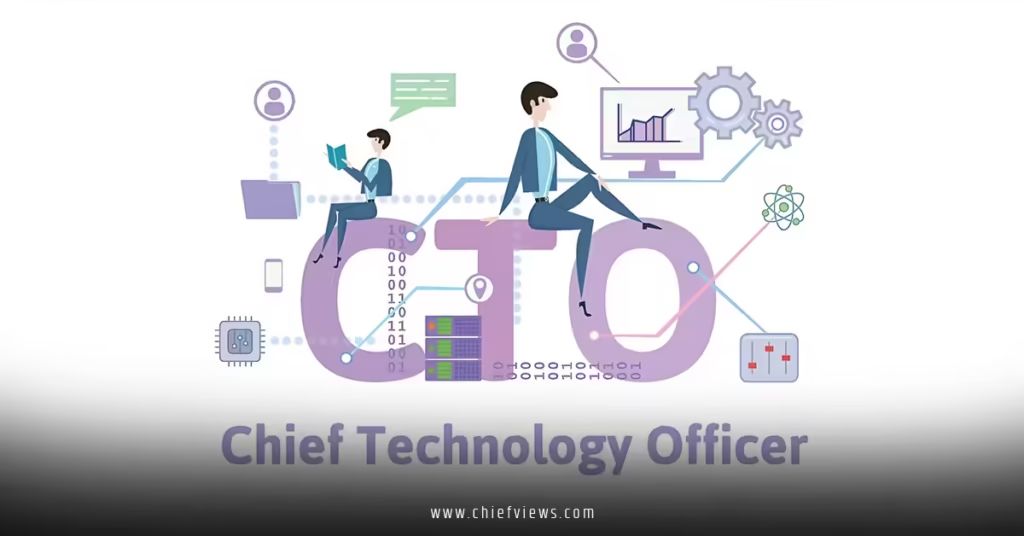
How to Become a Chief Technology Officer 2025: Timeline Breakdown
Realistic milestones assuming you’re starting from senior/lead level today:
- Year 0–2: Reach staff/principal engineer + own a major platform/domain
- Year 2–4: Become Head of Engineering or VP Engineering at 200–1000 person company
- Year 4–7: VP Engineering or CTO at Series C+ startup OR enterprise division CTO
- Year 7–10: Enterprise CTO or high-growth unicorn CTO
Age is increasingly irrelevant. I know multiple CTOs who hit the role at 31 and several who took it at 55 after pivoting from unrelated fields.
Networking and Personal Branding (Yes, You Have to Do This)
Sorry, introverts—this part is non-negotiable.
- Write monthly on LinkedIn or your own blog about hard tech decisions you’ve made (anonymize company names).
- Speak at one conference per year—even virtual ones count in 2025.
- Build a “CTO shadow board”—three current CTOs you talk to quarterly. Buy the coffee (or send the meme).
- Get quoted in industry reports. Journalists are desperate for practitioners who answer emails.
The AI Advantage: How Mastering AI Fast-Tracks Your CTO Journey
In 2025, AI fluency separates the contenders from the pretenders. You don’t need a PhD, but you must:
- Deploy production LLM applications end-to-end
- Understand retrieval-augmented generation, agentic workflows, and fine-tuning trade-offs
- Speak confidently about AI governance, hallucination risks, and evaluation frameworks
Pro tip: lead an AI transformation project at your current company. Nothing screams “future CTO” like shipping a $10M+ impact AI initiative.
Interviews: What Boards Actually Ask Future CTOs in 2025
Forget LeetCode. Real questions I’ve seen recently:
- “Walk us through a time you killed a darling technology project.”
- “How would you reduce our cloud spend 30% without hurting velocity?”
- “Explain our business model to me like I’m 12, then tell me where technology is the moat.”
- “What keeps you up at night about AI risk?”
Practice storytelling. The best candidates treat interviews like fireside chats, not interrogations.
Common Mistakes That Derail “How to Become a Chief Technology Officer 2025” Dreams
- Staying too long as an individual contributor hero
- Avoiding people management (“I’m technical, not a manager”)
- Never learning finance or sales
- Chasing shiny new tools instead of business outcomes
- Waiting to be “tapped” instead of actively campaigning for bigger roles
Final Motivation: Your 2025 CTO Playbook Summary
Here’s the brutal truth: how to become a chief technology officer 2025 comes down to three things almost no one wants to hear:
- You must ship massive business impact repeatedly.
- You must become the person everyone trusts in a crisis.
- You must want the job for the right reasons—building the future, not just the title.
Start today. Pick one lagging area (business acumen, public speaking, AI depth) and block four hours a week for deliberate practice. Compound interest works in careers too.
Ten years from now, when someone asks how you became CTO, you’ll smile and say, “I started back in 2025 when I decided to stop waiting and start leading.”
You’ve got this.
FAQs About How to Become a Chief Technology Officer 2025
1. How long does it realistically take to become a chief technology officer in 2025?
Most new CTOs in 2025 have 12–18 years of total experience, but the fastest paths (high-growth startups + AI expertise) can compress this to 7–10 years from graduation.
2. Do I need an MBA to become a CTO in 2025?
No. An MBA helps with enterprise companies, but shipping real products and demonstrating business impact beats the degree 80% of the time—especially in tech-first organizations.
3. Is it easier to become a chief technology officer 2025 at a startup or a big corporation?
Startups promote CTOs faster but with higher failure risk. Large corporations offer safer ladders but move slower. Many hybrid paths exist (e.g., enterprise spin-outs).
4. How important is AI knowledge when learning how to become a chief technology officer 2025?
Critical. By 2025, lack of production AI experience is the new “doesn’t know cloud.” Even infrastructure-heavy CTOs now own GenAI roadmaps.
5. Can women and underrepresented minorities become CTOs in 2025 more easily than before?
Progress is real but uneven. Many VC firms and boards now actively seek diverse CTO candidates, creating tailwinds if you build strong visibility and track record.
Read Also:ChiefViews