





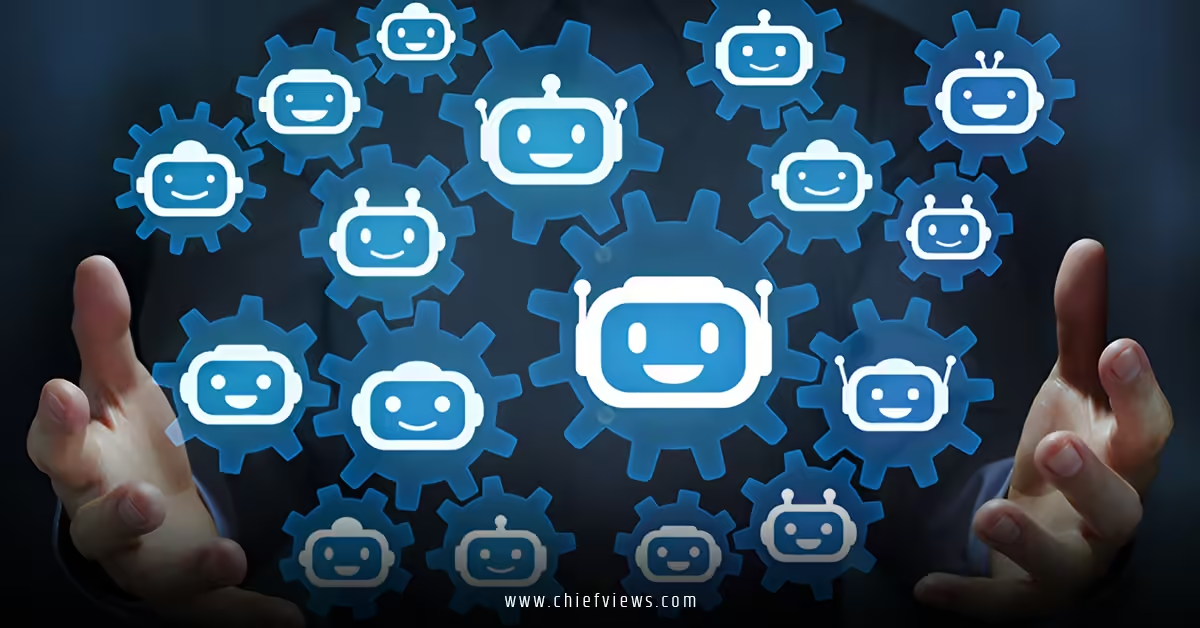
Multi-agent orchestration in enterprises is exploding right now. Picture this: instead of one lone AI agent grinding through tasks alone, you have a coordinated team of specialized digital workers—each handling its niche—chatting, delegating, and collaborating to tackle complex business problems end-to-end. It’s like upgrading from a solo freelancer to a full project squad that never sleeps. In 2026, this isn’t futuristic hype; it’s the practical reality driving massive efficiency gains across supply chains, customer service, incident response, and beyond.
As enterprises push beyond single-agent pilots, multi-agent orchestration in enterprises becomes the secret sauce for unlocking exponential value. But let’s be honest—coordinating multiple autonomous agents isn’t trivial. Done right, it transforms operations. Done poorly, it creates chaos, ballooning costs, or compliance headaches. That’s why smart CIOs tie this directly to proven frameworks like agentic AI governance best practices for CIOs 2026, ensuring autonomy stays bounded, auditable, and aligned with business goals.
In this guide, we’ll break down what multi-agent orchestration really means in the enterprise context, why 2026 is the tipping point, core architectures and patterns, best practices to implement it safely, emerging tools and frameworks, real-world challenges, and how strong governance (yes, circling back to those agentic AI governance best practices for CIOs 2026) keeps everything under control. Let’s dive in.
Understanding Multi-Agent Orchestration: From Single Agents to Intelligent Teams
Single agents are great for straightforward jobs—summarizing reports, answering queries, or triggering basic automations. But real enterprise work is messy: interdependent steps, cross-department data, dynamic decisions, and the need for reliability at scale.
Enter multi-agent orchestration. Here, a central coordinator (or sometimes a decentralized protocol) assigns roles to specialized agents: one pulls data, another analyzes risks, a third executes transactions, and a fourth validates outputs. They share context, resolve conflicts, and adapt on the fly.
Think of it as building a digital assembly line where each “worker” is an AI expert. Deloitte predicts the autonomous AI agent market hits $8.5 billion in 2026, potentially swelling to $45 billion by 2030 with better orchestration. Forrester and Gartner echo this: by 2026-2028, multi-agent systems will handle dozens or hundreds of agents in workflows like supply chain optimization or patient care coordination.



The payoff? 30-50% faster processes, 76% quicker incident response in some cases, and ROI often materializing in months rather than years. But only if you orchestrate thoughtfully.
Why 2026 Marks the Breakthrough Year for Multi-Agent Orchestration in Enterprises
2025 was the year of agent pilots. 2026 flips to production at scale. Single agents proved concepts; now enterprises demand systems that handle long-running, multi-step tasks autonomously.
Key drivers include maturing protocols (like MCP for model context sharing or A2A for agent-to-agent communication), cloud-native platforms (AWS Bedrock AgentCore, Google Vertex AI Agents), and exploding inquiries—Gartner saw a 1,445% surge in multi-agent interest from 2024-2025.
Enterprises report that 80% plan multi-agent expansion within two years of single-agent adoption, yet fewer than 10% succeed without structured approaches. The gap? Orchestration complexity, observability gaps, and governance voids. Those who master it gain structural advantages—faster decisions, lower costs, happier teams.
Core Architectures and Patterns for Multi-Agent Orchestration in Enterprises
Not all orchestration looks the same. Choose based on your needs for control, speed, and explainability.
Centralized Orchestration (Supervisor-Led)
A “manager” agent sits at the top, breaking goals into subtasks, delegating to specialists, synthesizing results, and escalating to humans when needed. Great for high-stakes workflows requiring traceability—like compliance checks or financial approvals.
Pros: Strong governance, easier auditing.
Cons: Potential bottleneck if overloaded.
Examples: Amazon Bedrock multi-agent collaboration, many LangGraph setups.
Decentralized / Peer-to-Peer Patterns
Agents communicate directly via protocols, negotiating tasks without a single boss. Ideal for high-scale, real-time scenarios like dynamic incident response.
Pros: Resilient, low latency.
Cons: Harder to debug conflicts or ensure alignment.
Emerging standards like MCP and A2A make this viable in enterprises.
Hybrid Patterns (Graph-Based or Role-Based Teams)
Tools like LangGraph use graphs for flexible flows—sequential, parallel, conditional branches. CrewAI assigns roles (e.g., researcher, writer, editor) for collaborative “teams.”
These shine in creative or knowledge-intensive processes, balancing autonomy with structure.
Human-in-the-Loop Integration
Even in 2026, humans remain essential for judgment calls. Best setups include dynamic HITL: agents proceed autonomously on routine paths but pause for approval on edge cases.

Essential Best Practices for Implementing Multi-Agent Orchestration in Enterprises
Success hinges on engineering discipline, not just cool tech.
1. Start with Clear Decomposition and Role Specialization
Decompose tasks ruthlessly. Narrow scopes reduce hallucinations and boost reliability. Avoid generalist agents—specialization is king.
2. Prioritize Observability and Monitoring
You can’t fix what you can’t see. Build dashboards tracking agent interactions, token spend, latency, errors, and decision traces. Tools like LangSmith or enterprise platforms provide audit trails.
3. Enforce Guardrails and Governance Early
Link directly to agentic AI governance best practices for CIOs 2026: define autonomy levels, sandbox environments, red lines (no agent touches sensitive data without approval), and escalation protocols. Use constitutional AI principles to embed ethics and compliance.
4. Manage Costs and Latency Aggressively
Multi-agent flows burn tokens fast—prune context, use efficient routing, monitor drift. Latency kills user experience; optimize with caching and parallel execution.
5. Test for Conflict Resolution and Reliability
Simulate failures: what if two agents disagree? Build reflection loops, confidence scoring, and rollback mechanisms.
6. Scale Iteratively with Pilots
Begin small—2-3 agents on low-risk processes. Measure ROI (efficiency gains, error reduction), then expand. Involve cross-functional teams early.
7. Integrate Securely with Enterprise Systems
Use approved APIs, middleware for ERP/CRM/RPA connections. Prioritize platforms with built-in security (enterprise SLAs on AWS, Azure).
Top Frameworks and Platforms Powering Multi-Agent Orchestration in Enterprises 2026
- LangGraph / LangChain: Graph-based flexibility, excellent for complex workflows.
- CrewAI: Role-based teams, user-friendly for quick starts.
- Microsoft AutoGen: Conversational multi-agent patterns, strong Azure integration.
- Amazon Bedrock Multi-Agent Collaboration: Native enterprise features, supervisor models.
- Kore.ai, ServiceNow, Salesforce MuleSoft: Production-grade with governance baked in.
- Open protocols (MCP, A2A): Enabling interoperability across vendors.
Choose based on your stack—open-source for customization, vendor platforms for speed and compliance.
Overcoming Key Challenges in Multi-Agent Orchestration
Coordination overhead, state management, hallucinations cascading, cost overruns—these trip up many. Counter with: shared memory pruning, specialized agents, robust monitoring, and tight governance ties to agentic AI governance best practices for CIOs 2026.
Shadow agents? Centralize via orchestration layers. Workforce pushback? Retrain for “agent boss” roles—humans oversee strategy while agents handle grind.
Conclusion: Orchestrate Now or Get Left Behind
Multi-agent orchestration in enterprises isn’t optional in 2026—it’s how leaders turn agentic AI from experiments into core competitive advantage. By coordinating specialized agents thoughtfully, you achieve faster workflows, smarter decisions, and massive scale. But remember: orchestration thrives under strong governance. Lean on agentic AI governance best practices for CIOs 2026 to set boundaries, ensure observability, and build trust.
The enterprises winning today aren’t just adopting agents—they’re building orchestrated digital workforces. Start small, govern rigorously, iterate fast. Your operations (and bottom line) will thank you.
For deeper dives, explore the Deloitte Insights on AI Agent Orchestration, check NIST AI Risk Management resources for governance alignment, and review Gartner predictions on agentic AI.
FAQ :
What is multi-agent orchestration in enterprises exactly?
It’s the coordination of multiple specialized AI agents to collaboratively handle complex, end-to-end business workflows—far beyond what single agents can achieve alone.
How does multi-agent orchestration in enterprises differ from single-agent setups?
Single agents tackle isolated tasks; multi-agent systems delegate, share context, resolve conflicts, and adapt dynamically for interdependent processes like procurement or incident response.
Why link multi-agent orchestration in enterprises to agentic AI governance best practices for CIOs 2026?
Strong governance ensures safe scaling—preventing rogue actions, maintaining compliance, and providing auditability as agent teams grow more autonomous.
What are the top challenges in implementing multi-agent orchestration in enterprises?
Coordination complexity, latency, cost management, conflict resolution, and observability gaps—addressed through structured patterns, monitoring, and governance frameworks.
Which frameworks are best for multi-agent orchestration in enterprises in 2026?
LangGraph for flexible graphs, CrewAI for role-based teams, AutoGen for conversational flows, and enterprise platforms like AWS Bedrock or Kore.ai for production reliability.