





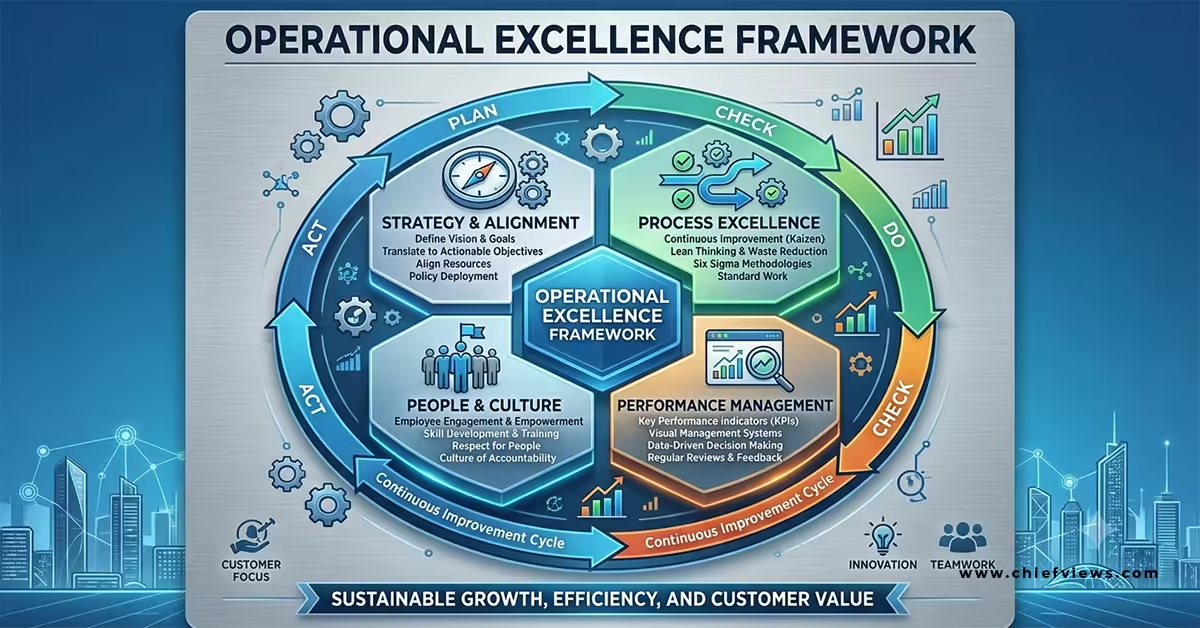
Operational Excellence Frameworks That Deliver Lasting Results :
Operational excellence frameworks give leaders a structured way to turn scattered improvement efforts into a reliable operating system. Without one, teams chase isolated wins that fade. With the right framework, every process, metric, and behavior reinforces the next. The result is lower cost, higher quality, and the ability to scale without the usual chaos.
Quick overview of what matters:
- Frameworks differ by primary focus—waste removal, variation reduction, bottleneck elimination, or cultural principles.
- The strongest results come from combining tools with leadership behaviors and clear management systems.
- Assessment and prioritization beat trying to deploy everything at once.
- Sustainability of gains depends more on daily rituals and ownership than on the initial toolkit.
- Modern applications layer AI and data visibility on top of proven principles rather than replacing them.
These systems form the practical backbone for any serious push on performance.
Why frameworks matter more than random improvement projects
Most organizations run continuous-improvement theater. A kaizen event here, a Six Sigma belt there, then the gains erode because the surrounding system never changed. Real operational excellence treats improvement as the normal way of working, not a special project.
McKinsey research has long shown that high-performing organizations execute consistently on a small set of elements: clear purpose and strategy, reinforcing behaviors and principles, a supporting management system, and technical systems that eliminate waste. The frameworks below operationalize those elements. They also create the process discipline required for broader COO strategies for sustainable cost and efficiency gains.

Choose poorly and you get activity without impact. Choose well and you build compounding capability.
The major operational excellence frameworks compared
Here is a practical side-by-side of the frameworks most organizations actually use.
| Framework | Primary Focus | Core Strength | Best Starting Point | Common Tools |
|---|---|---|---|---|
| Lean | Waste elimination & flow | Speed and cost reduction | Value-stream mapping of a key process | VSM, 5S, Kanban, standard work |
| Six Sigma | Variation & defect reduction | Quality and predictability | High-defect or high-variation process | DMAIC, control charts, Pareto |
| Theory of Constraints (TOC) | System bottleneck | Throughput maximization | Identifying the single constraint limiting output | Five Focusing Steps, buffer management |
| Kaizen | Daily small improvements | Cultural habit of change | Front-line problem solving | PDCA, Gemba walks, suggestion systems |
| Shingo Model | Guiding principles & culture | Sustainable behavior change | Leadership and cultural assessment | Principle-based systems, ideal behaviors |
| Lean Six Sigma | Combined waste + variation | Broad operational performance | Cross-functional process with both issues | Hybrid of Lean tools + DMAIC |
No single framework wins every situation. Lean clears flow problems fast. Six Sigma stabilizes quality. TOC unlocks constrained systems. Shingo keeps the whole effort from becoming tool-focused theater. Many mature organizations run a hybrid anchored by Shingo principles or similar cultural enablers.
How to select and implement the right operational excellence framework
Start with the signal, not the brand name. Ask three questions:
- What is the dominant problem right now—waste and delays, defects and variation, a clear bottleneck, or inconsistent behaviors?
- How mature is the current culture around problem-solving and standard work?
- What capacity exists for training and coaching?
In my experience, most mid-sized companies benefit from beginning with Lean or a focused Lean Six Sigma pilot on one high-visibility value stream. Once basic flow and stability exist, introduce Shingo-style principles to lock in the cultural side. TOC works especially well when a single constraint (machine, process step, or decision bottleneck) is clearly limiting the entire system.
Step-by-step action plan
- Assess current state. Walk the actual work. Map one critical end-to-end process. Capture baseline metrics for cycle time, defects, cost, and customer impact. Avoid surveys alone—go to the Gemba.
- Pick the primary framework and one pilot process. Limit scope deliberately. A single value stream or bottleneck yields faster learning and cleaner proof points.
- Train a small core team. Focus on the tools needed for the pilot, not a company-wide certification wave. Include front-line supervisors and the process owner.
- Run the pilot with visible management. Use daily or weekly visual boards, short stand-ups, and rapid problem-solving cycles. Document both the process changes and the behavior changes.
- Measure, stabilize, then expand. Confirm the gains hold for 60–90 days under normal conditions. Only then replicate to adjacent processes or sites.
- Build the management system. Cascade simple KPIs, create standard work for leaders (Gemba walks, coaching routines), and tie recognition to both results and the behaviors that produced them.
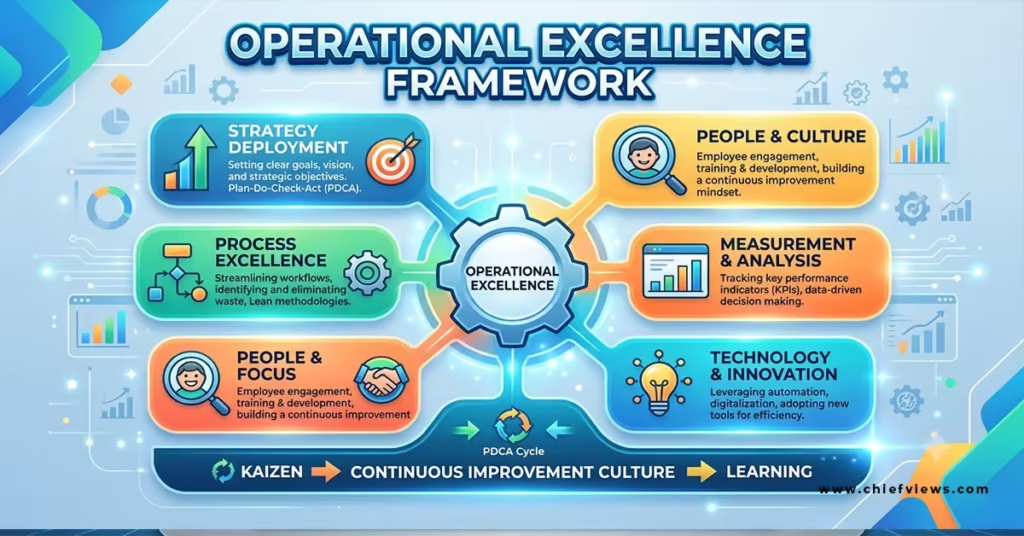
- Layer enabling technology. Once processes are stable, introduce process mining, real-time dashboards, or targeted AI for prediction and exception handling. Technology amplifies a clean system; it cannot fix a broken one.
This sequence prevents the classic failure mode of buying software or launching a big program before the work itself is understood.
Common mistakes that kill operational excellence efforts
Treating the framework as a project with an end date. Excellence is a system, not a finish line. Fix by building recurring rituals—daily tier meetings, weekly performance reviews, monthly coaching—into the calendar.
Optimizing local metrics at the expense of the whole. A department that looks efficient can create downstream chaos. Fix by measuring end-to-end flow and customer outcomes, not isolated utilization.
Over-investing in tools and under-investing in leadership behavior. Tools fade without coaching and modeling. Fix by training leaders first on how to ask questions, surface problems, and support standard work.
Launching too many initiatives simultaneously. Complexity overwhelms capacity and dilutes focus. Fix by maintaining a short, prioritized list and killing or parking everything else.
Ignoring the cultural enablers. Respect for people, psychological safety to raise problems, and scientific thinking are not soft extras. They determine whether standards stick. The Shingo Model makes this explicit for good reason.
Connecting frameworks to broader performance goals
Operational excellence frameworks supply the process discipline and cultural foundation that make larger initiatives durable. When paired with deliberate COO strategies for sustainable cost and efficiency gains, they turn one-time savings into structural advantage. Visibility into true costs, standardized processes, and continuous problem-solving become the daily operating rhythm rather than special events.
Organizations that treat frameworks as living systems—updated with new data, new technology, and new competitive pressures—keep improving long after the initial consultants leave.
Key Takeaways
- Match the framework to the dominant problem: Lean for waste, Six Sigma for variation, TOC for bottlenecks, Shingo for culture and sustainability.
- Assess before you deploy. Baseline data and direct observation prevent false starts.
- Pilot narrow, prove the gains, then expand. Scale only after stability is demonstrated.
- Leadership behavior and daily management systems matter more than the toolkit itself.
- Combine frameworks thoughtfully rather than forcing a pure approach.
- Use technology to amplify clean processes, never as a substitute for them.
- Measure end-to-end outcomes and protect the capacity for ongoing improvement.
- Treat excellence as an operating system that must be maintained, not a project to complete.
The organizations that win with operational excellence frameworks do not chase the latest methodology. They pick the right starting point, execute with discipline, and build the habits that keep improvement alive under pressure. Begin with one critical process this month, map it honestly, and apply the simplest framework that addresses the real constraint. Momentum compounds from there.
FAQs
What is the best operational excellence framework for most companies?
There is no universal best. Lean or Lean Six Sigma works well as a practical starting point for many operations-heavy organizations because the tools deliver visible results quickly while building problem-solving muscle. Add cultural frameworks such as Shingo once basic stability exists.
How long does it take to see results from an operational excellence framework?
Focused pilots often show measurable improvement in 60–90 days. Sustainable, organization-wide impact typically requires 12–24 months of consistent management system reinforcement.
Can operational excellence frameworks work alongside digital transformation and AI?
Yes—and they should. Clean, standardized processes with clear ownership are the foundation that allows AI and automation to deliver reliable returns rather than amplifying existing chaos.

