



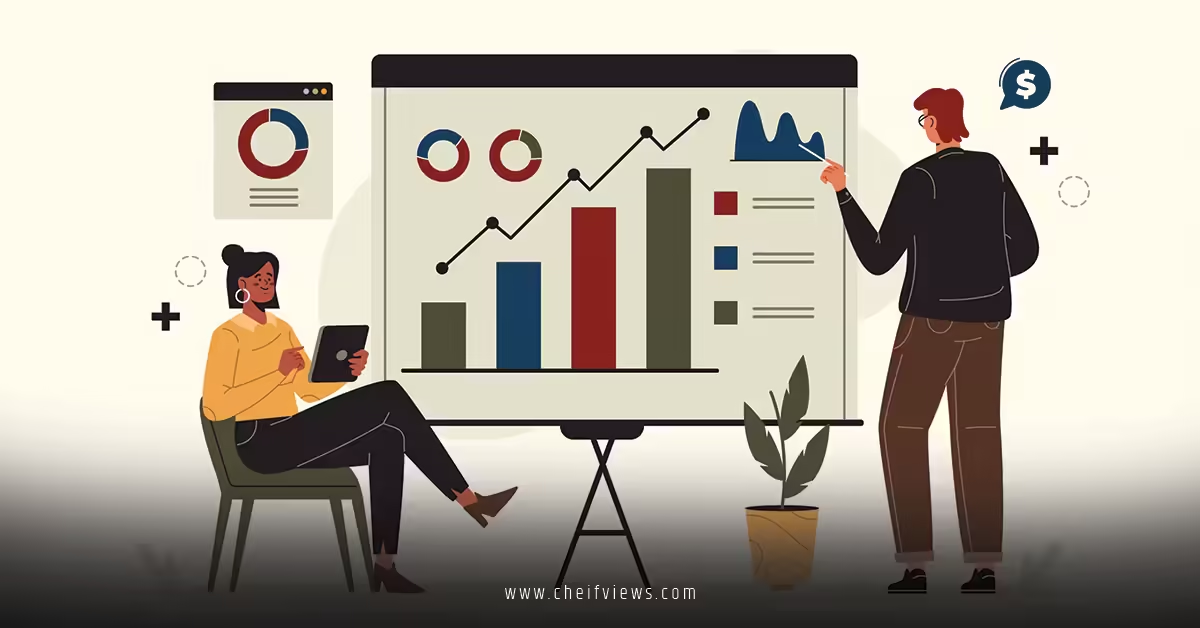
Performance Marketing ROI Strategies have become essential for brands seeking measurable growth. Unlike traditional branding campaigns, performance marketing focuses on measurable outcomes—clicks, conversions, leads, and sales—making ROI (Return on Investment) the ultimate benchmark of success.
As advertising costs rise and consumer behavior shifts, marketers need smart, agile strategies to ensure every rupee spent delivers maximum impact. This guide explores proven Performance Marketing ROI Strategies that deliver sustainable results.
What Is Performance Marketing ROI and Why Does It Matter?
Performance marketing ROI measures the profitability of campaigns where you pay for specific actions (CPA, CPL, CPS). The basic formula is:
ROI = (Revenue Generated – Marketing Cost) / Marketing Cost × 100
A positive ROI indicates profit; a negative one signals inefficiency. In competitive markets like India, where platforms like Google Ads, Meta, and programmatic networks dominate, optimizing ROI separates thriving brands from those burning budgets.

Key Metrics Beyond Basic ROI
Effective Performance Marketing ROI Strategies rely on tracking multiple interconnected metrics:
- ROAS (Return on Ad Spend): Revenue earned per rupee spent on ads. Target ROAS varies by industry (e.g., 4:1–8:1 for e-commerce).
- Customer Acquisition Cost (CAC): Total cost to acquire a new customer.
- Customer Lifetime Value (CLV): Long-term value of a customer. Aim for CLV:CAC ratio of at least 3:1.
- Conversion Rate & Attribution: Understanding which touchpoints drive final conversions (multi-touch attribution is often superior to last-click).
- Payback Period: Time taken to recover CAC.
Top Performance Marketing ROI Strategies for 2026
1. Audience Segmentation and Personalization at Scale
Hyper-targeting remains one of the highest-ROI tactics. Use first-party data, lookalike audiences, and dynamic creative optimization (DCO) to serve personalized ads. Segmented campaigns often deliver 2–3x higher ROI than broad targeting.
2. Rigorous A/B Testing and Experimentation
Never assume—test everything: landing pages, creatives, offers, and bidding strategies. Implement statistical significance checks and run continuous experiments. Brands that test frequently see 20–40% ROI improvements.
3. Advanced Attribution Modeling
Shift from last-click to data-driven attribution or incrementality testing. This reveals the true contribution of upper-funnel channels (awareness) and prevents under-investment in brand-building activities.
4. Creative Refresh Cycles and Ad Fatigue Prevention
Rotate creatives every 2–4 weeks. High-performing creative strategies, especially user-generated content and short-form video, consistently outperform static ads in ROI.
5. Bid Strategy Optimization and Automation
Leverage machine learning-based bidding (Google’s tROAS, Meta’s Value Optimization). Combine this with manual rules for high-value segments to protect margins.
6. Cross-Channel Synergy and Budget Allocation
Allocate budgets dynamically based on real-time performance. Performance marketing works best when search, social, display, affiliate, and email work together in a cohesive funnel.
Performance Marketing in Economic Slowdown: Smart Adaptation
During periods of economic uncertainty, Performance Marketing ROI Strategies become even more critical. Marketing leaders must focus on efficiency rather than vanity metrics.
For deeper insights into how marketing leaders are navigating these challenges, read our detailed guide on performance marketing trends for CMOs in economic slowdown.
Key adaptations include:
- Prioritizing lower-funnel campaigns (bottom-of-funnel) with strong purchase intent signals.
- Increasing emphasis on retention and loyalty programs (cheaper than acquisition).
- Negotiating better rates with publishers and platforms.
- Shifting budget toward high-ROAS channels while testing emerging platforms.
Tools and Technologies That Drive Better ROI
- Analytics: Google Analytics 4 + BigQuery for advanced analysis
- Attribution: Northbeam, Triple Whale, or AppsFlyer
- Creative: AdCreative.ai, Pencil, or creative intelligence platforms
- Bid Management: Google Ads scripts, Marin Software, or Kenshoo
- CRM Integration: HubSpot, Salesforce, or custom data pipelines
Real-World Success Examples
Many Indian D2C brands have achieved exceptional results by implementing disciplined ROI strategies:
- Fashion and beauty brands using Meta Advantage+ Shopping with creative testing reported 5–7x ROAS.
- EdTech and fintech companies combining Google Search with performance display and email retargeting achieved CAC payback periods under 4 months.
Common Pitfalls to Avoid
- Over-reliance on platform-reported metrics without verification
- Ignoring incrementality (paying for customers who would have converted anyway)
- Poor landing page experience leading to high bounce rates
- Neglecting post-conversion tracking and customer retention
Future-Proofing Your Performance Marketing ROI
Looking ahead, successful strategies will integrate:
- AI-powered predictive analytics
- Privacy-first measurement (cookieless solutions)
- Voice and visual search optimization
- Sustainable and value-driven marketing that resonates with conscious consumers
Conclusion: Build a ROI-First Culture
Mastering Performance Marketing ROI Strategies requires a combination of data discipline, creative excellence, and continuous optimization. The brands that treat marketing as an investment rather than an expense—and measure it accordingly—will emerge stronger regardless of economic conditions.
Start by auditing your current campaigns against the metrics and strategies outlined above. Small, consistent improvements in ROI compound into massive competitive advantages over time.
Ready to optimize your performance marketing ROI? Audit your campaigns today and focus on high-intent channels while building stronger customer lifetime value. The data doesn’t lie—those who measure better, win bigger.
FAQs
Q1: What is Performance Marketing ROI and how is it calculated?
Performance Marketing ROI measures the profitability of campaigns where you pay for specific actions like clicks, leads, or sales. It is calculated using the formula: (Revenue Generated – Marketing Cost) ÷ Marketing Cost × 100. A good ROI varies by industry but generally aims for 4:1 or higher.
Q2: How can I improve my Performance Marketing ROI?
To improve ROI, focus on audience segmentation, continuous A/B testing, advanced attribution modeling, creative refresh cycles, and smart bidding strategies. Prioritizing high-intent channels and improving Customer Lifetime Value (CLV) while lowering Customer Acquisition Cost (CAC) delivers the biggest impact.
Q3: What are the best Performance Marketing ROI Strategies during an economic slowdown?
During economic slowdowns, shift budget toward bottom-funnel campaigns, focus on retention and remarketing, use incrementality testing, and emphasize channels with proven high ROAS. Cutting vanity metrics and doubling down on measurable performance tactics helps CMOs maintain growth with tighter budgets.