








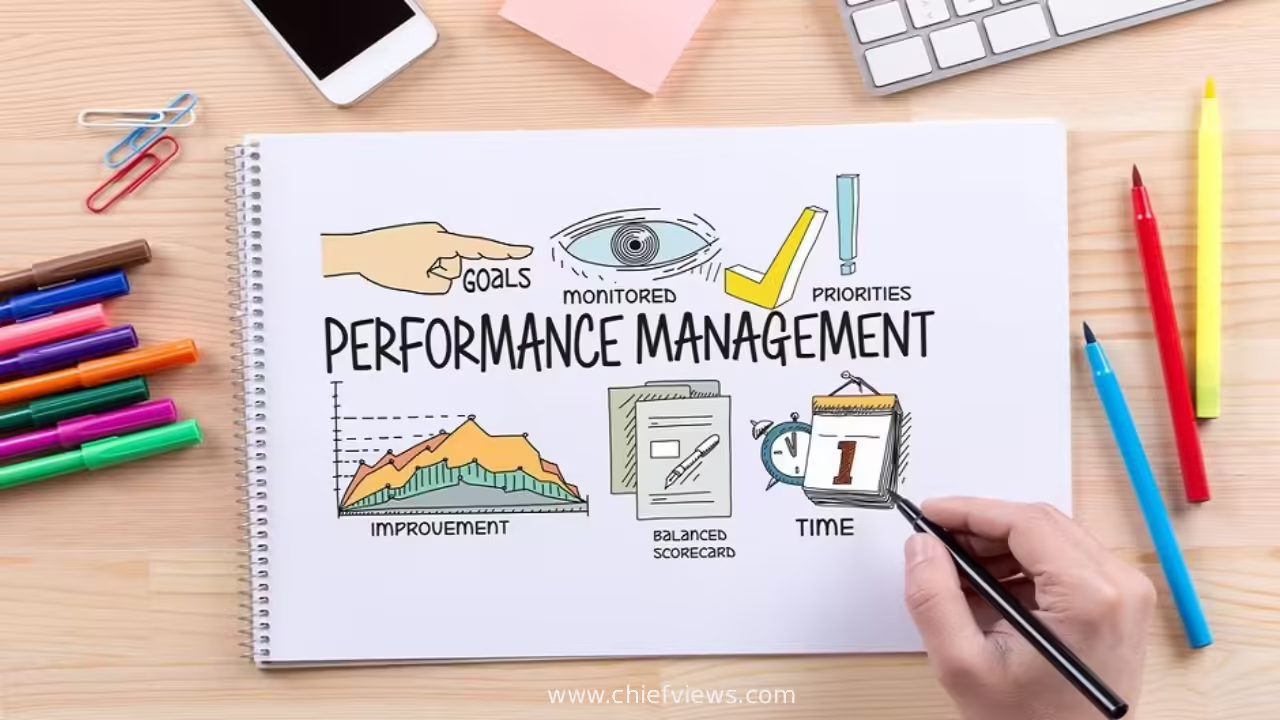
Redesigning performance management systems is no longer optional. AI has rewritten the rules of output, collaboration, and value creation, yet most companies still run reviews built for a pre-AI world. Annual forms, activity-based goals, and manager gut feel cannot keep pace with human-plus-agent work.
Here’s the fast overview:
- Traditional performance systems reward volume and individual effort. AI shifts the real value to outcomes, judgment, and system performance.
- When employees see a strong link between pay and performance, productivity can rise up to 17 percent, according to Gartner research.
- Leaving old frameworks in place creates unintended bonus inflation and fairness gaps as AI tools lift some roles faster than others.
- CHROs who treat this redesign as part of the broader CHRO role in AI transformation and talent costs protect both ROI and trust.
- Continuous feedback, clear human-AI accountability, and recalibrated incentives form the new baseline.
In my experience, the organizations that delay this work end up explaining why high performers feel under-recognized while variable pay quietly balloons. The ones that move early turn performance management into a strategic lever instead of an administrative tax.
Why redesigning performance management systems matters more in 2026
Redesigning performance management systems AI tools raise individual and team output. That is the easy part. The hard part is deciding what “good” looks like when a machine handles half the tasks.
Gartner’s April 2026 analysis is blunt: effective pay-for-performance rests on three foundations—a clear philosophy, fair assessment, and meaningful differentiation. AI threatens all three. It creates ambiguity about what should be rewarded, raises bias risk in AI-supported evaluations, and complicates already tight compensation decisions.
A December 2025 Gartner survey of 1,622 respondents showed that employees who believe pay is tightly linked to performance are up to 17 percent more productive. Break that link and motivation drops. Keep old metrics and you start paying for results the AI delivered while under-valuing the human judgment that made the AI useful.

McKinsey frames the shift cleanly. In an agentic organization, performance moves from “Who did the work?” to “How well did the system perform?” Agents get measured on decision quality, reliability, speed, and cost. Humans get measured on business impact, workflow improvement, ethical use of AI, and cross-team collaboration.
Leave the old system running and two problems surface fast. First, managers save time with AI-assisted reviews—Gartner found an average of four hours saved—but still rate people against outdated goals. Second, pay decisions drift. High AI users look more productive on volume metrics, so they capture larger raises and bonuses even when the real differentiator was access to better tools.
This is exactly where the CHRO role in AI transformation and talent costs becomes decisive. Talent costs do not stop at hiring premiums. They include the ongoing cost of misaligned incentives.
Core principles for redesigning performance management systems
Four principles guide a workable redesign.
Separate performance from potential and AI capability.
Paying purely for AI skill adoption weakens the results-to-reward connection. Reward outcomes first, then the behaviors that produced them—including smart AI use.
Move from annual events to continuous signals.
Static year-end reviews cannot keep up with work that changes monthly. Shift to frequent, lightweight check-ins focused on progress, obstacles, and learning.
Measure the human-AI system, not just the human.
Define which decisions stay human, which can be agent-led, and how exceptions are handled. Score both the individual contribution and the quality of the overall workflow.
Protect fairness and transparency.
AI can surface bias faster than it creates it. Guardrails, manager accountability, and clear explanations of pay decisions remain non-negotiable.
Deloitte’s 2026 Human Capital Trends research reinforces the point: organizations that intentionally redesign roles, workflows, and decision-making for human-AI collaboration are more likely to exceed expectations on AI investment returns. Performance management is the mechanism that makes that redesign stick.
Practical comparison: traditional vs. AI-ready performance management
| Element | Traditional Approach | AI-Ready Redesign |
|---|---|---|
| Goal setting | Annual, activity or volume focused | Continuous, outcome and system focused |
| Feedback cadence | Formal mid-year and year-end | Weekly/bi-weekly lightweight check-ins + quarterly snapshots |
| What gets measured | Individual output and competencies | Business impact + human-AI collaboration quality |
| Role of AI tools | Rarely considered | Explicitly scored for effective and ethical use |
| Manager time | Heavy administrative load | Reduced admin, higher coaching focus |
| Pay differentiation | Often compressed | Higher differentiation with equity guardrails |
| Risk if left unchanged | Bonus inflation, fairness complaints | Protected ROI and clearer motivation |
Redesigning performance management systems This table is not theoretical. Teams that keep the left column while AI tools raise output on the right column create exactly the cost and trust problems CHROs are paid to prevent.
Step-by-step action plan for redesigning performance management systems
Start small. Scale only after the pilot proves the new signals work.
- Diagnose the current gap.
Pull the last two performance cycles. Identify where AI tools already changed output. Flag roles where volume metrics no longer reflect value. Share the findings with the CFO and business unit leads. - Rewrite the performance philosophy.
State clearly what the organization now rewards: business outcomes, quality of human-AI collaboration, judgment under ambiguity, and contribution to system improvement. Publish it. Train managers on it before the next cycle begins. - Pilot revised goals in one function.
Limit each person to three to five measures. Define the outcome, the employee’s contribution, the role of AI, and the evidence managers will use. Run the pilot for one full quarter. - Equip managers with AI-supported assessment tools—and guardrails.
Use AI to synthesize feedback and surface patterns. Keep final judgment and explanations with humans. Require managers to document the “why” behind ratings. - Recalibrate pay decisions.
Adjust variable pay ranges so higher productivity does not automatically produce higher payouts without corresponding value. Preserve equity analysis. Make differentiation real but explainable. - Build continuous feedback into the operating rhythm.
Replace or heavily supplement the annual review with short, structured check-ins. Focus on progress against outcomes, obstacles, and skill growth—not activity lists. - Review and iterate quarterly.
Track three numbers: manager time spent on reviews, employee perception of fairness, and correlation between ratings and actual business results. Adjust before the next cycle.
Redesigning performance management systems What I would do if I inherited a broken system tomorrow: complete steps 1–3 in 60 days and present a joint recommendation with the CFO. That sequence turns a compliance exercise into a cost-control and motivation tool.
Common mistakes and how to fix them
Mistake 1: Treating AI adoption as a performance goal by itself.
Employees chase tool usage instead of results.
Fix: Score effective AI use only as a supporting behavior that enables better outcomes.
Mistake 2: Leaving volume metrics untouched.
AI users look like stars while the system hides quality or judgment gaps.
Fix: Replace pure volume targets with outcome and system-performance measures within one cycle of major tool rollout.
Mistake 3: Adding AI tools without training managers.
Managers save administrative time but still rate people the old way.
Fix: Pair every AI assessment tool with mandatory manager calibration and explanation standards.
Mistake 4: Ignoring fairness optics.
Unequal access to AI tools creates perceived (and real) rating bias.
Fix: Audit tool access and usage patterns. Adjust for differences in opportunity before final ratings lock.
Mistake 5: Waiting for a perfect enterprise-wide design.
The longer the wait, the larger the incentive distortion.
Fix: Pilot in one high-visibility function, prove the signals, then expand.
Key Takeaways
- Redesigning performance management systems is now a core requirement for capturing AI value and controlling talent costs.
- A strong perceived link between pay and performance can drive up to 17 percent higher productivity.
- AI shifts measurement from individual volume to system outcomes and human judgment quality.
- Continuous feedback and recalibrated incentives replace annual activity-based reviews.
- Manager accountability and clear explanations remain essential even when AI assists assessment.
- Pilots in one function followed by quarterly iteration outperform big-bang redesigns.
- This work sits squarely inside the CHRO role in AI transformation and talent costs—ignore it and the financial and cultural risks compound.
- Fairness audits and equity guardrails protect trust while differentiation increases.
Redesigning performance management systems The companies that treat performance management as a living system rather than a yearly ritual will turn AI-driven capacity into sustained results. Those that keep the old calendar and metrics will keep paying more for less clarity. Pick one function, rewrite the goals, equip the managers, and measure the difference in the next quarter. That is the practical starting point.
FAQs
How does redesigning performance management systems connect to controlling talent costs?
Misaligned incentives create two expensive problems: over-paying for AI-boosted volume that does not equal real value, and under-recognizing the judgment work that makes AI useful. Both distort total rewards spend and weaken motivation.
Should AI tools replace manager judgment in performance reviews?
No. AI can synthesize data and save administrative time—Gartner found managers save roughly four hours on average—but final ratings, differentiation, and explanations must stay with humans who remain accountable.
How quickly should organizations move on redesigning performance management systems?
Start the diagnosis and philosophy rewrite immediately. Pilot revised goals in one function within 90 days. Waiting a full annual cycle while AI tools raise output only widens the gap between metrics and reality.

