









Strategic workforce planning for operations leaders starts with a hard truth: your people are your most complex and valuable resource. Unlike budget spreadsheets or technology deployments, workforce planning involves human unpredictability, career aspirations, and the delicate balance between current needs and future growth.
Quick Overview:
- Demand forecasting based on business growth projections
- Skill gap analysis and capability mapping across teams
- Succession planning for critical operational roles
- Resource reallocation strategies for maximum efficiency
- Performance-driven hiring and development frameworks
The reality? Operations leaders who master workforce planning see 23% higher productivity and 18% lower turnover than those who don’t. Your competitive advantage isn’t just having great people—it’s having the right people in the right roles at the right time.
The Strategic Workforce Planning Foundation
Understanding Workforce Planning vs. HR Management
Here’s where most operations leaders get confused. HR manages the mechanics: job postings, interviews, onboarding, benefits administration. Strategic workforce planning is about business outcomes.
You’re asking different questions:
- What capabilities will we need to achieve next year’s targets?
- Where are our critical knowledge bottlenecks?
- How do we maintain productivity during periods of rapid growth?
- Which roles are most vulnerable to market competition?
The Three Planning Horizons:
- Immediate (0-6 months): Filling critical gaps, managing current workload distribution
- Tactical (6-18 months): Building capabilities for known business initiatives
- Strategic (18+ months): Developing organizational capacity for future market opportunities
The Business-First Approach
Workforce planning starts with business strategy, not with people strategy. What’s the company trying to achieve? What operational capabilities are required? Only then do you translate business needs into workforce requirements.
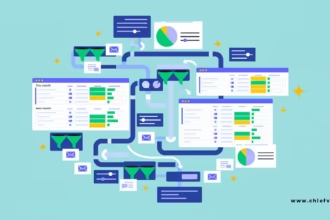


Strategic Alignment Process:
- Business Objective Analysis: Break down strategic goals into operational requirements
- Current State Assessment: Map existing workforce capabilities and capacity
- Future State Design: Define ideal workforce composition and structure
- Gap Identification: Quantify differences between current and required capabilities
- Action Planning: Create specific initiatives to close capability gaps
Demand Forecasting and Capacity Planning
Building Your Workforce Crystal Ball
Operations leaders need to predict workforce needs with enough accuracy to make smart hiring decisions, but enough flexibility to adapt when predictions are wrong.
Key Demand Drivers to Track:
- Revenue Growth Projections: How does a 30% revenue increase translate to operational headcount needs?
- Market Expansion Plans: New products, new markets, new channels all require different skill sets
- Seasonal Fluctuations: Understanding cyclical workforce needs prevents costly over-hiring
- Technology Implementation: Automation may reduce some roles while creating demand for others
Workload-Based Capacity Modeling
The most accurate workforce planning starts with understanding work volume, not just business metrics.
Capacity Planning Framework:
| Business Driver | Workload Impact | Workforce Requirement |
|---|---|---|
| Customer acquisition | Support tickets +40% | 2 additional customer success reps |
| Product launch | Marketing campaigns +60% | 1 campaign manager, 1 content creator |
| Geographic expansion | Logistics complexity +25% | 1 operations coordinator, 0.5 analyst |
Leading vs. Lagging Indicators
Most companies plan workforce based on lagging indicators—what happened last quarter. Smart operations leaders focus on leading indicators that predict future workforce needs.
Leading Workforce Indicators:
- Sales pipeline strength and conversion trends
- Product development milestones and launch schedules
- Market expansion timelines and regulatory approvals
- Technology implementation phases and go-live dates
Skill Gap Analysis and Capability Mapping
The Hidden Skill Inventory
Your biggest workforce planning challenge isn’t usually headcount—it’s capabilities. You might have enough people but not the right mix of skills for evolving business needs.
Comprehensive Skill Assessment:
- Technical Skills Audit: Software proficiency, certifications, specialized knowledge
- Soft Skills Evaluation: Leadership potential, communication abilities, problem-solving approaches
- Business Knowledge Assessment: Understanding of company processes, customer needs, industry dynamics
- Learning Agility Measurement: Ability to acquire new skills quickly as business needs evolve
Future-Proofing Your Talent Pipeline
Strategic workforce planning for operations leaders requires anticipating skill needs that don’t exist today. According to the World Economic Forum, 50% of all employees will need reskilling by 2025 due to technological advancement.
Emerging Skill Categories:
- Data Literacy: Ability to interpret analytics and make data-driven decisions
- Process Automation: Understanding how to optimize workflows with technology
- Cross-Functional Collaboration: Working effectively across departments and time zones
- Customer Experience Design: Thinking from the customer’s perspective in operational decisions
Building vs. Buying Talent
Every skill gap presents a choice: develop existing employees or hire new talent. The right answer depends on time, cost, and strategic importance.
Build vs. Buy Decision Matrix:
| Factor | Build Internally | Buy Externally |
|---|---|---|
| Urgency | 6+ months available | Immediate need |
| Skill Complexity | Moderate difficulty | Highly specialized |
| Employee Potential | High learning agility | Limited development capacity |
| Budget Impact | Lower cost, higher time | Higher cost, faster results |
| Strategic Value | Core competency | Supporting capability |
Succession Planning and Knowledge Management
Beyond the Org Chart
Traditional succession planning creates neat boxes showing who reports to whom. Strategic workforce planning identifies critical knowledge holders and ensures business continuity regardless of individual departures.
Knowledge Risk Assessment:
- Single Points of Failure: Processes that only one person understands completely
- Institutional Knowledge: Historical context and relationship insights that aren’t documented
- Technical Expertise: Specialized skills that would be expensive or time-consuming to replace
- Customer Relationships: Personal connections that drive significant business value
Dynamic Succession Planning
Instead of static succession charts, create flexible development pathways that prepare multiple people for various scenarios.
Multi-Path Development Strategy:
- Cross-Training Programs: Ensure critical functions can be performed by multiple team members
- Mentorship Networks: Pair high performers with experienced leaders across different areas
- Project-Based Development: Give emerging leaders exposure to different business challenges
- External Development: Industry conferences, certifications, and networking opportunities
Performance-Driven Workforce Optimization
Moving Beyond Traditional Performance Reviews
Strategic workforce planning requires real-time performance insights, not annual review cycles. You need to understand who’s excelling, who’s struggling, and who’s ready for new challenges.
Continuous Performance Intelligence:
- Objective Completion Rates: How consistently do team members deliver on commitments?
- Quality Metrics: Error rates, customer satisfaction, and peer feedback
- Innovation Contributions: Process improvements and problem-solving initiatives
- Collaboration Effectiveness: How well do they work with other teams and departments?
High-Performer Retention Strategies
Your top 20% of performers typically drive 80% of results. Losing them doesn’t just create a hiring need—it often requires hiring two or three people to replace their output.
Retention-Focused Planning:
- Career Path Clarity: Show high performers how their role connects to future opportunities
- Challenge Escalation: Gradually increase responsibility and complexity
- Skill Investment: Provide training and development opportunities aligned with their interests
- Recognition Systems: Acknowledge contributions in ways that matter to each individual
Managing Underperformance Strategically
Poor performers don’t just underdeliver—they consume disproportionate management time and can demotivate strong team members. Strategic workforce planning includes systematic approaches to performance improvement or transition.
Performance Improvement Framework:
- Root Cause Analysis: Is it skills, motivation, clarity, or fit?
- Targeted Development: Specific, measurable improvement plans with timelines
- Resource Allocation: Coaching, training, or role modification support
- Progress Monitoring: Regular check-ins with clear success criteria
- Transition Planning: Graceful exits when improvement isn’t achieved

Technology Integration in Workforce Planning
Workforce Analytics and Predictive Modeling
Modern strategic workforce planning leverages data analytics to make more accurate predictions and better decisions. You’re not just counting people—you’re analyzing patterns, predicting needs, and optimizing allocation.
Essential Workforce Data Points:
- Historical hiring patterns and time-to-productivity metrics
- Skill utilization rates across different projects and seasons
- Employee engagement scores correlated with performance outcomes
- Cost-per-hire and quality-of-hire measurements by source
Automation’s Impact on Workforce Strategy
Every operations leader faces the question: which roles will be automated, which will be augmented, and which will remain human-centric? Your workforce planning must account for this technological evolution.
Automation Planning Categories:
| Role Type | Automation Impact | Workforce Strategy |
|---|---|---|
| Routine Tasks | High automation potential | Reskill or redeploy |
| Analysis & Decision | Augmentation opportunity | Upskill for human-AI collaboration |
| Relationship Management | Low automation risk | Invest and retain |
| Creative Problem-Solving | Human advantage | Develop and expand |
Resource Allocation and Cross-Functional Planning
Breaking Down Departmental Silos
Effective strategic workforce planning for operations leaders requires looking beyond your direct reports. You need to understand how workforce decisions in one area impact other departments and overall business performance.
This connects directly to COO responsibilities in resource planning and efficiency, where workforce optimization is just one component of comprehensive resource management. The most successful operations leaders coordinate workforce planning with budget allocation, technology deployment, and process optimization to create integrated solutions.
Cross-Departmental Workforce Coordination:
- Sales and Operations Alignment: Ensuring customer-facing teams have adequate operational support
- Product and Engineering Coordination: Balancing development velocity with operational stability
- Marketing and Customer Success Integration: Managing the flow from lead generation to customer retention
Matrix Management and Resource Sharing
Modern organizations often require people to work across multiple projects and departments. Your workforce planning must account for this complexity while maintaining accountability.
Resource Sharing Framework:
- Core vs. Flex Allocation: Define what percentage of each person’s time is dedicated vs. available for cross-functional projects
- Priority Matrix: Clear guidelines for how competing demands are resolved
- Communication Protocols: Regular coordination meetings and shared visibility tools
- Performance Attribution: Fair evaluation systems that account for matrix contributions
Common Workforce Planning Mistakes
Mistake #1: Planning in a Vacuum
The Problem: Creating workforce plans without understanding broader business strategy or market dynamics.
The Fix: Start every workforce planning cycle with business strategy review. What’s changing? What new capabilities do we need? What assumptions might be wrong?
Mistake #2: Overemphasizing Current Pain Points
The Problem: Hiring to solve today’s problems without considering how needs will evolve.
The Fix: Balance immediate needs with strategic capability building. Aim for solutions that address current gaps while building future flexibility.
Mistake #3: Underestimating Cultural Fit
The Problem: Focusing only on skills and experience while ignoring cultural alignment and team dynamics.
The Fix: Include cultural assessment and team fit in every hiring and development decision. Skills can be taught; attitude and values alignment are harder to change.
Mistake #4: Neglecting Internal Development
The Problem: Defaulting to external hiring instead of developing existing talent.
The Fix: Create clear development pathways and invest in upskilling. Often, promoting from within is faster and more cost-effective than external recruitment.
Implementation Roadmap for Strategic Workforce Planning
Phase 1: Foundation Building (Month 1-2)
- Current State Assessment: Comprehensive skill inventory and performance analysis
- Business Alignment: Map workforce needs to strategic business objectives
- Data Infrastructure: Implement tracking systems for key workforce metrics
- Stakeholder Engagement: Align with leadership on planning assumptions and priorities
Phase 2: Strategic Development (Month 3-4)
- Demand Forecasting: Build models for predicting future workforce needs
- Gap Analysis: Quantify differences between current capabilities and future requirements
- Scenario Planning: Develop workforce strategies for different growth scenarios
- Resource Allocation: Balance investment between hiring, training, and retention
Phase 3: Execution and Optimization (Month 5+)
- Implementation: Execute hiring, development, and reallocation plans
- Monitoring: Track progress against objectives and leading indicators
- Adjustment: Refine strategies based on results and changing conditions
- Scaling: Expand successful approaches across the organization
Measuring Workforce Planning Success
Key Performance Indicators
Efficiency Metrics:
- Time-to-fill for critical positions
- Cost-per-hire by role and source
- Internal mobility and promotion rates
- Training ROI and skill development velocity
Effectiveness Metrics:
- Employee productivity and performance trends
- Retention rates for high performers
- Customer satisfaction scores tied to workforce changes
- Revenue per employee and operational efficiency ratios
Long-Term Success Indicators
According to McKinsey Global Institute research, organizations with strategic workforce planning see 30% faster time-to-market for new initiatives and 25% higher employee engagement scores.
Strategic Success Measures:
- Organizational Agility: How quickly can you adapt workforce to changing business needs?
- Capability Readiness: Do you have the skills needed for next year’s priorities?
- Competitive Advantage: Is your workforce a source of differentiation in the market?
- Future-Proofing: How resilient is your organization to industry disruption?
Key Takeaways
- Start with Business Strategy: Workforce planning must be driven by business objectives, not just current operational needs
- Think Beyond Headcount: Focus on capabilities, skills, and performance outcomes rather than just numbers of people
- Plan for Multiple Horizons: Balance immediate needs with medium-term capability building and long-term strategic positioning
- Invest in Data and Analytics: Use workforce intelligence to make better predictions and decisions
- Develop Internal Talent: Building capabilities internally is often more effective than constantly hiring externally
- Consider Cross-Functional Impact: Workforce decisions in one area affect the entire organization
- Embrace Continuous Planning: Workforce planning is an ongoing process, not an annual event
- Measure and Adjust: Track both leading and lagging indicators to improve planning accuracy over time
Conclusion
Strategic workforce planning for operations leaders isn’t about predicting the future perfectly—it’s about building organizational capability to succeed regardless of how the future unfolds. The most successful operations leaders create workforces that are both highly effective today and adaptable for tomorrow’s challenges.
Your competitive advantage comes from having the right people with the right skills in the right roles at the right time. But it also comes from creating systems that can evolve, adapt, and improve continuously as your business grows and changes.
The companies that will thrive in the next decade are those where workforce planning feels strategic rather than reactive, where development is intentional rather than accidental, and where people understand how their growth connects to organizational success.
Start with one critical capability gap. Apply the framework above to close it systematically. Then scale your approach across the organization. Excellence in workforce planning compounds over time—and so does the competitive advantage it creates.
Frequently Asked Questions
Q: How does strategic workforce planning for operations leaders differ from HR planning?
A: HR planning focuses on administrative processes and compliance, while strategic workforce planning for operations leaders concentrates on building capabilities that directly support business objectives. Operations leaders think about workforce as a competitive advantage, not just a cost center.
Q: What’s the ideal timeframe for workforce planning cycles?
A: Use a three-horizon approach: quarterly reviews for immediate needs (0-6 months), bi-annual planning for tactical initiatives (6-18 months), and annual strategic planning for long-term capability building (18+ months). Market volatility may require more frequent adjustments.
Q: How do you balance hiring externally vs. developing internal talent?
A: Generally, develop internally for core competencies and strategic roles, hire externally for specialized skills or urgent needs. Internal development builds loyalty and cultural continuity, while external hiring brings fresh perspectives and immediate capabilities.
Q: What technology tools are essential for workforce planning?
A: Start with workforce analytics platforms that integrate with your HRIS, project management tools for capacity planning, and skills assessment software. The key is having real-time visibility into workforce utilization and performance trends.
Q: How do you handle workforce planning during periods of rapid business growth?
A: Focus on scalable hiring processes, clear role definitions, and robust onboarding systems. Prioritize roles that enable others to be more effective, and don’t sacrifice quality for speed—bad hires during growth periods create compounding problems.


