




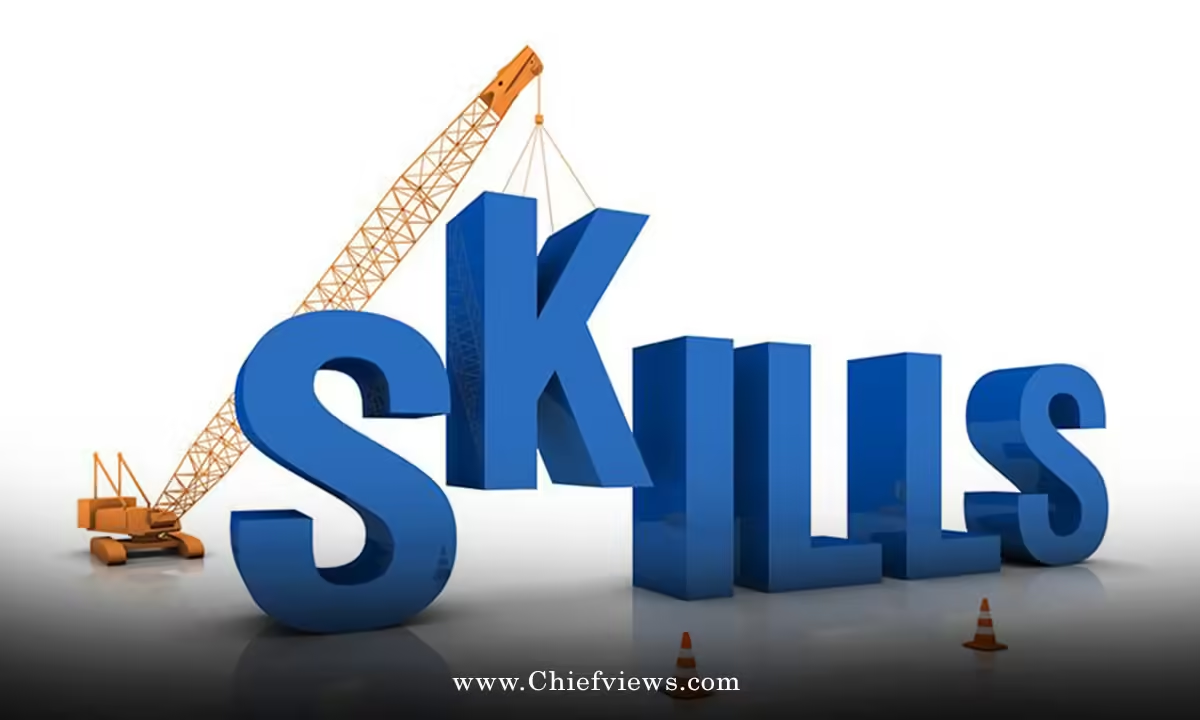
Building a skills-based talent strategy in the AI era means ditching rigid job titles and focusing on what people can actually do—right now and next.
AI reshapes work fast. Roles evolve, tasks shift to machines, and human strengths like judgment and creativity become the real edge. Organizations that map, build, and deploy skills dynamically stay agile. They unlock internal talent, reduce hiring friction, and pair humans with AI for better results.
This approach directly supports CHRO priorities for AI workforce transformation and leadership development in 2026 by creating the flexible workforce leaders need to navigate hybrid teams and continuous change.
Here’s the no-fluff overview:
- Shift from jobs to skills: Break down roles into tasks and capabilities, then rebuild them around AI augmentation.
- Dynamic skills intelligence: Use real-time mapping to spot gaps, adjacencies, and hidden talent inside your organization.
- AI as accelerator: Leverage tools for skills inference, personalized learning, and faster internal mobility.
- Human + AI balance: Prioritize technical fluency alongside uniquely human skills like critical thinking and ethical judgment.
- Business impact: Faster adaptation, higher retention, and measurable productivity gains in a volatile environment.
Why skills-based talent strategy beats traditional models in the AI era
Traditional job descriptions feel outdated when AI can handle routine work overnight.
One day a role involves data entry and basic analysis. The next, AI takes those pieces, leaving humans to interpret insights, handle exceptions, and build relationships. Stick to title-based planning and you miss talent that already exists in your ranks—or hire the wrong people for tomorrow’s needs.

In the AI era, skills decay faster. What worked last year might not cut it next quarter. A skills-based approach gives you visibility. You see current capabilities, forecast what’s coming, and move people into new configurations without starting from scratch every time.
The kicker? Organizations using skills-first methods report stronger agility. They respond to market shifts quicker because they aren’t locked into outdated structures. For CHROs driving AI transformation, this is foundational—it turns workforce strategy from reactive to proactive.
Think of it like upgrading from a paper map to live GPS. You don’t just know where you are. You see traffic ahead, alternate routes, and the fastest way to your goal.
Key components of a skills-based talent strategy
Effective strategies rest on a few practical pillars.
Enterprise skills taxonomy and inventory: Create a shared language of skills across the company. Include technical ones (prompt engineering, data literacy, AI tool proficiency) and human ones (systems thinking, adaptability, ethical reasoning). AI platforms help infer skills from work outputs, projects, and feedback—no more manual spreadsheets.
Role and workflow redesign: Deconstruct jobs into tasks. Identify what AI can augment or automate. Rebuild roles so humans focus on higher-value work. This isn’t downsizing—it’s often role evolution. Studies show AI reshapes 50-55% of US jobs in the coming years, with more augmentation than outright replacement.
Internal talent marketplaces: Enable project-based staffing and mobility based on skills, not hierarchy or tenure. Employees see opportunities that match their capabilities. Managers build teams from real strengths instead of available headcount.
Continuous learning in the flow of work: Move beyond annual training. Embed micro-learning, AI-recommended paths, and on-the-job application. Personalized development keeps skills fresh without pulling people off critical tasks.
Governance and measurement: Track proficiency levels, skill adjacency (how close one skill is to another for easier transitions), and business outcomes like time-to-productivity or innovation rates.
Here’s a comparison table:
| Element | Traditional Job-Based Approach | Skills-Based in AI Era | Real-World Advantage |
|---|---|---|---|
| Talent Sourcing | Resume keywords and degrees | Demonstrated capabilities and potential | 6x+ larger talent pools |
| Workforce Planning | Headcount and org charts | Dynamic skills supply vs. demand | Faster gap closure and redeployment |
| Learning & Development | One-size-fits-all programs | Personalized, AI-driven, in-flow | Higher engagement and retention |
| Role Design | Static descriptions | Task-level redesign with AI augmentation | More human-centric, higher-value work |
| Performance Focus | Job title deliverables | Skill proficiency and outcome impact | Clearer ROI on talent investments |
This shift isn’t theoretical. Companies applying it see reduced mis-hires and better internal fill rates.
Step-by-Step Action Plan to Build Your Strategy
Beginners and mid-level HR pros, start here. No need for a massive overhaul on day one.
- Audit and map existing skills (Weeks 1-6): Inventory current capabilities using surveys, performance data, and AI inference tools. Focus on high-impact functions first.
- Define your skills taxonomy (Weeks 4-8): Collaborate with business leaders and IT. Keep it practical—50-200 core skills to start, not thousands.
- Redesign priority roles (Months 2-4): Pick 2-3 workflows where AI is already in play. Break them into tasks. Reallocate what AI handles best and augment the rest.
- Pilot internal mobility (Months 3-6): Launch a simple talent marketplace for projects. Match people to opportunities based on skills.
- Embed learning and development: Integrate AI recommendations into daily tools. Tie upskilling to real business challenges.
- Measure and iterate: Track leading indicators (skills coverage, mobility rate) and lagging ones (productivity, retention, time-to-fill). Adjust quarterly.
Rule of thumb: Allocate more effort to change management and communication than to the tech itself. People resist what they don’t understand.
Common mistakes and quick fixes
- Treating skills mapping as a one-time event: Fix it by making it dynamic. Schedule quarterly refreshes and link to business planning cycles.
- Over-focusing on technical AI skills alone: Fix by balancing with human skills. Critical thinking and collaboration still win when AI handles the basics.
- Ignoring manager buy-in: Fix by involving leaders early. Train them to coach on skills, not just performance against old job specs.
- Building in isolation: Fix by creating cross-functional ownership—HR, IT, and business units together.
- No clear success metrics: Fix by tying everything to outcomes like faster project staffing or reduced external hiring costs.
Catch these early. Small course corrections prevent stalled initiatives.
How this links to broader CHRO priorities
Building a skills-based talent strategy isn’t a side project. It sits at the heart of CHRO priorities for AI workforce transformation and leadership development in 2026.
It equips leaders to orchestrate hybrid teams, helps employees adapt without burnout, and gives the organization the agility AI demands. When skills drive decisions, leadership development focuses on real needs—like coaching AI-augmented teams or navigating constant change. The result? A workforce ready for the human-machine era, not fighting it.
Key Takeaways
- Skills-based strategies replace static jobs with dynamic capabilities, essential in the fast-evolving AI landscape.
- Start with mapping, then redesign roles around human-AI collaboration.
- Use AI tools to accelerate skills intelligence without replacing human judgment.
- Balance technical and human skills for sustainable performance.
- Internal mobility and in-flow learning boost retention and agility.
- Measure both skill health and business outcomes.
- Tie your approach directly to CHRO-level AI transformation goals for maximum impact.
- Treat this as continuous—review and adapt every quarter.
Conclusion
Building a skills-based talent strategy in the AI era gives your organization speed, resilience, and a genuine edge. You stop guessing what talent you need and start knowing. You move people to where value is created fastest. And you create space for humans to do what they do best alongside powerful AI.
Pick one department or process this month. Map the skills, spot the AI opportunities, and redesign one workflow. Momentum starts small but compounds fast.
The companies pulling ahead aren’t waiting for perfect tools or perfect plans. They’re acting on skills today to lead tomorrow.
External links:
- Gartner Top Priorities for HR Leaders in 2026 for insights on shaping work in the human-machine era and skills-first strategies.
- BCG AI Will Reshape More Jobs Than It Replaces for data on job evolution and workforce strategy recommendations.
- Deloitte 2026 Global Human Capital Trends for trends on orchestrating capabilities and continuous adaptability with AI.
FAQs
What exactly is a skills-based talent strategy in the AI era?
It shifts focus from job titles and degrees to actual capabilities. Organizations map skills, redesign work around AI strengths, and enable faster matching of people to needs.
How does a skills-based approach connect to CHRO priorities for AI workforce transformation?
It provides the foundation for “now-next” talent planning, role evolution, and leadership development needed to make AI initiatives successful rather than disruptive.
Do I need advanced AI tools to start building a skills-based strategy?
No. Begin with simple audits and spreadsheets. Add AI inference and platforms as you scale for speed and accuracy.
What skills matter most when building this strategy?
Combine AI-related technical skills (fluency with tools, prompt engineering) with human ones (critical thinking, adaptability, ethical judgment, systems thinking).
How long does it take to see results from a skills-based talent strategy?
Pilots can deliver wins in 3-6 months through better internal mobility and reduced skill gaps. Full cultural and process shifts usually take 12-18 months with consistent effort.