




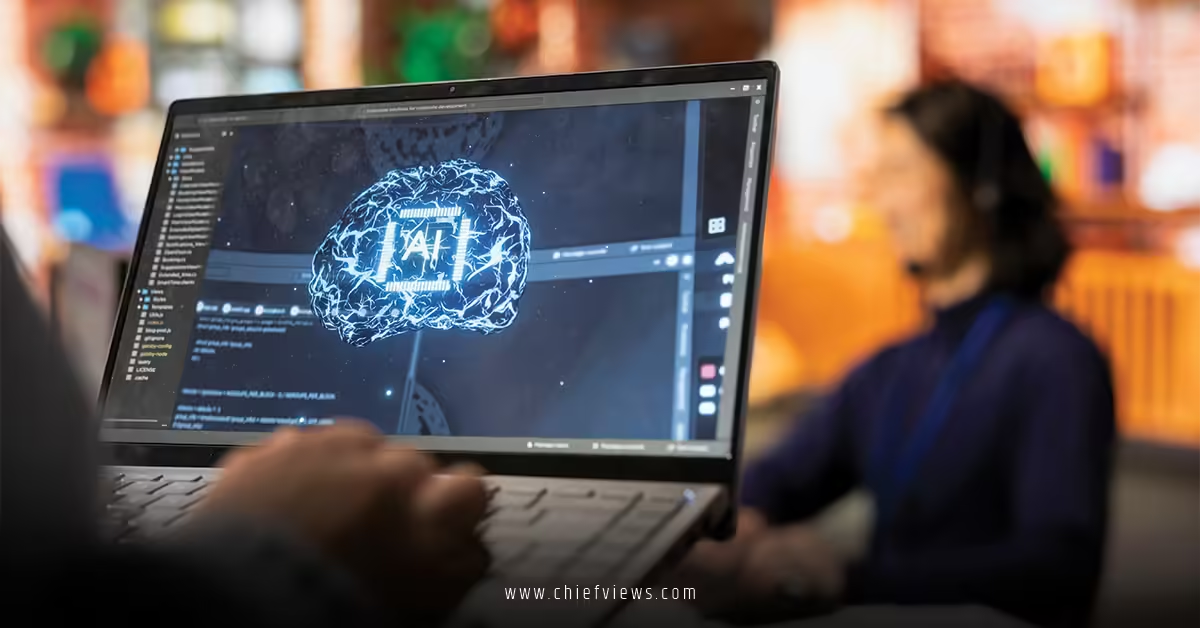
AI marketing tools for small business aren’t just leveling the playing field—they’re rewriting the rules of it entirely. For years, sophisticated personalization, predictive analytics, and automated campaign optimization were locked behind enterprise price tags and six-figure marketing teams. That wall is gone.
By the end of 2026, over 80% of small businesses will be using AI for marketing, according to Constant Contact’s Small Business AI Report. That’s not a trend. That’s a stampede. And if you’re not moving, you’re falling behind the businesses that are.
Here’s what you need to know right now:
- 🤖 54% of small businesses are already using AI marketing tools, with 27% planning to start within 2026
- 📈 Businesses using AI in three or more marketing functions report a 32% increase in ROI on average
- ⏱️ AI tools save small business marketers an average of 6.2 hours per week on administrative and content tasks
- 💰 A comprehensive AI marketing stack for SMBs costs just $200–$800/month—a fraction of what a single full-time hire costs
- 🎯 45% of SMBs are using AI to analyze trend data, 44% for content creation, and 40% for visual content generation
Why AI Marketing Tools for Small Business Actually Work Now
Three years ago, you needed a data science team to make AI marketing useful. Now? You need a free Canva account and fifteen minutes.
The fundamental shift is this: AI tools have gone from infrastructure plays to plug-and-play products. The underlying models are powerful. The interfaces are simple. And the pricing has dropped enough that a solo founder can access the same content intelligence a mid-market brand uses.
Here’s the analogy that nails it: AI marketing tools are the microwave of the modern business kitchen. A restaurant-grade chef oven (enterprise marketing platform) still makes better food at scale. But a microwave gets a real meal on the table in minutes, without a sous chef. That’s exactly what these tools do for small businesses with lean teams and limited runway.


What used to require a 10-person marketing department—segmented email campaigns, A/B tested ad copy, personalized landing pages, keyword-optimized blog posts—can now be executed by a team of two with the right stack.
AI Marketing Tools for Small Business: The Core Stack Breakdown
Don’t try to use twenty tools. Use five well. Here’s the breakdown by function that actually matters:
Content Creation & Copywriting
This is where most small businesses start, and for good reason. Content is the fuel for every marketing channel.
- Jasper AI — Best for long-form content, ad copy, and brand voice consistency. Used by 36% of content teams globally. Starts around $39/month.
- ChatGPT (Plus or Team) — The Swiss Army knife. Email drafts, social captions, campaign ideas, customer response templates. 64% of marketing professionals use it daily.
- Copy.ai — Solid for high-volume short-form copy: product descriptions, CTAs, social hooks.
Pro tip: Don’t use these tools as vending machines. Brief them like you’d brief a junior copywriter—give context, audience, goal, and tone. The output quality difference is dramatic.
Visual Design & Creative
- Canva (with AI features) — The go-to for small business marketers. 54% of SMB marketers use Canva’s AI design tools. Magic Design, Background Remover, text-to-image. Free tier is genuinely usable; Pro is $13/month.
- Adobe Firefly — If your brand requires higher-end visual output, Firefly’s generative image tools are commercially safe and integrated into the Creative Cloud ecosystem.
Email Marketing & Automation
Email still delivers the highest ROI of any digital channel. AI makes it substantially better.
- HubSpot Starter — The best all-in-one for SMBs who want AI-powered CRM, email, and lead tracking in one place. Free tier exists. Paid starts at $20/month. 72% of email automation strategies now use HubSpot’s AI features.
- Brevo (formerly Sendinblue) — Budget-friendly with strong AI send-time optimization and automated nurture sequences. Excellent for businesses under 5,000 contacts.
- Mailchimp — AI-powered audience segmentation and content recommendations. Still a solid choice for email-first businesses.
According to SurveyMonkey’s AI marketing research, AI-powered email campaigns yield 45% higher open rates on average. That single stat alone justifies switching.
Social Media Management
Consistency kills in social media—the businesses that show up daily win. AI helps you do that without burning out.
- Buffer (with AI Assistant) — Scheduling, repurposing, and AI caption generation. Clean interface, genuinely useful for small teams.
- Hootsuite (with OwlyWriter AI) — Better for businesses managing multiple accounts. Slightly heavier but more powerful for analytics.
- Lately AI — Underrated tool. Takes long-form content (a blog post, a podcast transcript) and atomizes it into dozens of social posts automatically.
SEO & Content Strategy
- Surfer SEO — On-page optimization with AI-driven content scoring. If you’re writing blog content, this tool tells you exactly what to include to rank.
- Semrush (with AI writing tools) — The dominant tool for keyword research, competitor analysis, and content gap identification. The AI features help translate data into actionable content briefs.
- Alli AI — Automated on-page SEO at scale. Particularly useful if you have a large product catalog or multi-page website.
Analytics & Paid Ads
- Google Analytics 4 (GA4) — Free. Powerful. Non-negotiable. Use it.
- Google Performance Max — AI-driven ad campaigns across Search, Display, YouTube, and Shopping simultaneously. Driving 58% of paid search optimization globally.
- Meta Advantage+ — Facebook and Instagram ad automation powered by AI. Excellent for local businesses targeting geographic audiences.
Side-by-Side: Best AI Marketing Tools for Small Business in 2026
| Tool | Best For | Free Tier? | Paid Pricing | Skill Level Needed |
|---|---|---|---|---|
| HubSpot Starter | CRM + Email + Automation | ✅ Yes | From $20/mo | Beginner |
| Canva Pro | Design + Visual Content | ✅ Yes | $13/mo | Beginner |
| ChatGPT Team | Copy + Strategy + Ideation | ✅ Limited | $25/user/mo | Beginner |
| Jasper AI | Long-form + Brand Voice | ❌ No | From $39/mo | Beginner–Intermediate |
| Brevo | Email + SMS Automation | ✅ Yes | From $25/mo | Beginner |
| Buffer | Social Media Scheduling | ✅ Yes | From $6/mo | Beginner |
| Surfer SEO | Blog + On-page SEO | ❌ No | From $89/mo | Intermediate |
| Google Performance Max | Paid Ads (Multi-channel) | ❌ No | Pay-per-click | Intermediate |
| Semrush | SEO + Competitor Research | ✅ Limited | From $139/mo | Intermediate |
| Lately AI | Content Repurposing | ❌ No | From $49/mo | Beginner |
Step-by-Step: How to Build Your AI Marketing Stack From Scratch
If you’re starting from zero, here’s the exact sequence that works—without wasting money on tools you don’t need yet.
Step 1: Lock Down Your Foundation (Week 1) Set up Google Analytics 4 on your website if you haven’t. No exceptions. You need data before AI can help you with anything meaningful.
Step 2: Start With One Content Tool (Week 1–2) Pick ChatGPT Plus or Jasper. Use it for one specific task only—email subject lines, social captions, or blog outlines. Get comfortable with prompting before expanding.
Step 3: Automate Your Email (Week 2–3) If you don’t have email automation running, set up HubSpot Starter or Brevo. Build one welcome sequence—three to five emails triggered by signup. This alone generates passive revenue while you sleep.
Step 4: Nail Your Visual Output (Week 3–4) Set up Canva Pro. Create branded templates for your top three content formats (social posts, email headers, promotional graphics). Consistency in visuals builds brand trust faster than almost anything else.
Step 5: Add Social Scheduling (Month 2) Connect Buffer. Batch a week of content in two hours on Monday. Let the AI assistant suggest captions. Schedule. Done.
Step 6: Layer in SEO (Month 2–3) Once content is flowing, add Surfer SEO or the free tier of Semrush. Start optimizing your top five most-visited pages. A 24% lift in organic traffic from AI-assisted SEO is documented—it’s real and replicable.
Step 7: Test Paid AI Ads (Month 3+) Only after your organic and email foundations are running. Start with Google Performance Max at a small daily budget ($10–$20/day). Let the algorithm learn for at least 30 days before drawing conclusions.
Common Mistakes Small Businesses Make With AI Marketing Tools
Mistake #1: Buying Too Many Tools Too Fast
The “shiny object” trap is real. Small business owners sign up for eight AI tools in a week, get overwhelmed, and abandon all of them within a month.
Fix it: Pick one tool per function. Master it before adding another. A simple, well-used stack beats a sprawling, half-used one every time.
Mistake #2: Using AI Output Without Editing
Raw AI copy is often generic, slightly off-brand, and occasionally factually wrong. Hitting “publish” without a human review pass is asking for trouble.
Fix it: Treat AI as a first draft generator, not a finished product machine. Edit for brand voice, accuracy, and emotional resonance before anything goes live.
Mistake #3: Ignoring Personalization Entirely
Most small businesses use AI tools only for content creation. They’re leaving the most valuable capability—personalization—completely untouched.
Fix it: Use HubSpot’s contact segmentation to send different emails based on where a contact is in the funnel. Even basic behavioral segmentation (opened your last email vs. didn’t) lifts results measurably. And if you want to understand how personalization scales at a strategic level, the same principles behind how CMO can leverage AI for personalized marketing strategy apply to small businesses—just at a smaller scope and lower cost.
Mistake #4: Not Measuring Before and After
You can’t know if AI tools are working if you didn’t record baseline metrics before using them. Most small businesses skip this step entirely.
Fix it: Before any new tool goes live, document your current metrics: email open rate, website conversion rate, monthly leads, social engagement rate. Then measure the same figures 60 and 90 days post-implementation.
Mistake #5: Using Free Tiers for Critical Functions
Free tiers are excellent for testing. They’re dangerous as a long-term strategy for functions your revenue depends on—like email automation or CRM. Free plans often come with contact limits, sending caps, or missing features that quietly kneecap your results.
Fix it: Identify your two or three most revenue-critical tools and pay for them. Keep free tiers for supplementary functions only.
How AI Marketing Tools Connect to Broader Personalization Strategy
Here’s something most SMB guides won’t tell you: the tools you use today as a small business are the same category of tools that enterprise marketing teams scale up. HubSpot grows with you. Performance Max runs for billion-dollar brands. Canva is used in Fortune 500 marketing departments.
What changes at scale isn’t the toolkit—it’s the strategy layer on top. Understanding how CMO can leverage AI for personalized marketing strategy gives you a blueprint for where your own marketing needs to evolve as your business grows. The sequencing, the data infrastructure thinking, the personalization frameworks—all of it applies, just at a smaller starting point.
Small businesses that grow into mid-market companies don’t rebuild their marketing from scratch. They scale what’s already working.
Key Takeaways
- 🚀 By end of 2026, 4 in 5 small businesses will use AI marketing tools — the adoption window for early-mover advantage is closing fast
- 🛠️ Build a focused stack: one tool per function, mastered well, beats eight tools used poorly
- 💸 A complete SMB AI marketing stack runs $200–$800/month — less than a part-time hire
- ✉️ AI-powered email automation delivers 45% higher open rates — if you only do one thing, automate your email
- 📊 Always establish baseline metrics before deploying any new tool — you can’t prove ROI you didn’t measure for
- 🎨 Canva + ChatGPT alone can handle 80% of your content creation needs at beginner level
- 🔍 SEO tools like Surfer and Semrush drive documented 24% lifts in organic traffic — don’t skip the content strategy layer
- 🧠 Personalization is the most underused capability in SMB AI marketing — even basic segmentation moves the needle
The businesses winning with AI marketing tools right now aren’t the ones with the biggest budgets. They’re the ones who picked a lean, focused stack, learned it properly, and stayed consistent. You don’t need everything on this list to start.
Pick one content tool and one email platform this week. Set them up. Run them for 30 days. Measure the results. Then expand.
That’s it. That’s the whole playbook for month one.
FAQs
Q1: What are the best free AI marketing tools for small businesses just getting started?
The strongest free starting point is HubSpot’s free CRM + email tools, Canva’s free tier, and ChatGPT’s free plan. Together, these three cover contact management, visual content creation, and AI copywriting without spending a dollar. As your needs grow, upgrading HubSpot Starter and Canva Pro first delivers the highest return per dollar spent. Most small businesses can generate measurable results from free tools alone within their first 60 days.
Q2: How do AI marketing tools for small business compare to hiring a marketing agency?
A full-service marketing agency typically costs $2,500–$10,000/month for a small business. A well-configured AI marketing stack runs $200–$800/month and delivers similar output volume for routine tasks like content creation, email automation, and social scheduling. The difference is strategy and creativity—an agency brings human judgment and campaign ideation that AI tools still can’t fully replace. The smartest move is using AI tools to handle execution while reserving human or agency time for strategy and creative direction.
Q3: How long does it take for AI marketing tools to show measurable results for a small business?
Most small businesses see measurable improvements within 60–90 days of consistent use, according to implementation data from tools like NUACOM and HubSpot. Email open rates and social engagement typically improve within the first 30 days. Organic traffic improvements from AI-assisted SEO take 60–120 days to register in analytics. Paid ad optimization through tools like Google Performance Max usually requires a minimum 30-day learning window before the algorithm’s full performance kicks in. Track your baseline metrics before starting so the gains are visible and verifiable.