







Building the CHRO-CTO-CFO triad for successful AI integration is no longer optional for U.S. companies that want real returns instead of expensive pilots that never scale. When these three leaders operate as a unit—owning skills, platforms, and capital together—AI moves from isolated experiments into the operating system of the business. When they don’t, projects stall, budgets bloat, and employees resist.
Here’s the quick snapshot of what works:
- The triad treats AI as a shared operating discipline, not a tech project or HR program.
- Clear decision rights and joint metrics prevent the usual handoff failures.
- Monthly capital-skills-tools reviews keep spending, capability, and adoption in the same conversation.
- Companies that align these three roles see faster maturity and better financial outcomes than those that leave AI to one function.
- The structure forces hard trade-offs early instead of discovering them after money is spent.
In my experience, the companies that get this right stop treating AI like a side bet. They make it part of how work gets redesigned, how capital is allocated, and how people develop.
Why the old model breaks in 2026
For years the default was a CEO-CFO-CHRO triangle focused on strategy, money, and people. Technology sat off to the side. That worked when systems were relatively stable. It falls apart when AI rewrites jobs, cost structures, and risk profiles at the same time.
What usually happens is this: the CTO launches tools, the CHRO runs training after the fact, and the CFO discovers the real cost and productivity numbers only when the pilot is already deep in the red. Or the CFO demands ROI models the CTO can’t yet deliver, while the CHRO watches middle managers quietly refuse to change workflows. The result is predictable. Projects linger in pilot mode. Employees treat the new tools as optional. Capital gets trapped.
High-performing organizations have already started adjusting. Recent leadership advisory work shows enterprise CHROs in strong companies are building partnerships with senior technology leaders that rival or exceed their traditional ties to the CFO. The focus is workforce capability and how AI actually reconfigures work. At the same time, research on AI returns points to shared decision rights across technology, finance, and strategy leaders as a stronger predictor of advanced maturity and better financial results than single-owner models.

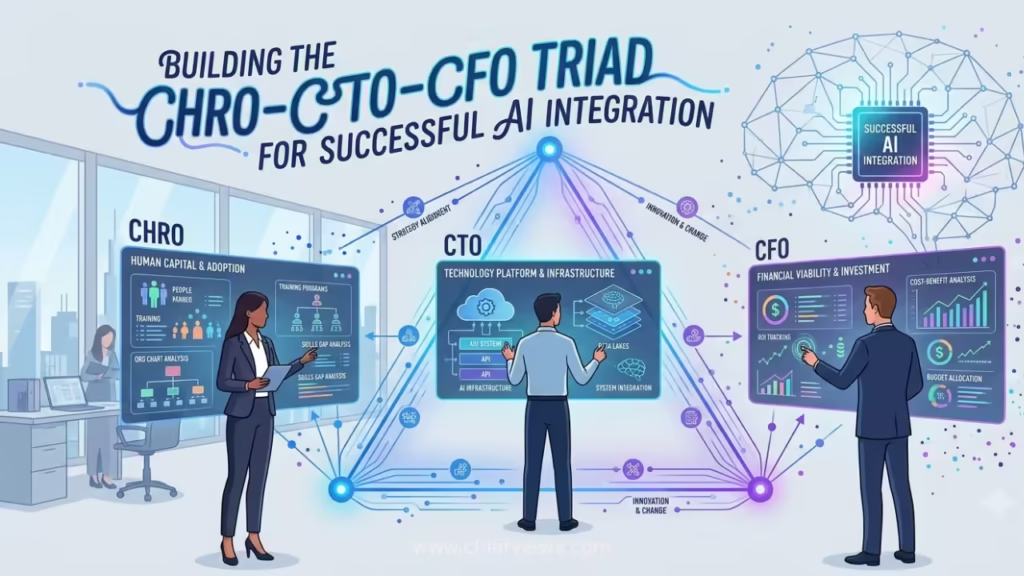
The triad is the practical answer for most mid-market and large U.S. firms. It keeps the human, technical, and financial lenses in the same room before decisions harden.
Roles inside Building the CHRO-CTO-CFO triad for successful AI integration
Each member owns a distinct piece. Overlap is deliberate. Ambiguity is not.
CHRO: Owns skills architecture, work redesign, change capacity, and the human side of adoption. That includes identifying which tasks move to agents, which stay human, and how roles evolve. The CHRO also surfaces cultural resistance early and translates it into terms the other two can act on—attrition risk, productivity drag, compliance exposure.
CTO: Owns platforms, data readiness, architecture, security boundaries, and the technical feasibility of scaling. The job is to keep the stack modular enough that workforce and financial decisions can change without constant rework. Clear data lineage and cost visibility for AI usage belong here.
CFO: Owns capital allocation, risk appetite, value measurement, and the portfolio view. This means treating AI spending like any other major investment class—with stage gates, reallocation triggers, and honest ROI tracking that includes both hard savings and productivity gains that show up later.
Building the CHRO-CTO-CFO triad for successful AI integration The kicker is joint accountability for the overall AI portfolio outcomes. No one gets to claim success if the other two dimensions fail.
Think of it like a three-legged stool on uneven ground. Remove any leg and the whole thing tips. Keep them linked and you can move weight around as conditions change.
A practical step-by-step action plan
Here’s what I’d do if I were standing up this structure in a mid-sized or larger U.S. organization starting from a typical fragmented baseline.
- Get explicit CEO sponsorship and a short charter. The CEO defines the triad as the primary decision body for AI portfolio choices above a defined threshold. Keep the charter to one page: shared outcomes, decision rights, escalation path, and meeting cadence.
- Map current decision rights and close the gaps. List every active or planned AI initiative. Who approved the spend? Who owns adoption? Who tracks value? Most organizations discover fuzzy ownership quickly. Rewrite the matrix so major investments require triad alignment.
- Build one shared dashboard. Combine three views: technical readiness and usage cost (CTO), skills progress and employee experience signals (CHRO), and financial performance versus business case (CFO). Review it monthly. Ninety minutes is usually enough if the data is clean.
- Run a work-redesign sprint on 3–5 high-value processes. Do not start with the technology. Start with the work. The triad co-leads. Identify tasks that can shift, the skills required, the capital needed, and the risk controls. Measure before and after.
- Align incentives. If the CHRO is measured only on engagement scores, the CTO on uptime, and the CFO on pure cost reduction, the triad will fracture. Tie a portion of each leader’s goals to shared AI portfolio metrics—adoption with quality, value realized, and capability built.
- Establish a light governance rhythm. Monthly operating review. Quarterly portfolio reallocation. Annual board-level update on posture and risk. Keep it tight. Bureaucracy kills momentum.
This sequence works for both beginner teams still piloting and intermediate organizations that already have scattered AI activity. The order matters. Structure before more tools.
Comparison of ownership models
| Model | Decision Speed | Risk of Siloed Failure | Value Realization | Best Fit |
|---|---|---|---|---|
| CTO-led only | Fast early | High (adoption and cost blind spots) | Low-to-medium | Small tech-heavy firms |
| CFO-led only | Medium | High (innovation and people gaps) | Medium on cost, low on growth | Cost-focused turnarounds |
| CHRO-led only | Slow | High (technical and capital gaps) | Low | Culture-first organizations |
| CHRO-CTO-CFO triad | Medium (deliberate) | Lower | Higher when executed well | Most mid-to-large U.S. enterprises |
The triad is not the fastest. It is the least likely to waste capital on tools that never change behavior or on training that never meets the technology.
Common mistakes and how to fix them
Mistake 1: Treating the triad as a committee instead of a decision body. Meetings turn into status updates. Fix: Require that every major agenda item ends with a clear decision or a defined next gate. The CEO enforces this early.
Mistake 2: Measuring different things. CTO tracks model performance. CHRO tracks completion rates on training. CFO tracks budget variance. None of them matches. Fix: Agree on a short list of shared outcome metrics—workflow-level productivity, capability coverage, and net value created—and report only those in the joint review.
Mistake 3: Ignoring middle management. The triad aligns at the top while managers protect their existing processes. Fix: Bring selected business leaders into the work-redesign sprints and give them skin in the outcome metrics.
Mistake 4: Over-indexing on headcount reduction. The CFO sees AI as a pure efficiency play. The CHRO faces resistance and quiet attrition. Fix: Frame the opportunity as work capacity expansion—humans plus agents—rather than pure labor arbitrage. Measure output and quality, not just FTEs.
Mistake 5: Waiting for perfect data. The CTO wants clean platforms first. Progress stalls. Fix: Accept “good enough” data for the first few high-value processes and improve lineage in parallel. Perfect is the enemy of learning.
I’ve watched each of these kill otherwise solid AI programs. The pattern is consistent: unclear ownership plus misaligned incentives equals stalled value.
Building the CHRO-CTO-CFO triad for successful AI integration in practice
The organizations making the fastest progress treat the triad as an operating mechanism, not a temporary project structure. They use it to force trade-offs that single functions avoid. Capital moves toward the use cases that actually change work. Skills investment follows the technology that is ready to scale. Risk conversations happen before models touch customers or employees at volume.
External perspectives reinforce the pattern. Deloitte’s analysis of C-suite leadership and AI returns shows stronger outcomes when technology and finance leaders share ownership of investment decisions rather than operating in isolation. Leadership advisory findings from Heidrick & Struggles, reported in HR Dive, highlight how high-performing companies are elevating CHRO-tech partnerships as AI reshapes work. Gartner’s guidance on shared CHRO-CIO ownership underscores the need for joint accountability on work redesign and ethics as AI agents proliferate.
These are not theoretical constructs. They reflect what is already working in 2026.
Key Takeaways
- Building the CHRO-CTO-CFO triad for successful AI integration turns AI from a collection of projects into a managed portfolio with human, technical, and financial accountability.
- Explicit decision rights and a single shared dashboard beat informal collaboration every time.
- Start with work redesign, not tool selection.
- Shared metrics and incentives keep the three leaders pointed at the same outcomes.
- Monthly capital-skills-tools reviews create the operating rhythm that prevents drift.
- Middle managers must feel ownership or the change dies at the team level.
- The structure is deliberately slower than single-owner models—and far less wasteful.
- CEO sponsorship is non-negotiable; without it the triad becomes theater.
The companies that treat this triad as permanent infrastructure will pull ahead of those still running AI as a series of disconnected bets. The next practical step is simple: schedule the first joint mapping session with the three leaders and the CEO. Put current initiatives, ownership, and metrics on the table. The gaps will show themselves quickly. Then close them.
FAQs
How does Building the CHRO-CTO-CFO triad for successful AI integration differ from simply adding a Chief AI Officer?
A dedicated CAIO can coordinate and accelerate, but the triad forces the three functions that actually control skills, platforms, and capital to own outcomes together. Without that joint ownership, even a strong CAIO often becomes a middle layer that reports upward rather than drives real trade-offs across people, technology, and money.
What is the first concrete step when Building the CHRO-CTO-CFO triad for successful AI integration in a company that still runs AI as scattered pilots?
Map every active and planned initiative on one page, then force the three leaders to assign clear ownership for adoption, technical delivery, and value tracking. The gaps and overlaps become obvious fast and create the urgency needed for a formal charter.
How should success be measured once the triad is in place?
Move away from isolated metrics (model accuracy, training completion rates, or pure cost variance) and track a short shared set: workflow-level productivity gains, skills coverage against redesigned roles, and net value realized versus the original business case. Review those three numbers together every month.

